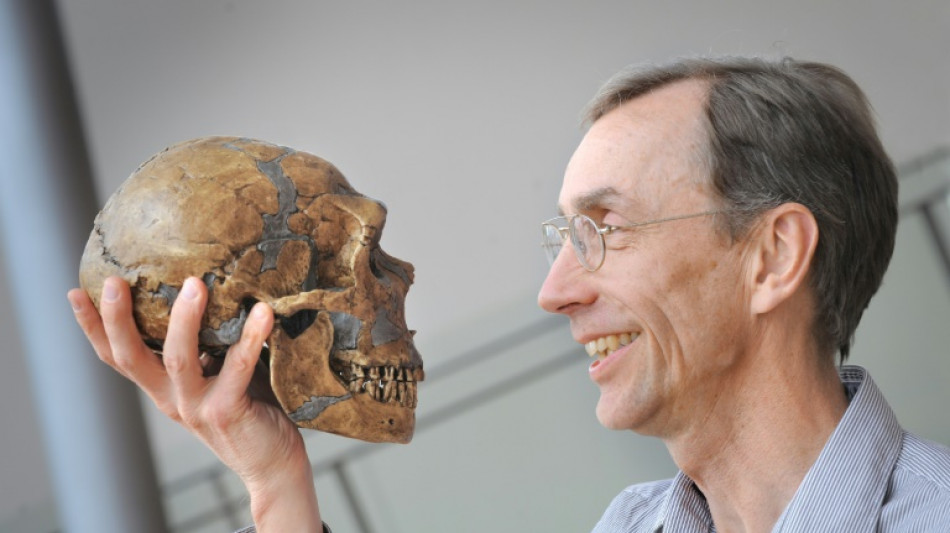
Sweden's Paabo wins medicine Nobel for sequencing Neanderthal DNA / Photo: Frank Vinken - digital/AFP

 RBI Grants Paytm In-Principle Approval to Revive Wallet Business

 China's Factory Activity Contracts as Export Orders Weaken

 US Retail Sales and Fed Minutes Set Up a Critical Test for Consumers

 MotorTrend’s Top Hybrid Vehicle Picks for 2026

 Asian Markets Slide as AI Concerns Hit Chip Stocks

 Brazil Faces Debt and Inflation Test as Lula Prepares Fourth Term

 Canada Expands Asian Trade Push as US Negotiations Resume

 Jennie Earns Two Grammy Nominations as Major K-pop Agencies Boycott New Asian Pop Category

 Italy Raises 2026 Growth View but Warns Energy Will Keep Inflation High

 UK Economy Grows 0.7% in Third Quarter as Services Lead Expansion

 India's Retail Inflation Reaches 6.09% as Food Prices Accelerate

 China's October Activity Data Reveal a Weak Start to the Fourth Quarter

 Critics Demand Stronger Action from Jeffries and Schumer Following Democratic Wave

 Grand Theft Auto VI: Inside the Decade-Long Development of a Billion-Dollar Cultural Phenomenon
Swedish paleogeneticist Svante Paabo, who sequenced the genome of the Neanderthal and discovered the previously unknown hominin Denisova, on Monday won the Nobel Medicine Prize.
Paabo's research gave rise to an entirely new scientific discipline called paleogenomics, and has "generated new understanding of our evolutionary history", it said.
"By revealing genetic differences that distinguish all living humans from extinct hominins, his discoveries provide the basis for exploring what makes us uniquely human", the Nobel committee said in a statement.
The founder and director of the department of genetics at the Max Planck Institute for Evolutionary Anthropology, Paabo found that gene transfer had occurred from these now extinct hominins to Homo sapiens following the migration out of Africa around 70,000 years ago.
"This ancient flow of genes to present-day humans has physiological relevance today, for example affecting how our immune system reacts to infections", the jury said.
One such example is that Covid-19 patients with a snippet of Neanderthal DNA run a higher risk of severe complications from the disease, Paabo found in a 2020 study.
Paabo, 67, who takes home the award sum of 10 million Swedish kronor ($901,500), will receive the prize from King Carl XVI Gustaf at a formal ceremony in Stockholm on December 10, the anniversary of the 1896 death of scientist Alfred Nobel who created the prizes in his last will and testament.
Paabo is the son of Sune Bergstrom, a Swede who won the 1982 Nobel Medicine Prize for discovering prostaglandins, which are biochemical compounds that influence blood pressure, body temperature, allergic reactions, and other physiological phenomena.
In a 2014 interview with The Guardian, Paabo said he was the result of a secret extra-marital affair and that Bergstrom's "official" family knew nothing of his or mother's existence, the Estonian chemist Karin Paabo until after Bergstrom's death in 2005.
- Achieved 'the seemingly impossible' -
Homo sapiens are known to have first appeared in Africa around 300,000 years ago, while our closest known relatives, Neanderthals, developed outside Africa and populated Europe and Western Asia from around 400,000 until 30,000 years ago when they went extinct.
That means that about 70,000 years ago, groups of Homo sapiens and Neanderthals coexisted in large parts of Eurasia for tens of thousands of years.
In order to study the relationship between present-day humans and extinct Neanderthals, DNA needed to be sequenced from archaic specimens with only trace amounts of DNA left after thousands of years.
In 1990, Paabo managed to sequence a bit of mitochondrial DNA from a 40,000-year-old piece of bone.
"For the first time, we had access to a sequence from an extinct relative", the Nobel jury said.
Comparisons with contemporary humans and chimpanzees showed that Neanderthals were genetically distinct.
Paabo then "accomplished the seemingly impossible", the Nobel committee said, publishing the first Neanderthal genome sequence in 2010.
It showed that the most recent common ancestor of Neanderthals and Homo sapiens lived around 800,000 years ago.
Paabo and his team were able to show that DNA sequences from Neanderthals were more similar to those from contemporary humans originating from Europe or Asia than those from Africa.
"This means that Neanderthals and Homo sapiens interbred during their millennia of coexistence", the Nobel jury said.
In modern day humans with European or Asian descent, around one to four percent of the genome originates from Neanderthals.
In 2008, Paabo and his team went on to sequence a 40,000-year-old bone fragment found in the Denisova cave in southern Siberia.
It contained exceptionally well-preserved DNA.
"The results caused a sensation: the DNA sequence was unique when compared to all known sequences from Neanderthals and present-day humans."
Paabo had discovered a previously unknown hominin, which was given the name Denisova.
Comparisons showed the gene flow had also occurred between Denisova and Homo sapiens.
When Homo sapiens migrated out of Africa, at least two extinct hominin populations inhabited Eurasia: Neanderthals lived in western Eurasia, whereas Denisovans populated the eastern parts of the continent.
The Nobel season continues this week with the announcement of the winners of the Physics Prize on Tuesday and the Chemistry Prize on Wednesday.
They will be followed by the much-anticipated prizes for Literature on Thursday and Peace on Friday, while the Economics Prize winds things up on Monday, October 10.
F.Cardoso--PC

