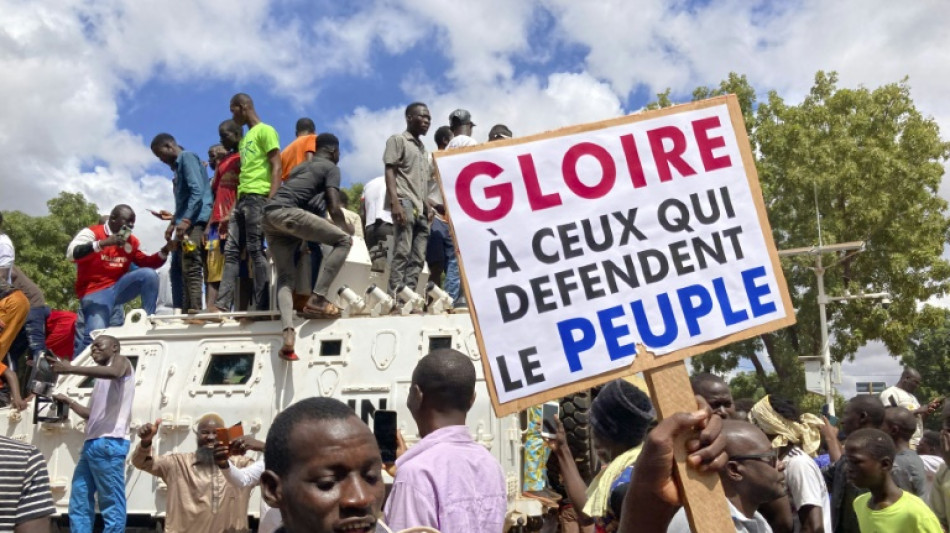
Sahel military coups only help jihadists: analysts / Photo: - - AFP

 UN approves resolution on dealing with rising sea levels
 Yalcouye makes dream debut as Ivory Coast beat Ghana in AFCON qualifier
 Chicago's White Sox and Cubs book MLB playoff berths
 Last-gasp Gakpo strike snatches Dutch draw to sour Klopp debut
 Global stocks mostly fall as oil prices and bond yields rise
 Israel's Netanyahu denounces enemies, allies in fiery UN speech
 Hollywood stars among arrests in NY anti-Netanyahu protest
 Losing start in AFCON qualifying for 78-year-old coach Le Roy
 Italy bans burqas in schools, caps numbers of foreign students per class
 Israel policies threaten 'life and existence' of Palestinians, Abbas says

 Paolini steers Italy past China in BJK
 Zidane admits emotion on eve of first game as France coach
 Breetzke and Maharaj sink Australia in first one-day international
 Zelensky broke confidentiality with North Korea POWs disclosure: South's president
 Former Liverpool star Carroll reveals he was sexually assaulted
 Dominican Republic calls for Haiti force to be strengthened
 Dolly Parton's nephew ordered to stay away from estate staff, properties
 Early exit for Philippine darling Eala at Singapore Open
 Hurricane Polo triggers huge waves in coastal Mexican city
 What happens if the US bans diesel exports
 Macklemore hits back with 'Free Palestine Tour' after Sheeran split
 Met Opera to give New Yorkers free tickets in affordability push
 Top ECB official to resign to take up IMF role
 Xi and Trump call for peace in lavish White House state visit
 Five up-and-coming players looking to make mark in Nations League
Burkina Faso's new rulers say they seized power to better fight jihadists, but history in the Sahel suggests the coup will merely stoke turbulence and division, benefitting the insurgents, analysts say.
The poor, arid region has been wracked by jihadist insecurity since 2012.
It began in northern Mali then in 2015 spread to its centre and neighbouring Niger and Burkina Faso, claiming thousands of lives and prompting more than two million people to flee their homes.
A new junta led by 34-year-old Captain Ibrahim Traore seized power in Burkina Faso last week, in the second such power grab since January blamed on failures to quell jihadist attacks.
It followed two similar coups in Mali in 2020 and 2021.
The latest takeover comes during a struggle for influence between France and Russia in the former French colonies, whose leaders appear to be increasingly turning to Moscow to help battle the jihadists.
But analyst Yvan Guichaoua said the coup would only serve the interests of the jihadists -- the Al-Qaeda-linked Group to Support Islam and Muslims (GSIM) and the local branch of the Islamic State group.
"The big winners are not the Russians or the French, but GSIM and IS," said Guichaou, an expert at the Brussels School of International Studies. "What a disaster."
Organisers of coups in the Sahel typically promise improved security, but these pledges are misleading, analysts say.
A putsch typically "destabilises the army structure and divides members of the military into supporters and opponents of the coup," said Djallil Lounnas at Morocco's Al-Akhawayn University.
"It means instability, division and purges."
Coups only compound problems in countries where the armed forces are already accused of inefficiency and mismanagement, and security forces are often under-equipped, he and others said.
- Army problems -
Alain Antil, a Sahel expert at the French Institute of International Relations, gave the example of more than 50 Burkinabe gendarmes killed by jihadists in November last year.
Two weeks earlier, they had warned headquarters they were running short of supplies.
"They were hunting gazelles in the scrubland to eat," he said, and were in no position to take on the insurgents.
"You can't go and fight such determined adversaries with this kind of logistics problem."
Disgruntled junior officers led by Traore forced out junta leader Lieutenant-Colonel Paul-Henri Sandaogo Damiba, whom they accused of failing his country.
Traore was declared president on Wednesday, three days after Damiba fled to neighbouring Togo following a prolonged standoff at the weekend.
But, said Antil, nothing indicates Traore will be any more successful.
"The myth of the enlightened military man able to fix problems... very rarely holds up," he said.
Soldiers are "often less well-equipped than the civilians they replace to understand" non-security aspects of a crisis.
GSIM this week mocked Burkina's latest change of leader.
"Let the tyrants know that the repeated coups will not avail them," it said in a statement.
Mauritanian journalist Lemine Ould Salem, who has written a book on jihadism, said political turmoil gives credibility to extremist talk that "delegitimises state institutions."
"They say, 'look, there is no democracy, no state, no constitution'," he said.
- Regional impact -
Military coups in the Sahel have also weakened regional cooperation in the fight against the jihadists.
Since its takeover, Mali had a bustup with France, the country's strongest foreign ally, which withdrew its last troops from the country in August.
The junta has brought in Russian operatives it describes as military trainers, but which western countries say are mercenaries from the Wagner group.
Mali has also quit a regional anti-jihadist force dubbed the G5 Sahel and antagonised its southern neighbour, Ivory Coast, by detaining 46 Ivorian soldiers in July.
Bamako "risks ruining all cooperation, including for security," Antil said.
The Soufan Center think tank in a note this week said France had "served as somewhat of a 'bogeyman', or an excuse to account for the growing strength of jihadists in Burkina Faso and the Sahel more broadly".
Michael Shurkin, a US historian specialised in the French army, said there were also "many who believe in conspiracy theories according to which the French arm the jihadists".
They "simplify a complex reality and enable people to avoid having to understand their own responsibility and find their own solutions," he said.
V.F.Barreira--PC