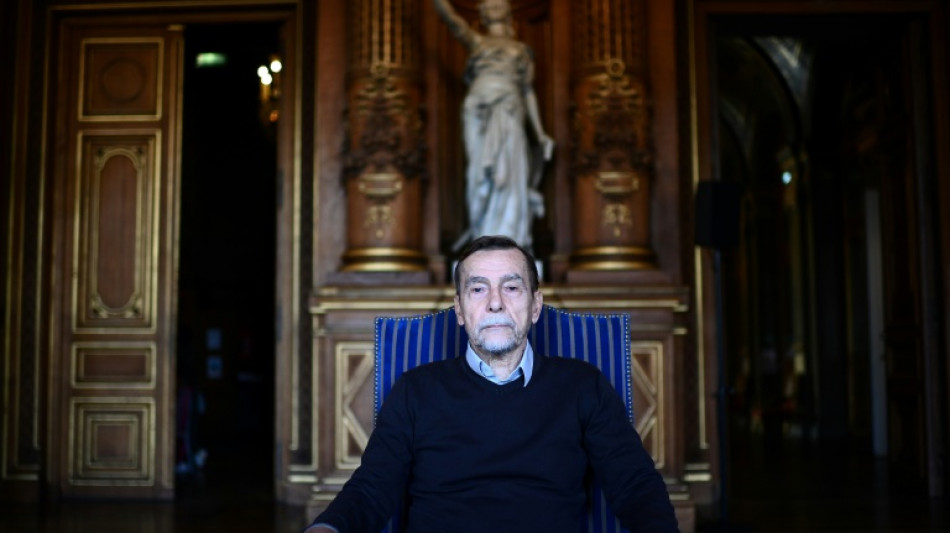
Russian political prisoners should have got Nobel: Memorial co-founder / Photo: Christophe ARCHAMBAULT - AFP

 RBI Grants Paytm In-Principle Approval to Revive Wallet Business
 China's Factory Activity Contracts as Export Orders Weaken
 US Retail Sales and Fed Minutes Set Up a Critical Test for Consumers
 MotorTrend’s Top Hybrid Vehicle Picks for 2026

 Asian Markets Slide as AI Concerns Hit Chip Stocks

 Brazil Faces Debt and Inflation Test as Lula Prepares Fourth Term
 Canada Expands Asian Trade Push as US Negotiations Resume

 Jennie Earns Two Grammy Nominations as Major K-pop Agencies Boycott New Asian Pop Category

 Italy Raises 2026 Growth View but Warns Energy Will Keep Inflation High
 UK Economy Grows 0.7% in Third Quarter as Services Lead Expansion

 India's Retail Inflation Reaches 6.09% as Food Prices Accelerate

 China's October Activity Data Reveal a Weak Start to the Fourth Quarter
The Russian rights group Memorial is honoured to have been jointly awarded the Nobel Peace Prize but it should have gone to political prisoners such as Alexei Navalny, who risk their lives for contesting President Vladimir Putin, the group's co-founder said Friday.
Lev Ponomarev, who helped create Memorial in the late 1980s under the perestroika Soviet reform drive, said his group had been "destroyed" as Russia presses its invasion of Ukraine, but was still seeking to continue its work.
"We were just 10 people and we thought everything would start with perestroika. It did not work out that way," Ponomarev told Agence France-Presse in an interview in Paris, where he now has political asylum.
"It is very well deserved and of course when I think of what I thought 30 years ago I am happy," he said.
But Ponomarev said an even better move by the Norwegian peace prize committee would have been to give the award to Navalny, Putin's leading opposition critic and an outspoken anti-corruption figure, or to liberal opposition figures Vladimir Kara-Murza or Ilya Yashin, who are also imprisoned.
"Those who are behind bars are the ones who need to be rewarded every year," Ponomarev said on the sidelines of a forum organised by the exiles group Russie-Libertes (Russia-Freedom) and the Paris City Hall.
"I am compelled now to say that the correct choice would have been to give the Nobel prize -- if they want to support Russia when it is under its harshest regime –- to political figures," he said.
"I mean Navalny, I mean Vladimir Kara-Murza, I mean Ilya Yashin. People who consciously choose that position, knowing they are risking their lives and don't step aside, and solidly say the words that need to be said."
Kara-Murza, who was jailed in April for denouncing the Kremlin's Ukraine offensive, has been charged with high treason, his lawyer said Thursday.
Yashin was jailed in July, also after denouncing Moscow's invasion of Ukraine.
- Organisation 'destroyed' -
Along with Memorial, the Nobel peace prize went to Ukraine's Center for Civil Liberties, which is documenting alleged Russian war crimes against the Ukrainian people, and the detained activist Ales Bialiatski of Belarus.
The Russian authorities ordered the closure of Memorial last year in a move Putin has done nothing to halt, and the pressures against rights advocates has further worsened during the invasion of Ukraine.
Ponomarev, a former physicist, has been at the centre of the Russian rights scene since the fall of the Soviet Union.
In Paris, he continues to push for the release of political prisoners in Russia and remains in close touch with his Memorial colleagues who remain in Russia.
He expressed doubt that at this point the prize would prompt Putin to change his attitude to Memorial, though there was a possibility he could bring up the organisation's status in eventual negotiations with the West.
"Putin is a total and utter global evil and it will not make him relate to Memorial better at all. But if he trades with the West then possibly it could be the issue of some kind of trading," Ponomarev said.
"The organisation is destroyed but there are people who want to preserve the archives and work. Most of Memorial's staff have gone abroad," he said.
Ponomarev, 81, obtained political refugee status in France after fleeing threats of arrest in Russia, but said he hoped his exile would not prove permanent.
"I think I can go back and I am working a lot on that, every day, with this activism. I left because there were threats against me, a criminal case, I could have been jailed," he said.
Ferreira--PC