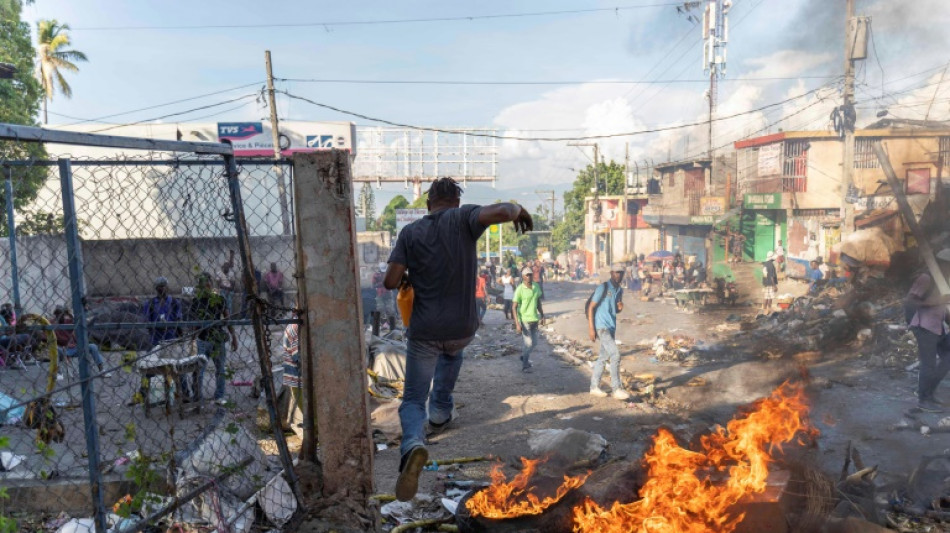
Guterres pushes for international troop deployment to crisis-hit Haiti / Photo: Richard Pierrin - AFP/File

 RBI Grants Paytm In-Principle Approval to Revive Wallet Business

 China's Factory Activity Contracts as Export Orders Weaken

 US Retail Sales and Fed Minutes Set Up a Critical Test for Consumers

 MotorTrend’s Top Hybrid Vehicle Picks for 2026

 Asian Markets Slide as AI Concerns Hit Chip Stocks

 Brazil Faces Debt and Inflation Test as Lula Prepares Fourth Term

 Canada Expands Asian Trade Push as US Negotiations Resume

 Jennie Earns Two Grammy Nominations as Major K-pop Agencies Boycott New Asian Pop Category

 Italy Raises 2026 Growth View but Warns Energy Will Keep Inflation High

 UK Economy Grows 0.7% in Third Quarter as Services Lead Expansion

 India's Retail Inflation Reaches 6.09% as Food Prices Accelerate

 China's October Activity Data Reveal a Weak Start to the Fourth Quarter

United Nations chief Antonio Guterres has called for the immediate deployment of a special armed force to Haiti to staunch spiraling insecurity, as the already crisis-hit country faces the threat of a cholera epidemic.
In a letter addressed to the UN Security Council on Saturday and seen by AFP, Guterres urged member states to deploy a "rapid action force" to the Caribbean nation to tackle "a dramatic deterioration in security."
The letter came a day after Haiti said it had formally sought international assistance with a worsening security situation that the national police were unable to overcome.
Haiti, the poorest country in the Americas, is facing an acute political, economic, security and health crisis, which has paralyzed the country and sparked a breakdown of law and order.
Protests and looting have rocked the already unstable country since September 11, when the government announced a fuel price hike.
Since mid-September, the country's largest fuel import terminal, in Varreux, has been controlled by powerful armed gangs.
In his letter, Guterres underlined a need to restore security to ensure access to supplies and services, to safeguard transport infrastructure and oil terminals and to tackle rampant gang violence.
"Addressing these objectives is imperative for the country to halt its spiraling instability," he said.
He called for the establishment of a unit made up of special armed forces personnel from member states, with the efforts led by one member state.
Guterres reiterated the call in a public statement Sunday, in which he said he "remains gravely concerned about the situation in Haiti," where already dire humanitarian conditions risk being exacerbated by a cholera outbreak.
The UN on Thursday warned of a possible explosion of cholera cases in the country after Haiti announced its first cases of cholera in three years last week, with at least seven deaths.
As of Friday, the UN said at least twelve cholera cases had been confirmed and another 152 suspected cases reported, though Ulrika Richardson, UN resident and humanitarian coordinator for Haiti, said the real numbers could be much higher.
Tests were underway abroad to determine whether it was the same strain of cholera as the one that killed more than 10,000 people from 2010 to 2019.
Guterres, in his Sunday statement, said the blockage of the Varreux terminal hindered efforts to tackle the outbreak, including by hampering the delivery of "critical services required to prevent the rapid spread of the disease to a stand-still, including the distribution of potable water."
"The most vulnerable sectors of the Haitian population are those hit the hardest," he warned.
C.Amaral--PC



