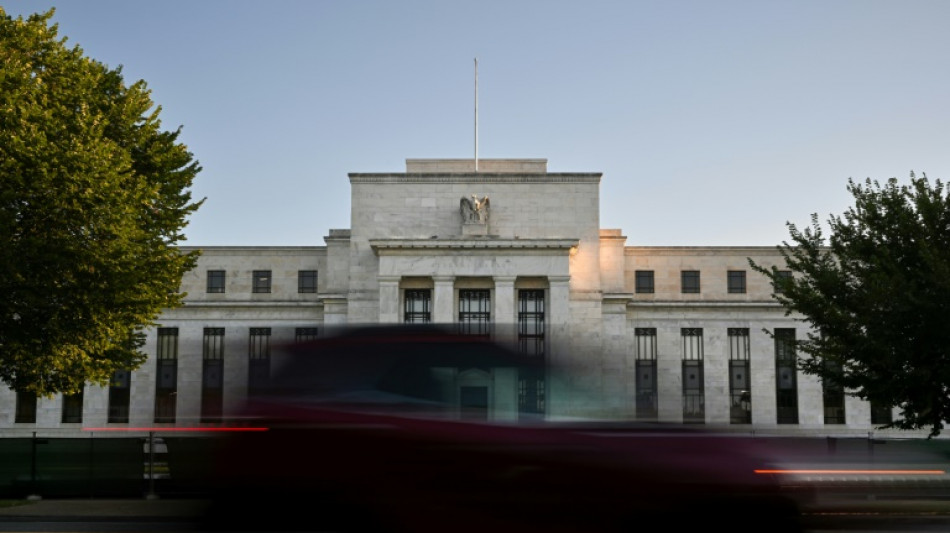
Stocks up despite more big US rate hikes seen / Photo: MANDEL NGAN - AFP

 RBI Grants Paytm In-Principle Approval to Revive Wallet Business

 China's Factory Activity Contracts as Export Orders Weaken

 US Retail Sales and Fed Minutes Set Up a Critical Test for Consumers

 MotorTrend’s Top Hybrid Vehicle Picks for 2026

 Asian Markets Slide as AI Concerns Hit Chip Stocks

 Brazil Faces Debt and Inflation Test as Lula Prepares Fourth Term

 Canada Expands Asian Trade Push as US Negotiations Resume

 Jennie Earns Two Grammy Nominations as Major K-pop Agencies Boycott New Asian Pop Category

 Italy Raises 2026 Growth View but Warns Energy Will Keep Inflation High

 UK Economy Grows 0.7% in Third Quarter as Services Lead Expansion

 India's Retail Inflation Reaches 6.09% as Food Prices Accelerate

 China's October Activity Data Reveal a Weak Start to the Fourth Quarter

European and US stocks climbed on Monday even as forecast-beating US jobs data fanned expectations for more large interest rate hikes from the Federal Reserve.
The rise in equities came despite investors growing increasingly worried that central bank rate hikes to tame runaway prices will plunge the global economy into recession.
Adding to the stress is the upcoming corporate earnings season, which many fear will show that companies are feeling the pain of tightening monetary policies.
Higher interest rates increase borrowing costs for individuals and businesses and risk cooling economic activity.
But the Fed's aggressive interest rate hikes have been a boon for the dollar, as investors seek to purchase US bonds.
Last week closed out with news that the US firms created a net 263,000 jobs in September.
While that was down from August it was more than expected, indicating that the economy is not yet slowing considerably and inflationary pressures likely remain.
That sent stocks sharply lower on Friday.
But on Monday, US and European equities recovered some of that ground.
Asian equities mostly closed lower on Monday.
With the spotlight on a US consumer price index reading later in the week, policymakers are expected to continue to take a hawkish tone, warning they will not ease up on their rate hikes even if that means causing a recession.
"With the jobs market remaining strong, it is unlikely that the Fed will ease off the gas any time soon" as inflation comes down slowly, said Fawad Razaqzada, markets analyst at StoneX.
"A lot will depend very much on incoming inflation data in the months ahead."
Elsewhere on Monday, the Moscow stock exchange plunged nearly 12 percent following a weekend explosion that partially destroyed the bridge connecting Crimea to Russia.
Meanwhile, the pound won little support from Britain ramping up efforts to calm markets after a heavily criticised budget.
In what was seen as co-ordinated action, the government brought forward the release date of key economic forecasts and the Bank of England boosted liquidity.
"With the pound remaining weak and (UK) government borrowing costs inching up again towards worrying levels, the UK government and the Bank of England have launched a two-pronged attempt to calm markets," noted Susannah Streeter, senior investment and markets analyst at Hargreaves Lansdown.
Oil prices meanwhile fell after the biggest weekly gain since March that followed a decision by OPEC and allied producers led by Russia to slash crude output by two million barrels per day.
The drop Monday came also on demand concerns caused by China's Covid flare-ups and more weak data out of Beijing owing to lockdowns.
- Key figures around 1330 GMT -
London - FTSE 100: UP less than 0.1 percent at 6,996.54 points
Frankfurt - DAX: UP 0.9 percent at 12,379.18
Paris - CAC 40: UP 0.1 percent at 5,874.23
EURO STOXX 50: UP 0.2 percent at 3,383.31
New York - Dow: UP 0.5 percent at 29,449.95
Hong Kong - Hang Seng Index: DOWN 3.0 percent at 17,216.66 (close)
Shanghai - Composite: DOWN 1.7 percent at 2,974.15 (close)
Tokyo - Nikkei 225: Closed for a holiday
Pound/dollar: DOWN at $1.1050 from $1.1082 on Friday
Euro/dollar: DOWN at $0.9706 from $0.9743
Euro/pound: DOWN at 87.79 pence from 87.97 pence
Dollar/yen: UP at 145.53 yen from 145.38 yen
West Texas Intermediate: DOWN 0.4 percent at $92.31 per barrel
Brent North Sea crude: DOWN 0.4 percent at $97.53 per barrel
burs-imm/rl
P.Sousa--PC



