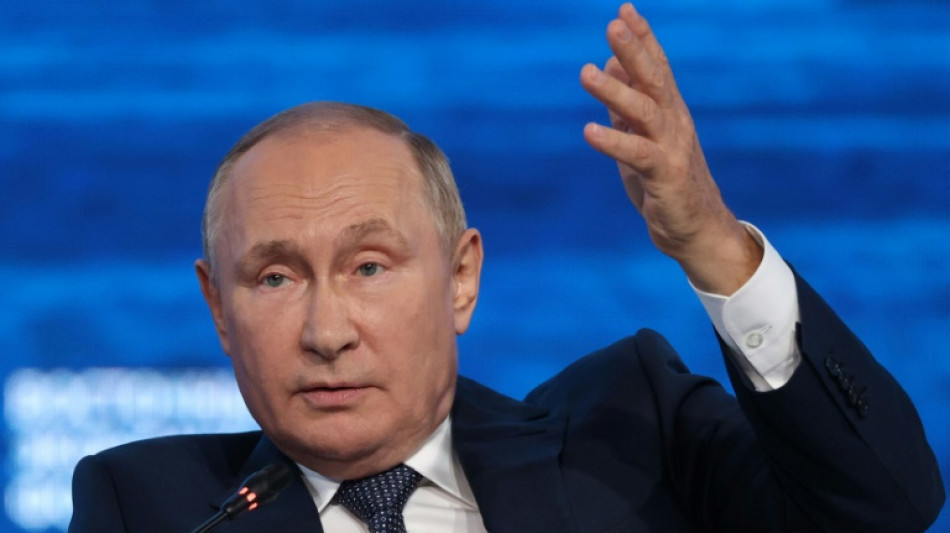
Resilient Russian economy surfs sanctions on oil boom / Photo: Sergei BOBYLYOV - SPUTNIK/AFP/File

 Bacteria suspected in deaths of hundreds of baby whales off Argentina

 US 'must choose' whether to end war: Iran president to Fox News

 UN approves resolution on dealing with rising sea levels

 Yalcouye makes dream debut as Ivory Coast beat Ghana in AFCON qualifier

 Chicago's White Sox and Cubs book MLB playoff berths

 Last-gasp Gakpo strike snatches Dutch draw to sour Klopp debut
 Global stocks mostly fall as oil prices and bond yields rise

 Israel's Netanyahu denounces enemies, allies in fiery UN speech
 Hollywood stars among arrests in NY anti-Netanyahu protest

 Losing start in AFCON qualifying for 78-year-old coach Le Roy
 Italy bans burqas in schools, caps numbers of foreign students per class

 Israel policies threaten 'life and existence' of Palestinians, Abbas says

 Paolini steers Italy past China in BJK

 Zidane admits emotion on eve of first game as France coach
 Breetzke and Maharaj sink Australia in first one-day international

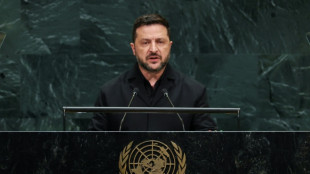 Zelensky broke confidentiality with North Korea POWs disclosure: South's president

 Former Liverpool star Carroll reveals he was sexually assaulted
 Dominican Republic calls for Haiti force to be strengthened

 Dolly Parton's nephew ordered to stay away from estate staff, properties

 Early exit for Philippine darling Eala at Singapore Open

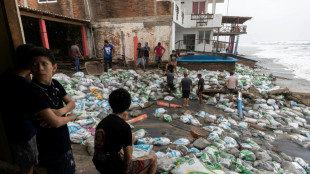 Hurricane Polo triggers huge waves in coastal Mexican city
 What happens if the US bans diesel exports
 Macklemore hits back with 'Free Palestine Tour' after Sheeran split

 Met Opera to give New Yorkers free tickets in affordability push
 Top ECB official to resign to take up IMF role

Russia's economy may face multiple long-term challenges, but for now energy exports appear to be helping it ride out Western sanctions imposed over the offensive against Ukraine.
Moscow says inflation is easing and employment is virtually full, contradicting the predictions of a catastrophe from many financial experts.
The International Monetary Fund on Tuesday offered some support to Russia's view, saying recession will be less severe than expected due to oil exports and relatively stable domestic demand.
The IMF forecast the Russian economy to contract just 3.4 percent over the whole year, after contracting 21.8 percent during the second quarter at a quarterly annualised rate.
It was only in June that the IMF forecast an annual drop of six percent.
"The contraction in Russia's economy is less severe than earlier projected, reflecting resilience in crude oil exports and in domestic demand with greater fiscal and monetary policy support and a restoration of confidence in the financial system," the IMF's latest World Economic Outlook report said.
President Vladimir Putin had stated in September that the economic situation in the country was "normalising" and that the worst was over after the series of economic penalties that followed the military operation launched against Ukraine on February.
Unemployment had fallen to its lowest level of 3.8 percent, Putin said, with annual inflation down to 13.7 percent a year, after record highs during the spring when the early sanctions began to bite.
- Impact of first sanctions 'over' -
"We can consider that the impact of the first sanctions has passed, notably in the financial sector," Elina Ribakova, deputy head of the Institute of International Finance, a trade group for the global financial services industry, told AFP.
The diplomatic and economic break with the West accelerated Moscow's rapprochement with energy-hungry China, with which it shares a 4,000 kilometre (2,500-mile) border.
Almost excluded from the European market, Russian "companies have been forced to find alternatives in other markets, particularly in Asia and Turkey", Moscow State University economist Natalya Zubarevich told AFP.
Russia and China have already announced their intention to settle gas and electricity contracts in rubles and yuan, a triumph for the Kremlin's efforts to take the US dollar out of the economy.
Last week's OPEC+ oil cartel's decision to slash output again, despite Washington's call to open the taps, was also warmly greeted by Moscow, which benefits from rising crude prices.
With the G7 rich nations club struggling to agree a ceiling price for Russian oil, a cap China and India appear reluctant to follow, Russia's prospects do indeed appear to be improving.
And for 2023, the IMF now expects Russia's economy will contract 2.3 percent, an improvement from the 3.5 percent it forecast in July.
However the Russian economy finds itself ever more dependent on energy exports and slipping further behind on many high value sectors.
- International isolation -
The promise of Russia developing its own hi-tech products once imported from abroad remains to be fulfilled, and it lacks domestic rivals to tech giants like Apple and Microsoft.
Firms dependent on cutting-edge foreign goods are having to face up to their isolation from international markets.
A glaring lack of spare parts has also hit car production.
Japanese manufacturer Toyota shut its Saint Petersburg factory in mid-September because of a lack of electronic components.
Nissan is selling its Russian assets, including a factory in the city, to the Russian government, after halting production in March.
"About half of the companies hit by sanctions are still having difficulties in finding alternative suppliers," said Ribakova.
As a result, the government has eased safety and environmental standards for domestically built vehicles.
In a leaked document published recently in local media, trade and industry ministry officials sounded alarm bells over a 10-15 year gap for Russia's technology industry, dependence on foreign goods and a lack of manpower.
A looming concern for Moscow is the European embargo on Russian oil due to start on December 5 ahead of a ban on refined oil products from February next year.
Over the first eight months of this year, more than 40 percent of federal income came from oil and gas, according to the finance ministry.
F.Santana--PC