'Cargo 200': Ukraine's grim search for its fallen / Photo: Dimitar DILKOFF - AFP

 India's 'Tree Father' plants for a greener future
 Hopping mad: New health warning stirs up Belgian brewers
 Canadian capital to rename 'Trump Ave'
 Pope heads to France on first state visit in 18 years
 Bacteria suspected in deaths of hundreds of baby whales off Argentina
 US 'must choose' whether to end war: Iran president to Fox News
 UN approves resolution on dealing with rising sea levels

 Yalcouye makes dream debut as Ivory Coast beat Ghana in AFCON qualifier
 Chicago's White Sox and Cubs book MLB playoff berths
 Last-gasp Gakpo strike snatches Dutch draw to sour Klopp debut
 Global stocks mostly fall as oil prices and bond yields rise
 Israel's Netanyahu denounces enemies, allies in fiery UN speech
 Hollywood stars among arrests in NY anti-Netanyahu protest

 Losing start in AFCON qualifying for 78-year-old coach Le Roy
 Italy bans burqas in schools, caps numbers of foreign students per class
 Israel policies threaten 'life and existence' of Palestinians, Abbas says

 Paolini steers Italy past China in BJK
 Zidane admits emotion on eve of first game as France coach
 Breetzke and Maharaj sink Australia in first one-day international
 Zelensky broke confidentiality with North Korea POWs disclosure: South's president
 Former Liverpool star Carroll reveals he was sexually assaulted
 Dominican Republic calls for Haiti force to be strengthened
 Dolly Parton's nephew ordered to stay away from estate staff, properties

 Early exit for Philippine darling Eala at Singapore Open

 Hurricane Polo triggers huge waves in coastal Mexican city
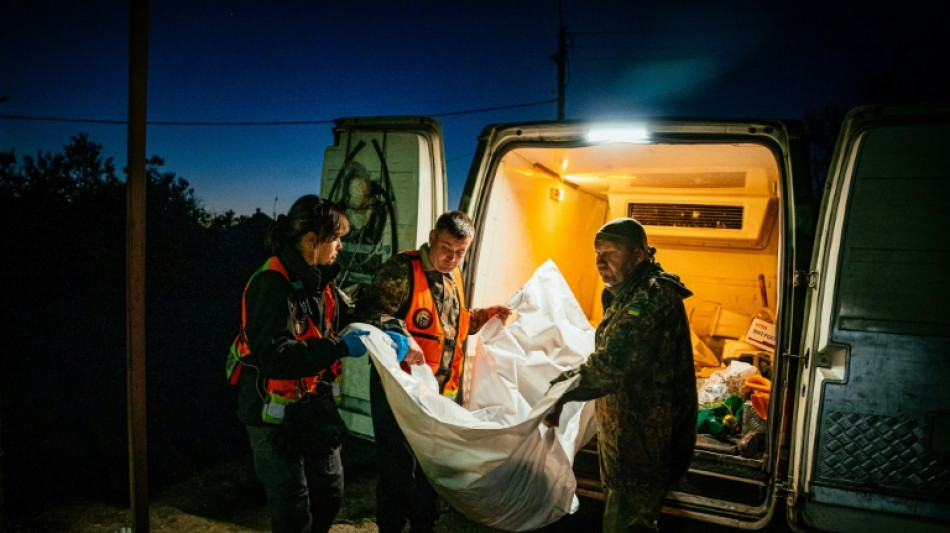
"He's bringing back the dead, so you leave him alone," a Ukrainian soldier barks at a comrade who has come to inspect a truck bearing the dreaded sign "Cargo 200".
It's military shorthand for a fallen soldier -- 200 being the number of kilos a zinc army coffin bearing a body generally weighs.
The scene at a checkpoint in war-ravaged Svyatogirsk is being played out in scores of other towns Ukraine has recaptured in a lightning counter-offensive across the eastern front.
"Cargo 200" dates from the Soviet invasion of Afghanistan in the 1980s, but in Ukraine both sides use the term for the untold thousands who have perished in eight months of the worst fighting Europe has witnessed since World War II.
Over the space of a week, Andriy Chernyavskiy and his specialist Ukrainian unit had already brought back the bodies of 19 other soldiers from the same sector.
- Yellow dots -
Rumbling over roads rutted by shell craters, Chernyavskiy's grim task relies on an interactive map with yellow dots marking spots where retreating Ukrainian soldiers reported burying or losing their comrades in the first months of war.
The convoy he commands pulled to a sudden stop at an isolated house in a nearby village called Oleksandrivka.
The rubbish and ammunition inside confirmed that the house had been held by Ukrainian troops before being taken by the Russians in late April.
"We know that a part of the 81st Brigade and the border guards withdrew from their positions in this house," Chernyavskiy said.
His search for the remains of a soldier the Ukrainians had to leave behind as they retreated under fire is helped by forensic dogs specialising in sniffing out the dead.
"Our dogs undergo a different kind of training than the ones involved in basic search and rescue," said Larysa Borysenko, 51, whose NGO Antares accompanies Chernyavskiy's Cargo 200 team.
After sniffing around for a few minutes, Professor, a young Belgian Shepherd, starts digging frantically with his front paws under a tree.
Two soldiers quickly fetch their spades. Chernyavskiy is already pulling on his white protective suit.
Once found half a metre (1.5 feet) below ground, the body is wrapped in a blue sheet, a cushion supporting the head.
"We are lucky. The body is well preserved.
"This kind of ritual is rarely possible," said Chernyavskiy, bent down beside it.
- Last honours -
In war, identification of the dead is rarely this straightforward.
The remains of one soldier was buried with three flak jackets, each one bearing a different name.
"We will only know who it is after matching the DNA test result," said Chernyavskiy, who has been doing this work for 20 years.
He started off with an NGO involved in identifying Soviet and Nazi soldiers killed across Ukraine during World War II.
He joined the Ukrainian army in 2014, offering his expertise during the Russian-backed conflict in the east after the annexation of Crimea that was a precursor to the current war.
"We must find each of our dead. That is my motto. There can be no missing," he said.
"Everyone deserves their last honours," even the Russian soldiers, whose corpses are also collected "in accordance with international law," Chernyavskiy said.
- Mined corpses -
Chernyavskiy is now well-known across the front and his van is often stopped by soldiers.
In the just-recaptured ghost town of Shandrygolove, one of the soldiers grabs a cable and guides Chernyavskiy to an isolated farm.
The cable will serve as a lasso to safely pull the corpse a few metres to make sure it is not booby trapped -- a dreaded practice in recaptured areas.
On a carpet of autumn leaves nearby, the bloated headless body of a soldier lies in utmost solitude. Beside it, a shell crater.
"What happened here is quite obvious," said the unit's deputy commander Oleksandr Lovynyuk, 53, unfolding a white body bag.
A soldier's helmet lies nearby, empty save for a few stuck strands of hair.
The team spends the 30 next minutes in heavy silence combing the surroundings in vain for the missing head.
"Behind each search, each effort, we try to remember that the mourning of a loved one depends on us," Borysenko said.
L.Henrique--PC