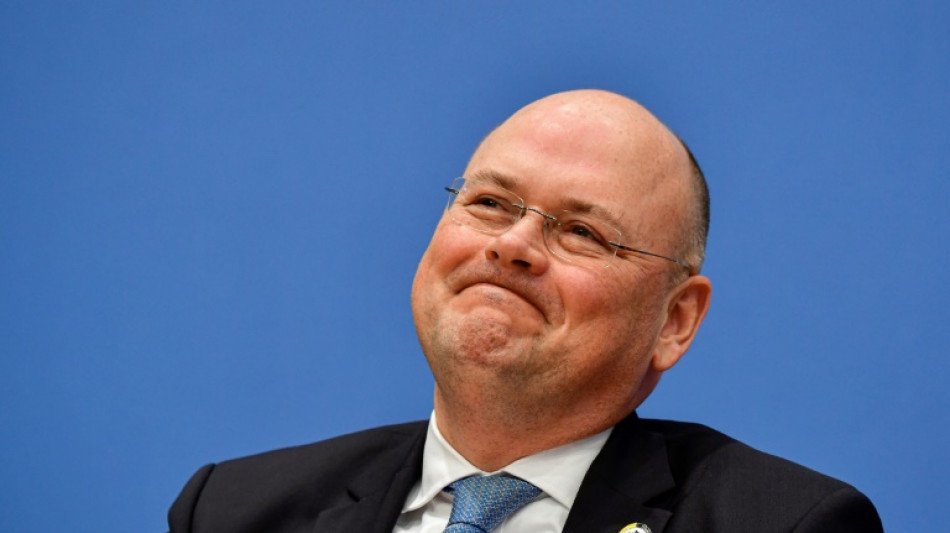
German cybersecurity chief sacked over alleged Russia ties / Photo: Tobias SCHWARZ - AFP/File

 Kauaʻi Writers Garden Challenges Honolulu-Centric Literary Scene
 French Economy Shrinks 0.1% as Consumer Confidence Slumps

 Wall Street Ends Turbulent Week Higher Despite Inflation and AI Jitters

 Kansas City Fed Chief Says Inflation Is Still Running Too Hot
 Oil Heads for Second Weekly Loss as Supply Surplus Emerges
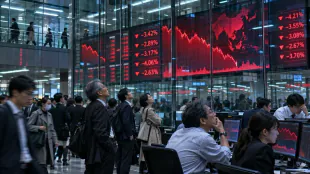
 Middletown High School Football Team Ends Legal Battle After Playoff Forfeit

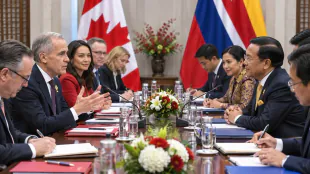
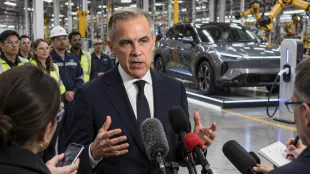 Canada Signals Openness to Chinese Automakers if US Trade Talks Fail
 US Mortgage Rate Falls for Fourth Week but Remains Above 7%

 US Jobless Claims Rise to 200,000 but Layoffs Remain Historically Low

 Euro-Area Growth Slows to 0.4% While Employment Stalls

 US Wholesale Inflation Eases Monthly but Hits a Four-Year Annual High

 India's Wholesale Inflation Jumps to 12.29% as Fuel Costs Surge

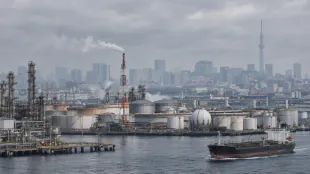 Japan's Economy Edges Into Contraction as Costly Oil Weighs on Demand
Germany's cybersecurity chief was sacked on Tuesday after a TV satire show accused him of having ties to Russian intelligence services, with the country on high alert over potential sabotage activities by Moscow.
Arne Schoenbohm, head of the Federal Cyber Security Authority (BSI), had been at the centre of intense speculation since the popular show accused him in early October of contacts with Russia.
He has now been relieved of his duties "with immediate effect", an interior ministry spokesman told AFP on Tuesday, citing "the allegations revealed and widely discussed in the media" as one of the reasons behind the move.
The allegations "have permanently damaged the necessary public trust" in Schoenbohm as head of the authority, the spokesman said.
"This is all the more true in the current crisis situation regarding Russian hybrid warfare," he added.
Schoenbohm was accused in the satire show on broadcaster ZDF of contacts with Russian secret services through an association he co-founded in 2012 known as the Cyber Security Council Germany.
One member of that association, Berlin cybersecurity company Protelion, reportedly operated under the name "Infotecs GmbH" until the end of March.
The report said this was a subsidiary of Russian cybersecurity company OAO Infotecs, founded by a former employee of the Russian KGB intelligence service.
According to other German media reports, Schoenbohm had maintained contact with the Cyber Security Council Germany until recently and the interior ministry had on August 24 approved a request for him to give a speech to the association.
The interior ministry spokesman on Tuesday said all allegations against Schoenbohm would be "thoroughly and emphatically examined and subjected to a detailed evaluation".
- 'Great annoyance' -
The cybersecurity chief would be "presumed innocent" in the meantime, he said.
The Handelsblatt daily had reported that there was "great annoyance" within the government over the allegations.
A planned joint appearance by Schoenbohm and Interior Minister Nancy Faeser to present a report on German cybersecurity in 2022 was cancelled last week.
Commenting on the scandal then, Faeser said Germany was "vulnerable" to cyberattacks, "especially due to the threat posed by Russia's war".
Europe's biggest economy has in recent years repeatedly accused Russia of online espionage attempts.
The most high-profile incident blamed on Russian hackers to date was a cyberattack in 2015 that paralysed the computer network of the lower house of parliament, the Bundestag, forcing the entire institution offline for days while it was fixed.
Russia denies being behind such actions.
Tensions between Russia and Germany have only intensified since Moscow's invasion of Ukraine.
The BSI has warned that companies, individuals and critical infrastructure are at risk of being hit by Russian cyberattacks.
Last week, the rail network in the north of the country was temporarily paralysed by what operator Deutsche Bahn called "sabotage", with some officials pointing the finger at Russia.
Important communications cables were cut at two sites, forcing rail services to be halted for three hours and causing travel chaos for thousands of passengers.
Moscow is also suspected of being behind explosions last month that set off leaks in the Nord Stream 1 and 2 gas pipelines, which connect Russia to Germany.
H.Portela--PC