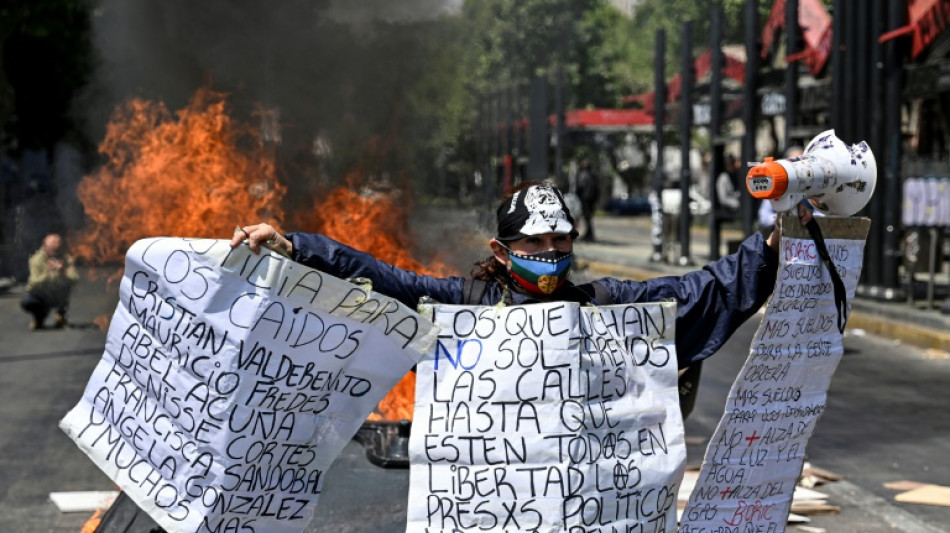
Fresh protests to mark anniversary of Chile revolt / Photo: Martin BERNETTI - AFP

 Kauaʻi Writers Garden Challenges Honolulu-Centric Literary Scene

 French Economy Shrinks 0.1% as Consumer Confidence Slumps

 Wall Street Ends Turbulent Week Higher Despite Inflation and AI Jitters

 Kansas City Fed Chief Says Inflation Is Still Running Too Hot

 Oil Heads for Second Weekly Loss as Supply Surplus Emerges

 Middletown High School Football Team Ends Legal Battle After Playoff Forfeit

 Canada Signals Openness to Chinese Automakers if US Trade Talks Fail

 US Mortgage Rate Falls for Fourth Week but Remains Above 7%

 US Jobless Claims Rise to 200,000 but Layoffs Remain Historically Low

 Euro-Area Growth Slows to 0.4% While Employment Stalls

 US Wholesale Inflation Eases Monthly but Hits a Four-Year Annual High

 India's Wholesale Inflation Jumps to 12.29% as Fuel Costs Surge

 Japan's Economy Edges Into Contraction as Costly Oil Weighs on Demand
Hundreds of Chileans, mainly students, protested in Santiago Tuesday, erecting burning barricades to mark three years since a social uprising they say has not yet yielded the desired societal change.
Demonstrators wearing goggles and facemasks as protection against tear gas stopped car traffic on the central Alameda avenue, and several metro stations were shuttered.
Police deployed 25,000 officers to keep the peace, and used water cannon to disperse trouble-making demonstrators in at least one venue.
Many shops closed early, or did not open at all, while schools sent pupils home early in a country where demonstrations in recent years have frequently been marred by clashes with the security forces.
"We have gained nothing" in the three years since the movement began, said Andrea Gomez, a 43-year-old social worker who was among those gathered.
The protests came exactly three years after the start of a mass revolt against a rise in metro fares in 2019 that quickly escalated into a general clamor for better conditions and social equality.
The government suspended the price hike but protests continued, and dozens were killed over months of clashes. Hundreds of people were injured.
The demonstrations kickstarted reforms that included the government's agreement to the drafting of a new constitution to replace the one inherited from the military dictatorship of Augusto Pinochet and perceived as market-friendly.
Last December, Chile elected a leftist president in Gabriel Boric, who supported the constitution-writing process.
But last month, nearly two-thirds of voters rejected the proposed draft despite the new revolutionary mood, amid concerns that parts of the document were too far-reaching.
A constitutional provision to legalize abortion was a key stumbling block in the conservative, majority-Catholic country.
Boric, a former student leader who had supported the 2019 protests, on Tuesday called for a new social dialogue to give shape to much-needed social reform.
The 2019 uprising, he said, "was an expression of pain and fractures in our society that politics, of which we are a part, has failed to interpret or answer."
Boric came to office with promises of turning the deeply unequal country into a greener, more egalitarian "welfare state."
A.Santos--PC



