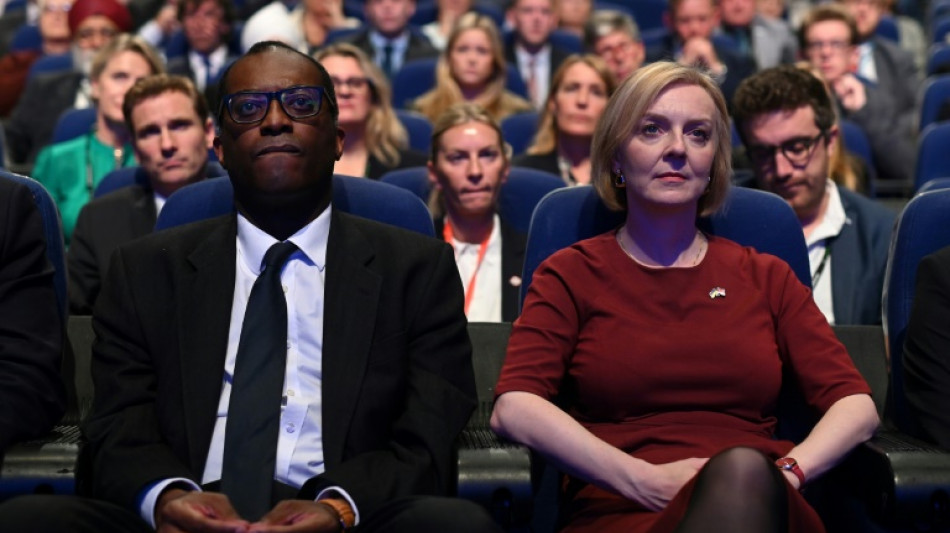
'Extraordinary mayhem': Truss's nightmare on Downing Street / Photo: Oli SCARFF - AFP

 Kauaʻi Writers Garden Challenges Honolulu-Centric Literary Scene

 French Economy Shrinks 0.1% as Consumer Confidence Slumps

 Wall Street Ends Turbulent Week Higher Despite Inflation and AI Jitters

 Kansas City Fed Chief Says Inflation Is Still Running Too Hot

 Oil Heads for Second Weekly Loss as Supply Surplus Emerges

 Middletown High School Football Team Ends Legal Battle After Playoff Forfeit

 Canada Signals Openness to Chinese Automakers if US Trade Talks Fail

 US Mortgage Rate Falls for Fourth Week but Remains Above 7%

 US Jobless Claims Rise to 200,000 but Layoffs Remain Historically Low

 Euro-Area Growth Slows to 0.4% While Employment Stalls

 US Wholesale Inflation Eases Monthly but Hits a Four-Year Annual High

 India's Wholesale Inflation Jumps to 12.29% as Fuel Costs Surge

 Japan's Economy Edges Into Contraction as Costly Oil Weighs on Demand
British Prime Minister Liz Truss has enjoyed the shortest of political honeymoons -- her chaotic premiership apparently mortally wounded despite having barely begun.
Discounting 10 days of mourning for the late Queen Elizabeth II, Truss had only a week before her political programme imploded, leading to the sacking of her finance minister.
"That is the shelf-life of a lettuce," The Economist newspaper commented last week.
- September 5 -
Truss wins a vote by Conservative party members by 81,326, against 60,399 for Rishi Sunak, who served as finance minister under previous prime minister Boris Johnson.
As the new leader of the largest party in parliament, that makes her prime minister -- despite support from less than 0.2 percent of the electorate and a minority of her own MPs.
The next day, she is confirmed as prime minister by the queen.
Truss installs the like-minded Kwasi Kwarteng as chancellor of the exchequer.
- September 8 -
Truss unveils a costly scheme to cap household energy bills, in response to Russia's invasion of Ukraine.
But the dramatic announcement is eclipsed by the queen's death, which suspends all government business for 10 days.
- September 23 -
Kwarteng announces a "mini-budget" which details the price of the energy scheme -– £60 billion ($67 billion) over the next six months.
But there are no measures to raise funds.
Instead, he announces massive new borrowing to pay for sweeping tax cuts -- including for top-earners -- along with scrapping a cap on bankers' bonuses.
The announcement draws immediate political fire for being unfair. But the most stinging verdict comes from the markets as the pound plummets towards parity against the dollar.
Two days later, on a Sunday, Kwarteng vows "more to come" on tax cuts. The next day, when markets reopen, the pound plumbs new depths.
The budget is dubbed "Kami-Kwasi" by media, which begin reporting tensions between Kwarteng and Truss, and deep disquiet among Tory MPs including cabinet ministers.
- September 28 -
With bond market turmoil placing British pension funds in jeopardy, the Bank of England announces a two-week programme to buy long-term UK bonds, capped initially at £65 billion, "to restore orderly market conditions".
- September 29 -
Pollsters YouGov report a 33-point lead for the main opposition Labour party –- its biggest margin over the Tories since the heyday of former Labour prime minister Tony Blair in the late 1990s.
Other polls also point to electoral disaster for the Conservatives. Hours before his keynote speech at the party's annual conference at the start of October, Kwarteng vows to "stay the course".
- October 3 -
Kwarteng and Truss are forced into a humiliating U-turn, scrapping the planned cut in the top rate of income tax following hurried late-night talks.
In her own conference speech on October 5, Truss vows to pursue her "growth, growth, growth" agenda but fails to reassure party rebels and nervous markets.
UK government bond yields keep rising, inflicting more pain for UK households as mortgage rates surge.
- October 10 -
In another volte-face, Kwarteng reveals he will publish a medium-term fiscal plan alongside independent budget forecasts on October 31 –- Halloween –- rather than in late November as originally planned.
But on October 12, Truss rules out any cuts to public spending, despite vowing no further U-turns on the remaining tax cuts, compounding perceptions of a government in chaos.
- October 14 -
With markets still rattled and pressure piling on Truss, the prime minister fires Kwarteng after just 38 days in the role.
Kwarteng defends the economic programme in a letter to Truss, insisting it was needed because "the status quo was simply not an option".
In his place, she appoints former foreign minister Jeremy Hunt.
- October 19 -
In what right-wing tabloid The Sun calls "a day of extraordinary mayhem", hardline interior minister Suella Braverman quits following a row with Truss and Hunt over immigration, saying that she had "serious concerns" about the government.
A parliament vote on banning fracking descends into chaos as Tory MPs are told they must vote in line with the government, despite widespread opposition.
Truss won the vote, but many MPs rebelled anyway, briefing journalists that it was the final nail in the coffin for Truss's premiership.
J.Pereira--PC



