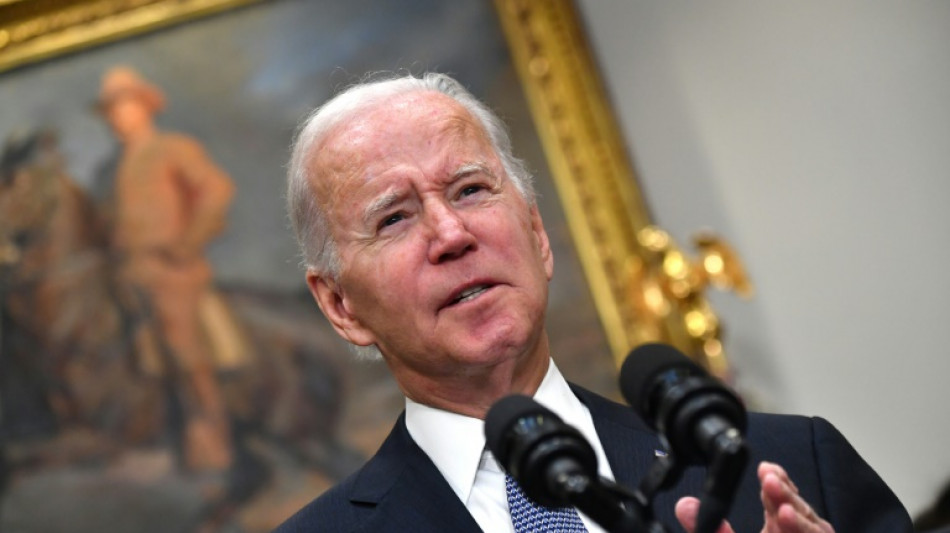
US budget deficit drops by half in 2022 on pandemic recovery / Photo: Nicholas Kamm - AFP

 Kauaʻi Writers Garden Challenges Honolulu-Centric Literary Scene

 French Economy Shrinks 0.1% as Consumer Confidence Slumps

 Wall Street Ends Turbulent Week Higher Despite Inflation and AI Jitters

 Kansas City Fed Chief Says Inflation Is Still Running Too Hot

 Oil Heads for Second Weekly Loss as Supply Surplus Emerges

 Middletown High School Football Team Ends Legal Battle After Playoff Forfeit

 Canada Signals Openness to Chinese Automakers if US Trade Talks Fail
 US Mortgage Rate Falls for Fourth Week but Remains Above 7%

 US Jobless Claims Rise to 200,000 but Layoffs Remain Historically Low

 Euro-Area Growth Slows to 0.4% While Employment Stalls

 US Wholesale Inflation Eases Monthly but Hits a Four-Year Annual High

 India's Wholesale Inflation Jumps to 12.29% as Fuel Costs Surge

 Japan's Economy Edges Into Contraction as Costly Oil Weighs on Demand
The US budget deficit fell by half in the past year to $1.4 trillion on the back of a pandemic recovery and as relief spending eased, the government said Friday.
Covid-related spending on things like unemployment insurance and other programs have declined following a recovery in the world's biggest economy from the virus outbreak, with businesses returning to normal.
The drop in the budget deficit marks the "largest one-year decrease," said the Treasury Department and White House budget office on Friday.
This was helped by higher individual and corporation tax collections, bolstered by employment growth, with tax revenues for the fiscal year ended September 30 surging a record $850 billion from 2021.
President Joe Biden hailed the big drop as evidence of a resurgent economy just three weeks ahead of November's crucial midterm elections to decide control of Congress.
Hailing the "largest ever decline in the federal deficit," Biden called the development "further proof that we're rebuilding the economy."
The development, he said, was part of "the good news on the economy" that he predicted would help Democrats climb back in the polls, which currently show Republicans poised for victory.
Treasury Secretary Janet Yellen, in a statement citing the American Rescue Plan stimulus package, said "today's joint budget statement provides further evidence of our historic economic recovery."
In a statement, officials also added that the US has "more than recovered all of the jobs lost during the pandemic".
The economy added more than 10 million jobs since early 2021, while unemployment returned to its pre-pandemic level.
The figures for the latest fiscal year showed government outlays dipped $550 billion to $6.3 trillion, in part reflecting reductions in Covid-19 related spending.
But spending for categories such as student loans increased, the report added.
This was the first fall in outlays since 2013, Treasury officials told reporters.
- Loan forgiveness -
The overall drop in the deficit came after Biden announced plans to forgive part of the country's massive student debt burden, a topic of controversy between Democrats and Republicans.
Republicans accuse Biden of wasting money on the measure, arguing that public funds could be used more effectively.
Loan modifications had a $430 billion impact in September, with a Treasury official acknowledging that loan forgiveness was one of the primary reasons for the increase.
But the department does not expect to see "similar large modifications" in the future unless there were further changes to policy moving forward.
In the latest fiscal year, federal borrowing rose by $2 trillion to $24.3 trillion, still close to the size of the world’s biggest economy, data showed.
With soaring inflation bringing a sharp rise in borrowing costs, interest on the public debt came in at $36.6 billion higher than estimated, the Treasury Department said.
The Federal Reserve has raised its benchmark lending rate several times this year to cool surging prices.
In a breakdown, the report on Friday also showed that individuals paid $2.6 trillion in taxes and those from corporations totaled $425 billion.
The Health and Human Services Department spent $1.6 trillion while the Defense Department spent $727 billion and foreign aid came up to an estimated $24.6 billion, the report said.
S.Caetano--PC



