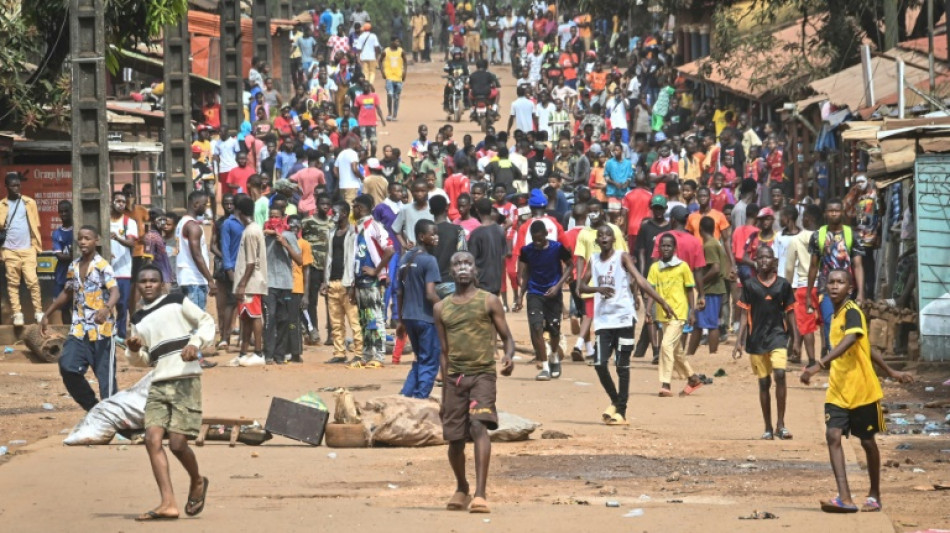
Guinea junta agrees return to civilian rule in 2 years / Photo: CELLOU BINANI - AFP

 Kauaʻi Writers Garden Challenges Honolulu-Centric Literary Scene

 French Economy Shrinks 0.1% as Consumer Confidence Slumps

 Wall Street Ends Turbulent Week Higher Despite Inflation and AI Jitters

 Kansas City Fed Chief Says Inflation Is Still Running Too Hot

 Oil Heads for Second Weekly Loss as Supply Surplus Emerges

 Middletown High School Football Team Ends Legal Battle After Playoff Forfeit

 Canada Signals Openness to Chinese Automakers if US Trade Talks Fail

 US Mortgage Rate Falls for Fourth Week but Remains Above 7%

 US Jobless Claims Rise to 200,000 but Layoffs Remain Historically Low

 Euro-Area Growth Slows to 0.4% While Employment Stalls

 US Wholesale Inflation Eases Monthly but Hits a Four-Year Annual High

 India's Wholesale Inflation Jumps to 12.29% as Fuel Costs Surge

 Japan's Economy Edges Into Contraction as Costly Oil Weighs on Demand
Guinea's ruling junta has agreed to restore civilian rule in two years, after facing sanctions over its original plan for a three-year transfer of power, the West African bloc ECOWAS said Friday.
West African leaders had last month suspended Guinea from the bloc and imposed sanctions on a number of individuals following a military coup.
"In a dynamic compromise, experts from ECOWAS and Guinea have jointly developed a consolidated chronogram (timetable) for a transition spread over 24 months," ECOWAS said in a report following a technical mission to the country published on social media by the junta.
The country's military leader, Colonel Mamady Doumbouya, said in an address broadcast on state television that the timetable would take effect from January 1, 2023.
Leaders from the Economic Community of West African States must approve the timetable before it is officially implemented, with the bloc due to hold a summit before the end of the year.
The bloc had given the junta one month to present a "reasonable and acceptable" timetable for the return to civilian rule, an ultimatum that theoretically expires this weekend.
Diplomatic links between the two sides have remained and Guinean authorities have reiterated their readiness to cooperate with ECOWAS, which had dispatched its mission to Conakry to work out a compromise schedule.
- Acceptable -
The poor but mineral-rich West African state has been under a military government since a September 2021 coup that ousted president Alpha Conde after more than 10 years in power.
Colonel Doumbouya has since appointed himself president and vowed to restore civilian rule within three years.
Several West African officials have indicated that a two-year transition period would be acceptable.
A similar timeframe was agreed between ECOWAS and the junta in neighbouring Mali after months of wrangling.
Under the terms of that agreement, reached in July, the Malian military was to hand over power in March 2024. By that time, they would have been in power for more than three-and-a-half years since overthrowing the elected civilian president in August 2020.
In recent years, ECOWAS has witnessed a succession of military coups in West Africa, in 2020 and 2021 in Mali, in 2021 in Guinea and twice this year in Burkina Faso.
In the face of military authorities, the bloc has duly increased its summits and country missions while ramping up pressure to shorten the transitional periods back to civilian rule.
- Four dead in clashes -
The transition compromise was reached after demonstrations broke out Thursday in the capital Conakry, with young protesters clashing with security forces and opposition group the National Front for the Defence of the Constitution claiming four civilians had been killed.
The FNDC -- outlawed by the junta -- had called for the protests to demand a quick return to a civilian-led government and the release of all prisoners detained for political reasons.
In response, Guinea's top prosecutor on Friday called for a crackdown on the organisers and participants of a giant anti-government protest in which he said six security personnel had been wounded while the opposition said four civilians had been killed.
The FNDC identified three of the people killed as Thierno Bella Diallo, Boubacar Diallo and Thierno Moussa Barry. It said 20 people suffered gunshot wounds while many others were arrested.
Justice Minister Alphonse Charles Wright confirmed their deaths in a statement on Friday, but said the causes "remain to be clarified by autopsy".
He ordered prosecutions, without commenting on the alleged perpetrators.
R.J.Fidalgo--PC



