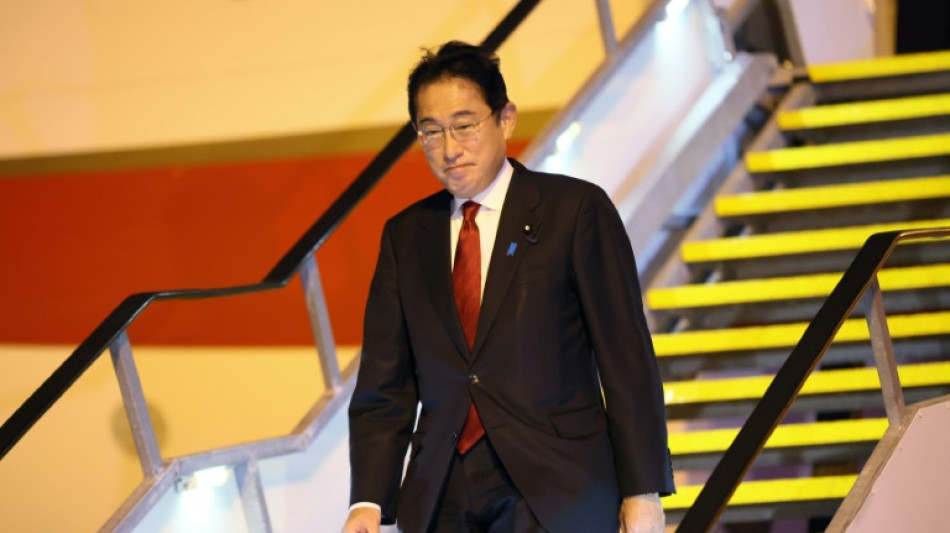
Japanese, Australia PMs eye new security pact / Photo: TREVOR COLLENS - POOL/AFP

 Cash for nature protection: hotelier's offer to Principe islanders
 US miner KoBold bets on AI to gain edge in DR Congo mineral hunt

 Internet disrupted in Ethiopia as conflict rages

 Asian markets mixed after oil gains
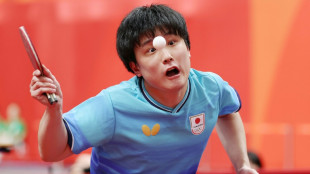
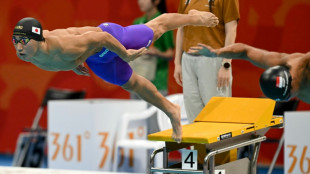 'Genius' Ohashi bids for third Asian Games gold after world record

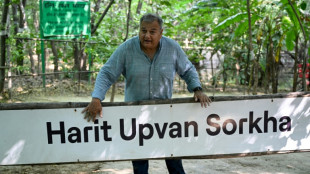 India's 'Tree Father' plants for a greener future
 Hopping mad: New health warning stirs up Belgian brewers
 Canadian capital to rename 'Trump Ave'
 Pope heads to France on first state visit in 18 years
 Bacteria suspected in deaths of hundreds of baby whales off Argentina
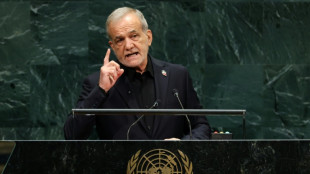 US 'must choose' whether to end war: Iran president to Fox News

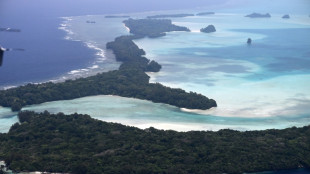 UN approves resolution on dealing with rising sea levels

 Yalcouye makes dream debut as Ivory Coast beat Ghana in AFCON qualifier
 Chicago's White Sox and Cubs book MLB playoff berths

 Last-gasp Gakpo strike snatches Dutch draw to sour Klopp debut

 Global stocks mostly fall as oil prices and bond yields rise

 Israel's Netanyahu denounces enemies, allies in fiery UN speech
 Hollywood stars among arrests in NY anti-Netanyahu protest

 Losing start in AFCON qualifying for 78-year-old coach Le Roy
 Italy bans burqas in schools, caps numbers of foreign students per class
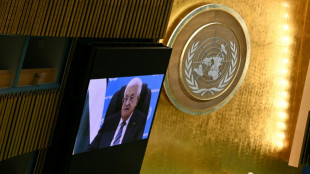 Israel policies threaten 'life and existence' of Palestinians, Abbas says

 Paolini steers Italy past China in BJK

 Zidane admits emotion on eve of first game as France coach
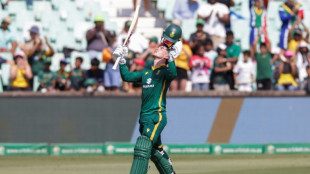 Breetzke and Maharaj sink Australia in first one-day international

 Zelensky broke confidentiality with North Korea POWs disclosure: South's president
Japanese Prime Minister Fumio Kishida visited Australia on Saturday, where he is expected to ink a revamped security deal with his Australian counterpart to address China's rapidly growing military clout.
Kishida met Anthony Albanese for talks to finalise an agreement to share more sensitive intelligence and deepen military cooperation.
"The Japan and Australian relationship on security issues has built up for many years," a Japanese foreign ministry official said ahead of the meeting in the western city of Perth.
"We hope that this visit will be an opportunity to further deepen security cooperation."
It is the first visit of a Japanese prime minister to Australia since 2018.
The two Pacific nations are expected to focus on sharing intelligence -- particularly signals and geospatial intelligence gleaned from electronic eavesdropping and high-tech satellites.
Neither country has extensive foreign spy networks or armies of human assets overseas -- Japan has no foreign spy agency equivalent to America's CIA, Britain's MI6 or even Australia's much smaller agency ASIO.
But according to expert Bryce Wakefield, both Australia and Japan have sophisticated signals intelligence capabilities -- a form of information gathering by intercepting communications.
Wakefield, director of the Australian Institute of International Affairs, said the agreement could be a model for Japan to develop deeper security ties with countries like Britain.
There have long been rumours about Japan and Australia cooperating on intelligence behind the scenes.
This accord will deepen and codify that partnership, but it is also being seen as another small step toward Japan joining the powerful Five Eyes intelligence-sharing alliance between Australia, Britain, Canada, New Zealand and the United States.
It is "an epoch-making event that Japan can share SIGINT (signals intelligence) with a foreign nation except for the United States," Ken Kotani, an expert in the history of Japanese intelligence at Nihon University, told AFP.
But hurdles remain.
Closer cooperation has been hampered by longstanding concerns about Japan's ability to handle sensitive confidential material and transmit it securely.
For now, Australia will likely be forced to scrub any intelligence passed to Japan for information gleaned from the Five Eyes network.
- China top of mind -
Prime ministers Kishida and Albanese are also expected to vow more military and energy cooperation.
Japan is a major buyer of Australian gas and has made a series of big bets on hydrogen energy produced in Australia, as it tries to ease a lack of domestic energy production and dependence on fossil fuels.
"Japan imports 40 percent of its LNG from Australia. So it's very important for Japan to have a stable relationship with Australia, from the aspect of energy," the Japanese official said.
Saturday's deal is expected to update a 2007 accord, which was agreed upon when Beijing was much weaker militarily and much less bellicose in its dealings with the world.
Since Xi Jinping came to power, Beijing's military has become much stronger and its posturing more aggressive.
During Xi's decade-long rule, China has built the world's largest navy, revamped the globe's biggest standing army, and amassed a nuclear and ballistic arsenal to trouble any foe.
V.Fontes--PC