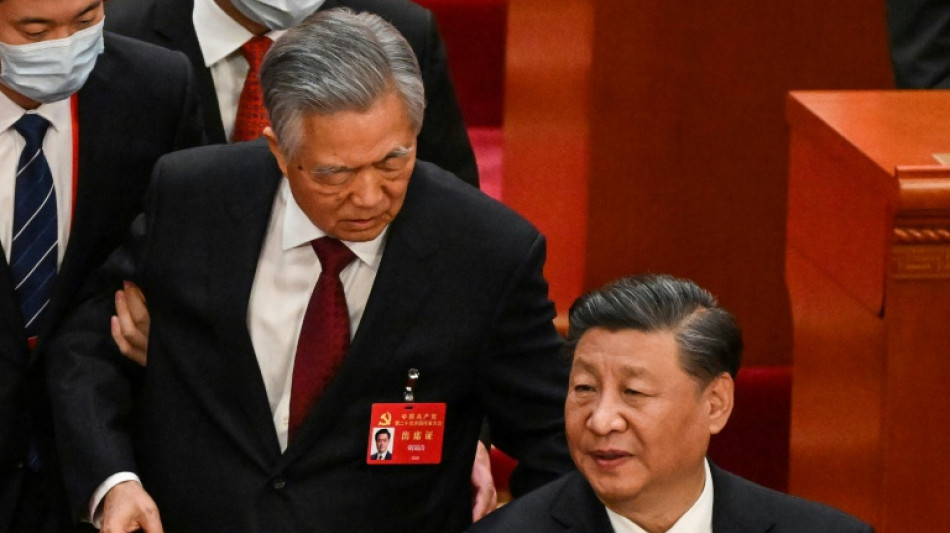
Ill health or power play? Hu Congress exit sparks speculation storm / Photo: Noel CELIS - AFP

 DiDi Advances Robotaxi Operations in China with New R2 Vehicle and Expanded Safety Infrastructure
 RBI Grants Paytm In-Principle Approval to Revive Wallet Business

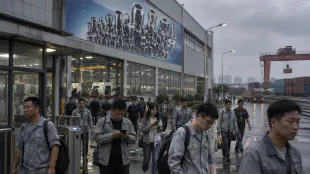 China's Factory Activity Contracts as Export Orders Weaken

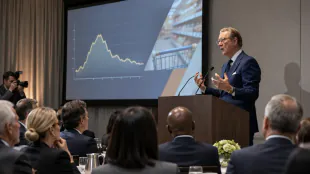
 US Retail Sales and Fed Minutes Set Up a Critical Test for Consumers
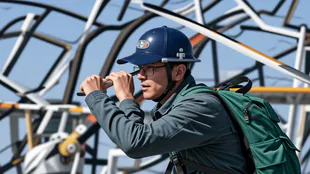 MotorTrend’s Top Hybrid Vehicle Picks for 2026

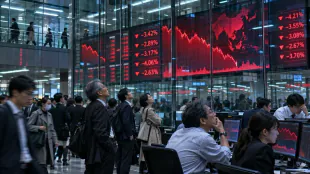 Asian Markets Slide as AI Concerns Hit Chip Stocks

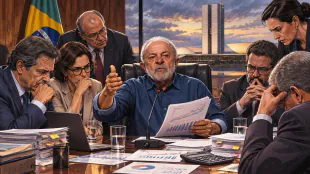 Brazil Faces Debt and Inflation Test as Lula Prepares Fourth Term
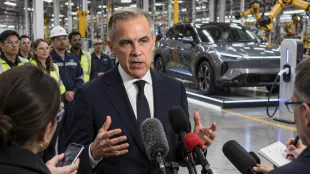
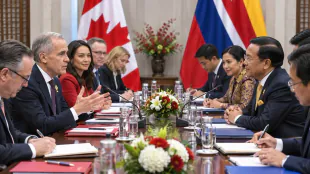 Canada Expands Asian Trade Push as US Negotiations Resume

 Jennie Earns Two Grammy Nominations as Major K-pop Agencies Boycott New Asian Pop Category

 Italy Raises 2026 Growth View but Warns Energy Will Keep Inflation High

 UK Economy Grows 0.7% in Third Quarter as Services Lead Expansion

The abrupt exit of former Chinese leader Hu Jintao from a key political meeting grabbed global headlines, providing a rare moment of drama at the meticulously choreographed event intended to hand President Xi Jinping a historic third term in power.
And while Beijing's state media later said Hu was escorted out by security due to ill health, the 79-year-old appeared reluctant to leave his seat next to Xi -- leading to speculation his departure was a political power play.
Here are some of the main theories about what took place:
- Ill health -
State news agency Xinhua said late Saturday that Hu had insisted on attending the session despite being unwell.
"When he was not feeling well during the session, his staff, for his health, accompanied him to a room next to the meeting venue for a rest. Now, he is much better," Xinhua said on Twitter, a social media platform that is blocked in China.
State broadcaster CCTV showed Hu casting a ballot for the party's new leadership during a closed-door session on the last day of the Congress -- before foreign journalists were allowed into the venue.
Later, a steward attempted to take a sitting Hu by the arm before being shaken off. The steward then tried to lift Hu up with both hands from under the armpits, and he was escorted out as most of his colleagues stared firmly ahead.
Speculation has long swirled that Hu is suffering from health issues, Alfred Wu Muluan, a Chinese politics expert at the National University of Singapore, told AFP.
"Hu has aged dramatically," Wu said, adding that in 2012 -- when he handed the reins of power over to Xi -- the former leader already appeared “to have some sort of Parkinsons-like symptoms."
Hu's hands were "trembling significantly" during another public appearance in 2015, Wu noted.
- Political show of force -
But others said the unexpected move was meant to send a strong political signal to those in the party that might oppose Xi's coronation.
Hu's 2003-2013 tenure was seen as a period of increased tolerance of different political factions within the Communist Party and a greater opening up to the world -- a time of comparative pluralism now unthinkable in China under Xi.
Hu's unceremonious exit, then, "must be read together with the scathing criticism of the Hu era as outlined in the 20th Party Congress report by Xi," Henry Gao at Singapore Management University said.
"Given how carefully choreographed the Party Congress is, it is no coincidence that this was allowed to be seen in front of all party delegates and the media," he said.
Xi on Sunday promoted some of his closest Communist Party allies, cementing his position as the nation's most powerful leader since Mao Zedong.
He also notably removed several officials seen as reform-minded and close to his predecessor, including Hu Chunhua, a vice premier once dubbed "little Hu" due to his similarities with China's former leader.
"The way Hu was basically dragged out of the Great Hall of the People is a way of saying in no ambiguous terms that this new era has no room for anyone affiliated with the Jiang-Hu era," William Sima, a China expert at Australian National University, told AFP, referencing Hu's predecessor Jiang Zemin.
- Discontent -
Another expert suggested that Hu was removed after expressing his reservations about the current Chinese leader's policy decisions.
"My speculation is that (Hu) was very unhappy about the composition of the Central Committee," Willy Lam, adjunct professor at the Chinese University of Hong Kong, said.
"I think he must have said something that upset Xi Jinping, maybe some words of protest, and that's why Xi Jinping summoned security people to drag him away."
- Opaque politics -
The Communist Party typically does not air its dirty laundry in public.
And critics say it's for that reason that Hu's removal has sparked so much speculation -- there is simply no transparency on the power struggles within the party.
The former leader being escorted out was "unusual but not consequential," Jean-Pierre Cabestan, professor of political science at Hong Kong Baptist University, argued.
"It's impossible to know what happened to Hu Jintao," Mary Gallagher, who specialises in Chinese politics at the University of Michigan, added.
"Even if he was ill... it's hard to believe that the last general secretary of the CCP would be removed from the stage," she added.
"It shows that Xi is in charge and no one challenges him."
L.Torres--PC



