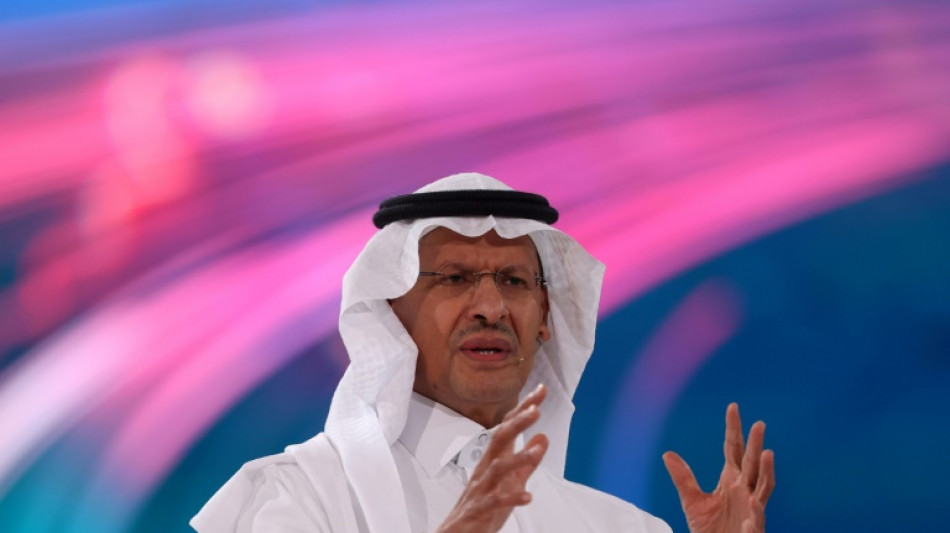
Saudi blasts release of oil reserves 'to manipulate markets' / Photo: Fayez Nureldine - AFP

 DiDi Advances Robotaxi Operations in China with New R2 Vehicle and Expanded Safety Infrastructure

 RBI Grants Paytm In-Principle Approval to Revive Wallet Business

 China's Factory Activity Contracts as Export Orders Weaken

 US Retail Sales and Fed Minutes Set Up a Critical Test for Consumers

 MotorTrend’s Top Hybrid Vehicle Picks for 2026

 Asian Markets Slide as AI Concerns Hit Chip Stocks

 Brazil Faces Debt and Inflation Test as Lula Prepares Fourth Term

 Canada Expands Asian Trade Push as US Negotiations Resume

 Jennie Earns Two Grammy Nominations as Major K-pop Agencies Boycott New Asian Pop Category

 Italy Raises 2026 Growth View but Warns Energy Will Keep Inflation High

 UK Economy Grows 0.7% in Third Quarter as Services Lead Expansion

Saudi Arabia's energy minister on Tuesday blasted the release of emergency oil stocks as an attempt to "manipulate markets", the latest apparent salvo in a spat with Washington over oil production.
"People are depleting their emergency stocks, had depleted it, used it as a mechanism to manipulate markets while its profound purpose was to mitigate shortage of supply," Prince Abdulaziz bin Salman told an investor conference in the Saudi capital.
"However, it is my profound duty to make it clear to the world that losing emergency stock may become painful in the months to come."
Prince Abdulaziz did not single out the United States in his comments about emergency stocks, but last week US President Joe Biden announced he was putting the final 15 million barrels on the market from a record release of US strategic reserves.
That tranche was to complete a 180-million-barrel release authorised in the spring, in response to price hikes linked to Russia's invasion of Ukraine.
It also came on the heels of a decision by the OPEC+ oil cartel, which Riyadh co-leads with Moscow, to cut oil production by two million barrels a day from November.
The cartel's decision has drawn intense criticism from the White House, which has said it amounted to "aligning with Russia" in the Ukraine war.
Prince Abdulaziz pushed back against that assessment on Tuesday.
"I keep listening, are you with us or against us? Is there any room for, 'We are for Saudi Arabia and for the people of Saudi Arabia'?" he said to applause.
Asked about getting the decades-old partnership between Riyadh and Washington back on track, he said: "I think we as Saudi Arabia decided to be the maturer guys and let the dice fall."
Speaking on an earlier panel, Saudi investment minister Khalid al-Falih described the dust-up as "unwarranted" and temporary.
"If you look at the relationship with the people side, the corporate side, the education system, you look at our institutions working together, we are very close, and we will get over this recent spat that I think was unwarranted," he said.
JPMorgan Chief Executive Jamie Dimon also said he was optimistic that bilateral ties would eventually improve.
"Saudi Arabia and the US have been allies for the last 75 years... They'll work it through," he said.
"These countries will remain allies going forward."
- Davos in the Desert -
Hundreds of CEOs and finance moguls are in Riyadh for the three-day Future Investment Initiative (FII), a Davos-style investment conference that analysts say will highlight Saudi Arabia's geopolitical muscle despite strained ties with Washington.
The FII, often referred to as "Davos in the Desert", was launched in 2017 as an economic coming-out party for the world's largest crude exporter, which is trying to diversify away from oil under Crown Prince Mohammed bin Salman.
The 37-year-old who is first in line to the throne "takes a very hands-on approach" to projects associated with his Vision 2030 reform agenda, said Kristin Diwan of the Arab Gulf States Institute in Washington.
"Ultimately those attending will know that they will need his approval or those of his confidants to work in the kingdom," she said.
Up to 400 American CEOs are expected to participate in the conference, though unlike in previous years there is no representation from the US government.
The event's organiser told AFP last week that American officials had not been invited.
"Saudi Arabia needs to attract American investment, technology, and popular interest to succeed," Diwan said.
"It still remains to be seen if this broader engagement can be maintained if the political mood in the United States turns hostile toward Saudi Arabia."
X.Brito--PC



