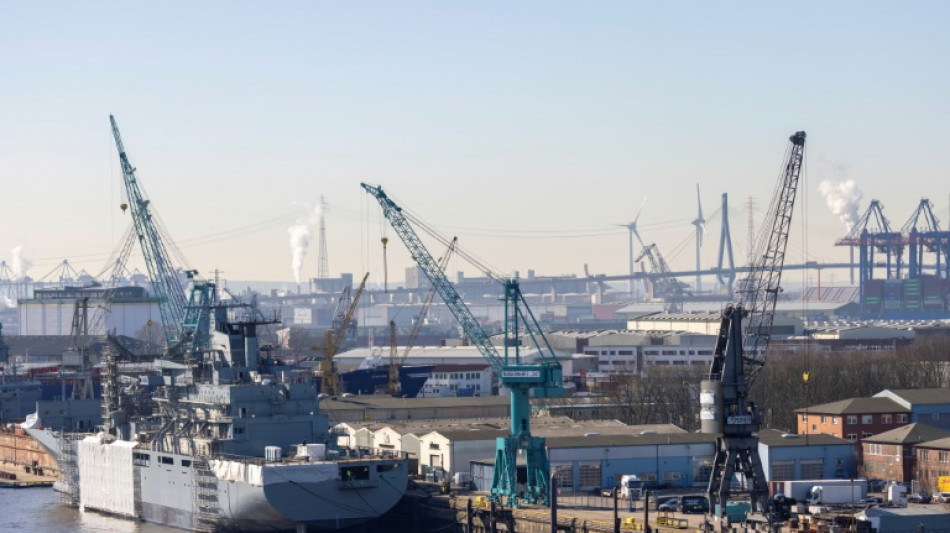
Germany allows smaller Chinese stake in Hamburg port / Photo: Odd ANDERSEN - AFP/File

 DiDi Advances Robotaxi Operations in China with New R2 Vehicle and Expanded Safety Infrastructure

 RBI Grants Paytm In-Principle Approval to Revive Wallet Business

 China's Factory Activity Contracts as Export Orders Weaken
 US Retail Sales and Fed Minutes Set Up a Critical Test for Consumers

 MotorTrend’s Top Hybrid Vehicle Picks for 2026

 Asian Markets Slide as AI Concerns Hit Chip Stocks

 Brazil Faces Debt and Inflation Test as Lula Prepares Fourth Term
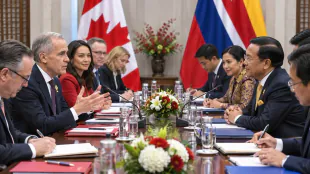 Canada Expands Asian Trade Push as US Negotiations Resume

 Jennie Earns Two Grammy Nominations as Major K-pop Agencies Boycott New Asian Pop Category

 Italy Raises 2026 Growth View but Warns Energy Will Keep Inflation High

 UK Economy Grows 0.7% in Third Quarter as Services Lead Expansion

Germany's coalition government on Wednesday allowed a Chinese firm to take a smaller-than-planned stake in a Hamburg port, after Chancellor Olaf Scholz resisted calls to ban the controversial sale outright.
Under the compromise reached by Scholz's cabinet, Chinese shipping giant Cosco will be allowed to buy a stake "below 25 percent" in a container terminal owned by HHLA, the economy ministry said in a statement.
"The reason for the partial prohibition is the existence of a threat to public order and safety."
China's state-owned Cosco had initially sought a 35-percent stake and the deal would have automatically gone ahead if a compromise solution hadn't been found this week.
The fate of the Tollerort terminal at Hamburg's port -- Europe's third busiest -- has sparked a fierce row in Scholz's coalition government, amid growing concern about critical infrastructure falling into foreign hands.
Scholz, a former Hamburg mayor, had supported the sale and has repeatedly stressed the importance of strong trade ties with China.
He is due to visit China next week, the first European Union leader to make the trip since November 2019.
But Scholz's coalition partners the Greens and the FDP wanted to veto the Hamburg port deal, citing security risks.
Badly burnt by its over-reliance on Russian energy, many in Germany are also wary of becoming too dependent on China economically.
Six German ministries, including those of economy, defence and foreign affairs, had opposed the Cosco sale.
The European Commission had also expressed reservations about the deal, a source told AFP at the weekend.
The agreement to settle for allowing a reduced stake of 24.9 percent, thereby depriving Cosco of voting rights, "reduces the acquisition to a purely financial participation", the economy ministry said.
But the face-saving compromise failed to silence some critics.
Anton Hofreiter, a Green party lawmaker and chairman of the German parliament's European affairs committee, said greenlighting the deal was the wrong decision.
"(Scholz's) argument... that this is a purely commercial project is fatally reminiscent of the statements on Russia and Nord Stream," he told the Funke media group.
"The attitude can be described as naive at best. We urgently need a realistic view of China."
Beijing meanwhile welcomed the deal's sign off and accused critics of "hyping up" the acquisition.
"Cooperation is mutually beneficial. We hope the relevant parties will view pragmatic cooperation between China and Germany rationally and stop baselessly hyping it up," said foreign ministry spokesman Wang Wenbin.
F.Santana--PC