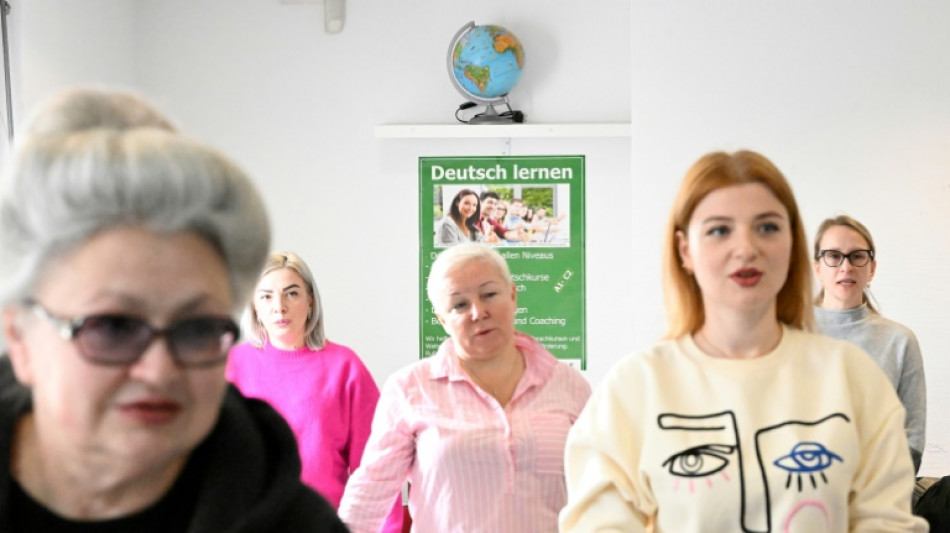
Facing uncertain future, Ukrainians struggle to adapt in Germany / Photo: Tobias Schwarz - AFP

 DiDi Advances Robotaxi Operations in China with New R2 Vehicle and Expanded Safety Infrastructure

 Freezz Italia Awarded ESA Contract for IRIS(2) Low-LEO Pre-Operational and De-Risk Activities

 French Economy Shrinks 0.1% as Consumer Confidence Slumps

 Wall Street Ends Turbulent Week Higher Despite Inflation and AI Jitters

 Kansas City Fed Chief Says Inflation Is Still Running Too Hot

 Oil Heads for Second Weekly Loss as Supply Surplus Emerges

 Middletown High School Football Team Ends Legal Battle After Playoff Forfeit

 Canada Signals Openness to Chinese Automakers if US Trade Talks Fail

 US Mortgage Rate Falls for Fourth Week but Remains Above 7%

 US Jobless Claims Rise to 200,000 but Layoffs Remain Historically Low

In her previous life in southern Ukraine, Tetiana Chepeliova was an accountant.
In Berlin, she is unemployed, like the 16 other Ukrainian women with whom she is learning German in a course aimed at helping them integrate into society.
The 47-year-old is one of more than a million Ukrainians who have fled to Germany since Russia's invasion in February. Among the European Union countries, only Poland has welcomed more.
The influx has put huge pressure on local authorities with Interior Minister Nancy Faeser recently describing the situation as "tense".
But unlike in 2015, when huge protests stoked by the far-right erupted over the arrival of Syrians and Iraqis fleeing war, this time there have been few dissenting voices over the influx.
Instead, a key challenge is turning out to be the "major uncertainty" faced by the Ukrainians, said Benjamin Beckmann, who oversees integration programmes at Germany's federal office for migration and refugees.
For many of them -- mostly women and children -- it remains an open question whether or not they will return to their homeland once the war is over, he added.
- Qualifications not recognised -
At a language school in a residential district of the German capital, Chepeliova is among a group of Ukrainians learning to navigate the German language.
When AFP visited, she was learning basic terms to express herself during a visit to the doctor.
The courses consist of three hours of classes a day, offered free to Ukrainians for nine months.
"The are extremely motivated," said teacher Petra Schulte.
But Schulte also senses the frustration of her class, which has just one male student. They include a mechanical engineer, a dentist, a doctor, nurses, and a piano teacher.
"They have worked for years... and suddenly, their qualifications are not recognised, and they cannot practise" their professions, the teacher said.
Chepeliova fled the southern city of Kherson after it fell to the Russians in March. Today, she sees her future in Germany: "It is the best place for me. The country is super welcoming towards Ukrainians."
Her 12-year-old son found German school difficult at first but "after spending a weekend with his class, it is as if a wall fell -- he was no longer frightened of speaking German".
Other women however want eventually to return to Ukraine, where they have left loved ones behind.
"None of them seem happy in the role of housewife," observed Schulte, 63.
She even questioned sometimes why she was teaching them when they might end up returning home, she admitted.
For now, while the Ukrainians weigh up their future in Europe's biggest economy, Schulte and others like her can only support them in their journey to adapt in Germany.
"The will to help has not weakened," she said.
G.M.Castelo--PC



