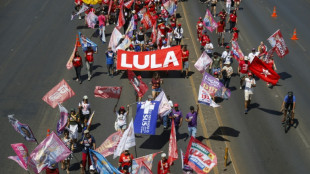
Lula's leftist triumph: Is this Latin America's second 'pink tide'? / Photo: CAIO GUATELLI - AFP

 Williams boss hails Chadwick as F1 inspiration for women

 World No.1 Sinner delays return with China Open withdrawal

 South Lebanon children return to school destroyed by Israel strike

 Jewish group urges Berlin far-left vote winners to tackle antisemitism

 European stock markets climb as oil prices drop

 Trump accuser E. Jean Carroll finally has her damages

 Germany's Havertz, Musiala ruled out of Greece match with injury

 Ireland's Gaza stance spills from Eurovision into football

 Welcome aboard the Costa Serena, the Asian Games floating hotel

 Asian markets mixed after recent oil surge

 Cash for nature protection: hotelier's offer to Principe islanders
 US miner KoBold bets on AI to gain edge in DR Congo mineral hunt

 Internet disrupted in Ethiopia as conflict rages

 Asian markets mixed after oil gains

 'Genius' Ohashi bids for third Asian Games gold after world record

 India's 'Tree Father' plants for a greener future
 Hopping mad: New health warning stirs up Belgian brewers
 Canadian capital to rename 'Trump Ave'
 Pope heads to France on first state visit in 18 years
 Bacteria suspected in deaths of hundreds of baby whales off Argentina

 Scheffler and Burns give US 3-2 Presidents Cup lead
 Hollywood stars among 100 arrested in NY anti-Netanyahu protest

 Klopp denied on Germany debut as Portugal win in Nations League

 Rich nations should foot climate bill, says Nepal minister

 Wellalage and Mendis star as Sri Lanka level England series in thriller

With his narrow election victory over incumbent Jair Bolsonaro Sunday, Brazil's president-elect Luiz Inacio Lula da Silva appears to have cemented a left-wing political conquest of Latin America.
From Mexico in the north to Chile in the south, the region's constantly see-sawing political map once again resembles that of the early 2000s, when a so-called "pink tide" of left-leaning governments washed over it.
But analysts say this time is different: the trend is driven by pragmatism rather than ideology.
"It's not because Latin Americans are becoming more leftist. I don't think there's any evidence to support that," analyst Michael Shifter of the Inter-American Dialogue told AFP.
In their most recent election cycles, Latin American countries have resoundingly dethroned incumbent parties on the right and center-right of the political spectrum.
Honduras, Bolivia and Argentina are among those to have turned their backs on the right, while Colombia in June elected its first leftist president despite a deep-rooted mistrust, as elsewhere in the region, of anything with perceived links to "communism."
Many voters were jolted leftward by economic troubles and the devastating effects of the Covid-19 pandemic.
Voters across the globe felt ignored, even denigrated, by the political establishment as poverty and inequality deepened.
"It is more of a rejectionist trend than anything else... people looking for an alternative," said Shifter of the recent string of leftist victories.
"It just so happens that we are in that moment in Latin America where a lot of the governments that are being rejected are of the right or the center right."
- 'Optimistic wave' -
In Brazil, far-right Jair Bolsonaro -- widely seen as racist, sexist and homophobic -- was a divisive leader, adding to the push towards Lula, an icon of the Brazilian and Latin American left.
His Covid-skeptic stance is blamed in large part for Brazil's enormous pandemic death toll of more than 685,000, and he presided over record destruction of the Amazon rainforest.
Lula is a political veteran who served two terms from 2003 to 2010 and was credited with lifting some 30 million Brazilians out of poverty.
He was a part of the original "pink tide" that also saw the rise of leftist leaders such as Evo Morales in Bolivia, Michelle Bachelet in Chile, Rafael Correa in Ecuador and Hugo Chavez in Venezuela.
At the time, "there was a very optimistic wave of left-wing governments trying to reduce poverty, trying to deal with inequality," said Guilherme Casaroes, political analyst at the Getulio Vargas Foundation's Sao Paulo School of Business Administration.
"And economic conditions were much better."
Then came the global financial crisis that ravaged export-dependent Latin America, and triggered a reactive shift, en masse, to the political right.
But this generation of leaders could not, or would not, rise to the challenge of an economic crunch made infinitely worse by a pandemic that underscored unequal access to healthcare and education and exposed weak leadership.
As inequality became more pronounced, the electorate became more polarized.
- What next? -
Unlike the last time, this "pink tide" -- if it is one at all -- does not seem to be driven by a common, ideological purpose, observers say.
"The left-wing governments that we have in Latin America today, they are very different to each other," Casaroes told AFP.
"You have authoritarian governments in Nicaragua and Venezuela, we have a left-wing populist in Mexico, we have relatively weak governments in Chile and Colombia and Argentina."
And so Lula -- generally viewed as a fiscally moderate and pragmatic leftist rather than a radical or populist one -- would struggle with any project to encourage regional political or economic integration.
"This left-leaning turn is less coordinated," than with the first 'pink tide," said Leonardo Paz, Brazil consultant for the International Crisis Group think tank.
"Why is it happening at the same time? Because the right was in power in almost all countries but... these presidents failed to provide change."
For Shifter, Lula's victory was part of a global anti-incumbent trend, indicative of Bolsonaro having been a "failed president."
"Believe me, if Lula is not successful, it could go the other way in four years. If he doesn't satisfy Brazilian voters, they'll reject him and will go to somebody who is more to the right."
X.Matos--PC