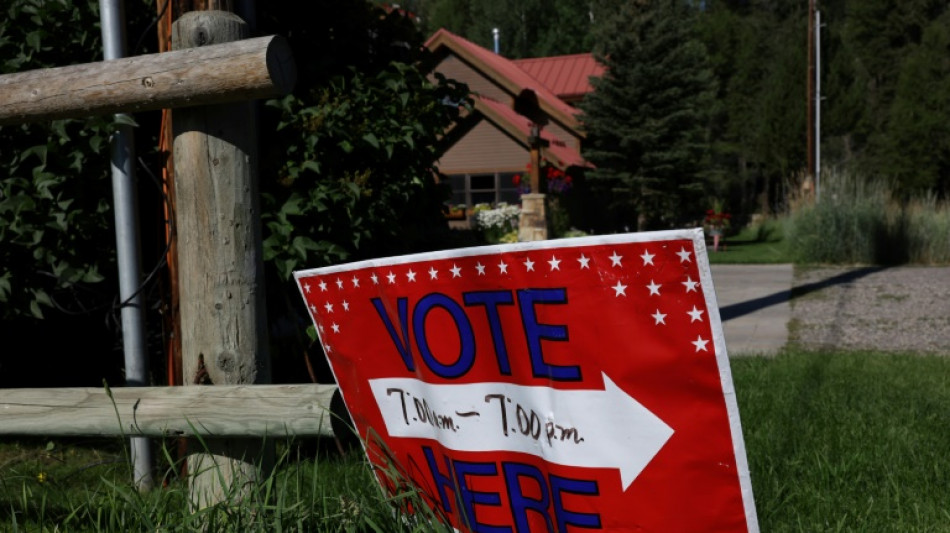
How dubious 'local news' sites are feeding US misinformation / Photo: ALEX WONG - GETTY IMAGES NORTH AMERICA/AFP/File

 Antonelli 'mad' about crash in Azerbaijan qualifying
 'Perfect lap' gives Russell pole for Azerbaijan GP as Antonelli crashes out
 UN Security Council condemns Houthi attacks on Saudi Arabia

 China swimmer makes Asian Games history as Thai wins 100m sprint

 Top French literary prize drops best-selling novel over AI claims

 US 'must choose' whether to end war: Iran president

 Pope warns against losing humanity in AI-driven 'paradise of machines'

 Pope warns against losing humanity in 'paradise of machines'

 From FBI warning to literary acclaim: the Russian journalist who took on Putin

 China swimmer in Asian Games first as North Korea lifters reign
 French literary prize removes novel from longlist after AI claims

 China's Zhang wins record seventh Asian Games swimming gold

 Verstappen edges Russell in final practice in Azerbaijan

 English, Spanish, Italian, German football leagues call for FIFA reform

 Pope arrives in France on first official visit in 18 years

 Pope arrives in France on first state visit in 18 years

 Heavy fighting, internet disruption as Ethiopia conflict rages

 From transit to consumption: drug use surges in Mozambique
 Chicago teams, Guardians and Padres all book MLB playoff berths
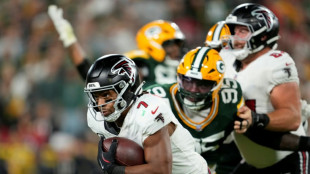 Bijan Robinson destroys Packers in 35-14 win for Falcons

 Harimoto hails new era as Japan dethrone table tennis kings China

 India rape cases turn focus back onto women's safety
 Rebellious Afghan taxi drivers defy ban on music
 Brazil candidates mount digital armies for fierce online campaign
 Nepal PM says floods 'a warning to the world' about climate change

When Elon Musk amplified a conspiracy theory about the hammer attack on US House Speaker Nancy Pelosi's husband, he joined the growing ranks of Americans routinely sharing misinformation published by dubious websites presenting themselves as local news outlets.
The new Twitter owner eventually deleted his tweet linking to the false article by the Santa Monica Observer, but millions had already digested and re-circulated a smear that went viral on Facebook and other social networks.
Many US voters seeking and sharing news about midterm elections may find themselves in both a desert and an ocean, only to be left in a fog.
"Fewer journalists means more opportunities for conspiracy theories without any check at all," said Daniel Kreiss, a University of North Carolina (UNC) political communication professor.
Hundreds of newspapers have shuttered since the start of the Covid-19 pandemic, but there are plenty of imitators popping up in their stead.
The Santa Monica Observer received a trust score of just 12.5 out of 100 on media monitor NewsGuard's rating scale last year, being described as: "Another example of a publisher producing unreliable content under the guise of local news."
The site, according to NewsGuard, has published numerous conspiracy theories and false and misleading claims about politics, vaccines and the pandemic.
A Northwestern University report in October revealed the huge newspaper dropoff. It also showed more than a fifth of Americans live in "news deserts" or in communities at risk of losing local outlets.
Most of the sites filling the gaps make little or no attempt to show balance or be transparent. NewsGuard flagged many of them as failing to meet "basic journalistic standards."
"People say there is no shortage of information -- there's news on my phone, there's news anywhere," said Steve Waldman, president of Report for America, a non-profit group that deploys journalists to news organizations nationwide.
But Waldman and other experts say the relative deficit of credible reporting -- about one in four US newspapers has disappeared since 2005, and another third are likely to be gone by 2025 -- makes it harder for voters to separate fact from fiction.
"People are repeating and sharing the most outrageous and nonsensical information imaginable," said Les High, former publisher of the Whiteville News Reporter in eastern North Carolina and founder of a nonprofit news site called the Border Belt Independent.
"It's awfully hard to have a democracy when nobody can discern the truth."
- Masquerading as neutral -
More than 1,200 outlets that Kreiss of UNC described as "thinly veiled actors posing as neutral news websites" have cropped up in the past few years, according to researchers at Columbia University's Tow Center for Digital Journalism.
Priyanjana Bengani, a senior research fellow at the center, said most of the sites are not transparent.
"They don't always say they are funded by advocacy groups," she noted.
Both sides of the political divide are involved, issuing news articles that are little more than campaign pitches for local Democrat and Republican candidates.
The sites get readers by delivering content in paid ads on social media platforms, which allow targeting of specific groups by geography or demographics. This can mislead readers into thinking the articles are "organic" content from established news outlets, researchers say.
NewsGuard said in a report in October that millions of dollars are being poured into such ads for the midterms, notably on Facebook and Instagram.
"These pseudo-newsrooms have taken advantage of Meta's low costs, hyper-targeting tools and porous policies related to political ad spending to target voters in battleground states while underplaying or entirely hiding their partisan-driven agendas and financing," NewsGuard said, referring to the owner of Facebook and Instagram.
- Filtering misinformation -
Recent research by the nonprofit Reboot Foundation, which focuses on media literacy, found just 28 percent saying they felt very confident in their ability to filter election misinformation, a finding that suggests US voters are primed to fall for misleading or one-sided political narratives.
Roughly half get at least some of their news from social media sites, according to a 2021 Pew Research Center report. An estimated 10 percent get news from TikTok, according to a separate Pew report, and some six percent get news from "alternative" platforms such BitChute, Parler and Truth Social.
Penelope Abernathy, a lead researcher for Northwestern's news deserts study, said social media fundamentally changes the nature of the news people consume, fueling partisanship.
"What appears on your feed may be posted by a friend or determined by algorithm, and this tends to favor (content) designed to inflame passions," she said.
P.L.Madureira--PC