Sinking Alexandria faces up to coming catastrophe / Photo: Khaled DESOUKI - AFP

 Antonelli 'mad' about crash in Azerbaijan qualifying
 'Perfect lap' gives Russell pole for Azerbaijan GP as Antonelli crashes out

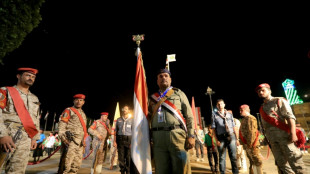 UN Security Council condemns Houthi attacks on Saudi Arabia

 China swimmer makes Asian Games history as Thai wins 100m sprint

 Top French literary prize drops best-selling novel over AI claims

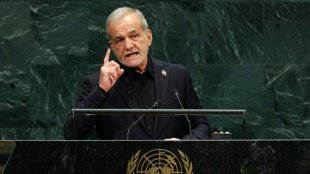 US 'must choose' whether to end war: Iran president
 Pope warns against losing humanity in AI-driven 'paradise of machines'

 Pope warns against losing humanity in 'paradise of machines'

 From FBI warning to literary acclaim: the Russian journalist who took on Putin
 China swimmer in Asian Games first as North Korea lifters reign
 French literary prize removes novel from longlist after AI claims

 China's Zhang wins record seventh Asian Games swimming gold

 Verstappen edges Russell in final practice in Azerbaijan

 English, Spanish, Italian, German football leagues call for FIFA reform

 Pope arrives in France on first official visit in 18 years

 Pope arrives in France on first state visit in 18 years

 Heavy fighting, internet disruption as Ethiopia conflict rages
 From transit to consumption: drug use surges in Mozambique
 Chicago teams, Guardians and Padres all book MLB playoff berths
 Bijan Robinson destroys Packers in 35-14 win for Falcons

 Harimoto hails new era as Japan dethrone table tennis kings China
 India rape cases turn focus back onto women's safety

 Rebellious Afghan taxi drivers defy ban on music

 Brazil candidates mount digital armies for fierce online campaign
 Nepal PM says floods 'a warning to the world' about climate change

Alexandria, Egypt's fabled second city and its biggest port, is in danger of disappearing below the waves within decades.
With its land sinking, and the sea rising due to global warming, the metropolis Alexander the Great founded on the Nile Delta is teetering on the brink.
Even by the United Nations' best case scenario, a third of the city will be underwater or uninhabitable by 2050, with 1.5 million of its six million people forced to flee their homes.
Its ancient ruins and historic treasures are also in grave danger from the Mediterranean.
Already hundreds of Alexandrians have had to abandon apartments weakened by flooding in 2015 and again in 2020.
Every year the city sinks by more than three millimetres, undermined by dams on the Nile that hold back the river silt that once consolidated its soil and by gas extraction offshore.
Meanwhile, the sea is rising.
The Mediterranean could rise a metre (3.2 feet) within the next three decades, according to the most dire prediction of the UN's panel of climate experts, the IPCC.
That would inundate "a third of the highly productive agricultural land in the Nile Delta", as well as "cities of historical importance, such as Alexandria", it said.
- Third of city could go -
UN experts say the Mediterranean will rise faster than almost anywhere else in the world.
"Climate change is a reality and no longer an empty threat," said Ahmed Abdel Qader, the head of the authority protecting Egypt's coastline.
Even under the best-case scenario outlined by other Egyptian and UN studies, the Mediterranean will rise 50 centimetres by 2050.
That would leave 30 percent of Alexandria flooded, a quarter of the population having to be rehoused and 195,000 jobs lost.
Such a catastrophe will have dramatic repercussions for Egypt's 104 million people because "Alexandria is also home to the country's biggest port" and is one of the main hubs of the economy, Abdel Qader said.
Across the Delta, the sea has already advanced inland more than three kilometres since the 1960s, swallowing up Rosetta's iconic 19th-century lighthouse in the 1980s.
All this is happening as Alexandria's population is exploding, with nearly two million more people arriving in the last decade, while investment in infrastructure, as elsewhere in Egypt, has lagged.
The city's governor, Mohamed al-Sharif, said the drainage system for its roads was built to absorb one million cubic metres (35 million cubic feet) of rain. But with the more violent storms that have come with climate change, "today we can get 18 million cubic metres falling in a single day".
The changing climate is also playing havoc with Alexandria's weather, which can veer from unseasonal heat to snow.
"We have never experienced such heat at the end of October," resident Mohamed Omar, 36, told AFP, with the temperature rising to 26 degrees Celsius (78.8 Fahrenheit), five degrees above normal.
- 'Lost beneath the waves' -
The looming threat has also been a hammer blow to the image of a city that likes to celebrate its cosmopolitan golden age at the start of the 20th century, with its art deco cafes and elegant avenues of Paris-style apartment buildings.
Many Egyptians were horrified when Britain's then-prime minister Boris Johnson warned that Alexandria was at risk of being lost "beneath the waves" at the COP26 climate change conference in Glasgow last year.
"Yes, the threat exists and we don't deny it, but we're launching projects to attenuate it," Abdel Qader said.
A huge belt of reeds is being planted along 69 kilometres of coastline. "Sand sticks around them and together they form a natural barrier," he said.
Alert mechanisms and wave measuring systems are also soon to be put in place, Abdel Qader added.
- Treasures in jeopardy -
Alexandria's rich and ancient heritage is particularly vulnerable. Most exposed is the 15th-century Mamluk citadel of Qaitbay, built on a neck of land that was once the site of the Lighthouse of Alexandria, one of the seven wonders of the ancient world.
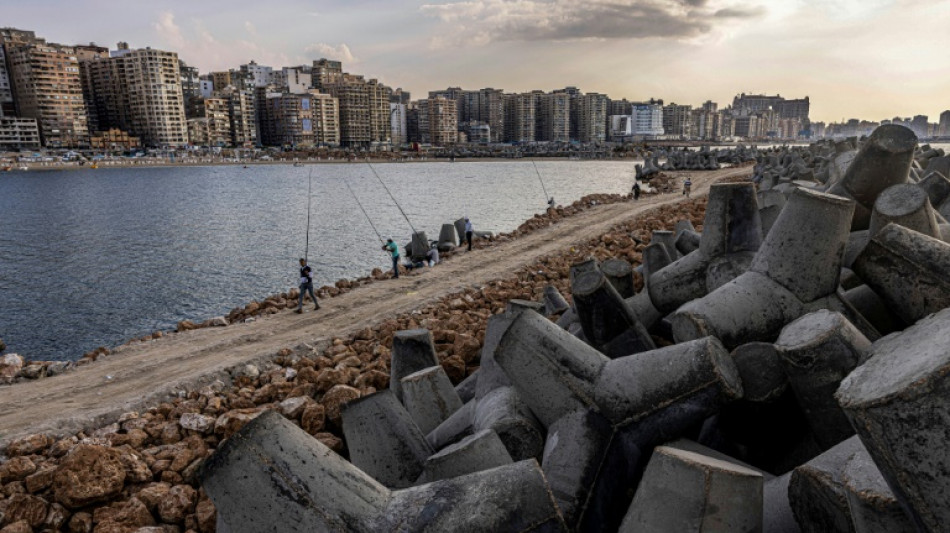
Lashed relentlessly by the sea, a breakwater made up of 5,000 huge concrete blocks has been installed to protect it.
More have been put in place to limit damage to the 19th-century corniche.
Destruction and rebuilding is nothing new to a city that once was home to the Library of Alexandria, the world's greatest temple of knowledge until it was accidentally burned by Julius Caesar's troops.
Neither its modern heir, a gleaming edifice on the corniche tilting like a solar disc toward the Mediterranean, nor the rest of the city can be left to a watery grave, Abdel Qader insisted.
"The West has a moral responsibility: it must help to counter the negative effects of climate change, which are the result of its civilisation" and industrialised model.
And Egypt will be hammering that message home when the UN COP27 climate talks open there on November 6.
V.F.Barreira--PC