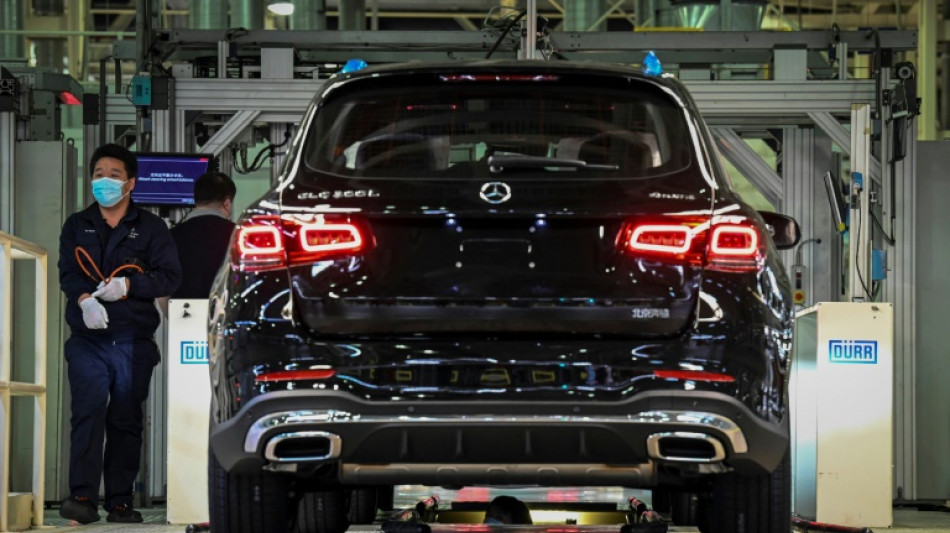
Germany wrestles with economic dependence on China / Photo: Jade GAO - AFP/File

 Assefa seeks 'better than my best' at Berlin marathon
 US court refuses to overturn Pentagon ban on Anthropic

 Verstappen and Norris blame slow cars as Mercedes tops qualifying

 Crowds cheer pope in Paris after AI 'paradise of machines' warning

 Teen swimmer makes Games history as Thai, Chinese sprinters win gold
 Man City found guilty of 114 Premier League charges - reports
 Concerns over 'missing' UK explorer Ranulph Fiennes
 Suspected Paris killer of Argentine rugby star begs forgiveness

 Oil prices fall on cautious hopes for US-Iran progress

 Noskova, Muchova take Czech Republic into BJK Cup final
 Thai sprinter Puripol breaks own Asian Games record to win 100m gold
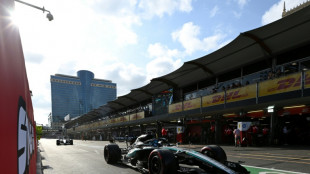 Russell takes pole for Azerbaijan GP, Antonelli crashes out
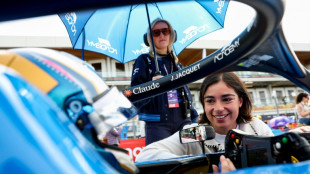 Williams boss hails Chadwick as F1 inspiration for women
 World No.1 Sinner delays return with China Open withdrawal
 South Lebanon children return to school destroyed by Israel strike

 Jewish group urges Berlin far-left vote winners to tackle antisemitism
 European stock markets climb as oil prices drop

 Trump accuser E. Jean Carroll finally has her damages
 Germany's Havertz, Musiala ruled out of Greece match with injury
 Ireland's Gaza stance spills from Eurovision into football
 Welcome aboard the Costa Serena, the Asian Games floating hotel

 Asian markets mixed after recent oil surge

 Cash for nature protection: hotelier's offer to Principe islanders

 US miner KoBold bets on AI to gain edge in DR Congo mineral hunt

 Internet disrupted in Ethiopia as conflict rages

As Chancellor Olaf Scholz travels to Beijing, policymakers and businesses at home are grappling with an existential question: how can they reduce their reliance on China and can they survive without the world's second-largest economy?
- Massive exposure -
The Russian invasion of Ukraine and the upheaval caused in Germany by breaking off economic ties with Moscow has cast a new light on Berlin's relationship with another autocratic regime.
China, where German industrial groups turn a sizeable chunk of their profits, has been Berlin's biggest trading partner for the past six years, with goods worth 246 billion euros ($243 billion) passing back and forth between the two countries last year.
Around 104 billion euros of that growing business were accounted for by the auto, chemical and manufacturing sectors -- the backbone of German industry.
In the first half of 2022, direct investments in China reached a record of approximately 10 billion euros, according to a study by the IW economic institute.
More than 5,000 German businesses are active in China, including such heavyweights as Volkswagen and Siemens, as well as large number of smaller businesses from the "Mittelstand".
Another major dependence is in the area of rare earth minerals, such as lithium, cobalt and magnesium, desperately needed in Europe for the production of key technologies like batteries.
- Awakening -
Any "naivety" in relations with China was "over", German Economy Minister Robert Habeck said in September. Even liberal Finance Minister Christian Lindner has called on businesses not to rely too much on China amid increased tensions with Beijing.
Before heading to Beijing, Scholz sketched out the contours of his China strategy in an newspaper op-ed. Germany should "reduce one-sided dependencies" on China, while keeping a sense of "proportion and pragmatism", he said.
"There are a number of German businesses who see China above all as a competitor and not as a potential market," said Tim Ruehlig, a China expert at the German foreign policy institute DGAP.
Since 2019, the BDI German industrial lobby defined China as a "systematic rival" and not just a partner, before the European Union moved to do the same.
- Resistance -
The heavyweights of the German economy are the most reluctant to change their approach towards China.
"Some big businesses are continuing to increase their presence considerably," said Juergen Matthes of the IW economic institute in Cologne.
The three big auto manufacturers -- Volkswagen, BMW and Mercedes-Benz -- as well as the chemical group BASF, together accounted for a third of all European investments in China between 2018 and 2021, according to a recent study by the Rhodium group.
In 2021, 40 percent of Volkswagen's revenues came from China. At sportswear group Adidas, the figure was 21 percent, and for Siemens it was 13 percent.
"More dialogue" was needed with China, the former CEO of Volkswagen Herbert Diess said earlier this year, noting his concern at the tack being taken by the German government.
Last week, the head of BASF Martin Brudermueller, who will travel with Scholz, warned against "China bashing" and said the chemicals giant would build its business in the country as its European operations come under pressure from inflation.
Breaking off trade ties with China would be "foolish" in the current economic context and without any "suitable alternative", said the BVMW federation of small and medium-sized businesses.
- Economic levers -
"Nobody is asking for a complete decoupling (from China)", said Ruehlig, but it would be possible to "tackle dependencies in a targeted way".
Policymakers in Berlin could lean on businesses by limiting or withdrawing investment guarantees that have smoothed their entries into China. The risk and any unexpected costs would then rest wholly with the business, notably in cases where technologies were transferred to China.
Public lenders such as KfW could target their loans to other Asian countries such as Indonesia or Thailand.
"Diversification is essential. More trade with other countries, especially those that are growing dynamically in Asia," said Matthes.
At the same time, Germany could weather some turbulence in the bilateral relationship. Only "three percent of jobs" depend directly or indirectly on trade with the Asian giant, he said.
G.Machado--PC