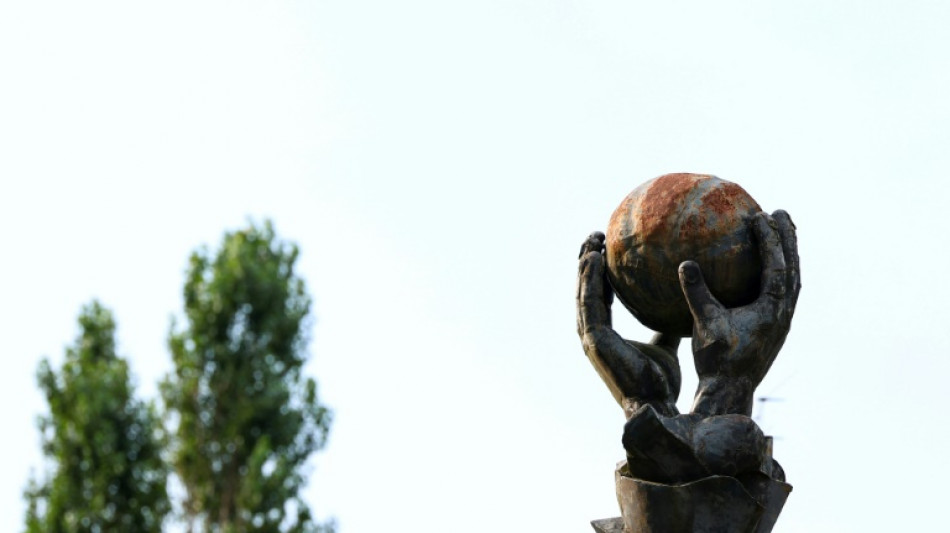
Ancient game feeds Georgia's rugby DNA / Photo: GIORGI ARJEVANIDZE - AFP

 Director Russell Goldman on 'Sender': The Dreary Psychology of Online Shopping

 ALIX LASERS GERMANY TAKES OVER CUSTOMER CARE FOR ALL ALIX LASERS AUSTRIA CUSTOMERS

 Monomark Engineering and Matangi Rubber IPOs to Open in Early December

 Avenging the Ancestors Coalition Sues Trump Administration Over Slavery Exhibit Changes

 Malta's Chris Bonett Named Among Maritime Industry's 'Men of Influence'

Georgia's presence at their sixth successive Rugby World Cup since 2003 is a remarkable achievement given that they only joined the International Rugby Board (now World Rugby) in 1992 after the dissolution of the Soviet Union.
It should not be a surprise, however, given that Georgian DNA is suffused with the rough and tumble of the ancient game of Lelo Burti, which translates as 'Field Ball'.
This brutal folk game has no limit to the number of participants or the match time. Nor is there a referee: none is needed when there are so few rules.
It is still played occasionally in rural parts of the country such as the village of Shukhuti in the western region of Guria where the annual match commemorates a battle victory by the Gurians over the Ottomans.
Every Easter, the village splits into Upper and Lower Shukhuti with the two teams competing to carry the black leather 16-kilogramme handcrafted and soil-filled ball to their side of the village.
A local priest kicks off the action by throwing the ball into the crowd from the steps of a church. Players form a massive scrum spreading throughout the village for hours, the kind of contest that is meat and drink to the likes of Pau pair Guram Papidze and Beka Gorgadze.
The winners carry the ball to a cemetery and place it to the grave of a villager who passed away during the previous year.
The rise of Georgian rugby in the 21st century has been breath-taking with crowds in their thousands turning up to matches in Tblisi.
In deference to the ancient game, the word 'lelo' has come to mean 'try' in rugby and the national team are nicknamed The Lelos.
They are now ranked seventh in Europe, and 11th in the world, and last November produced their best result ever with a 13-12 win over Wales in Cardiff.
With so many playing in France's Top 14 -- there is barely a side without at least one Georgian prop while Lyon's Davit Niniashvili is a superstar in the making -- there will come a time soon when the Lelos are regularly challenging the established order.
They have yet to make it out of the pool stage at a World Cup and they will face a tough task again this time around, although the indifferent form of both Wales and Australia will give them some hope.
They open against the Wallabies before taking on Portugal and Fiji, whose win over England at Twickenham suggests they will also provide an awkward afternoon.
Georgia will then use that Cardiff result as evidence that they can flourish against Wales once again when they meet in their final pool game in Nantes on October 7, perhaps with a place in the quarter-finals at stake.
++ Ahead of the Rugby World Cup in France, Agence France-Presse asked 20 aspiring photographers from each country qualified for the competition to show one aspect of the rugby union culture in their homeland, with the help of Canon cameras who are sponsoring the tournament. From Namibia to Fiji via Georgia and Scotland this photo essay gives us a glimpse of the core values of rugby on five continents.
M.Gameiro--PC