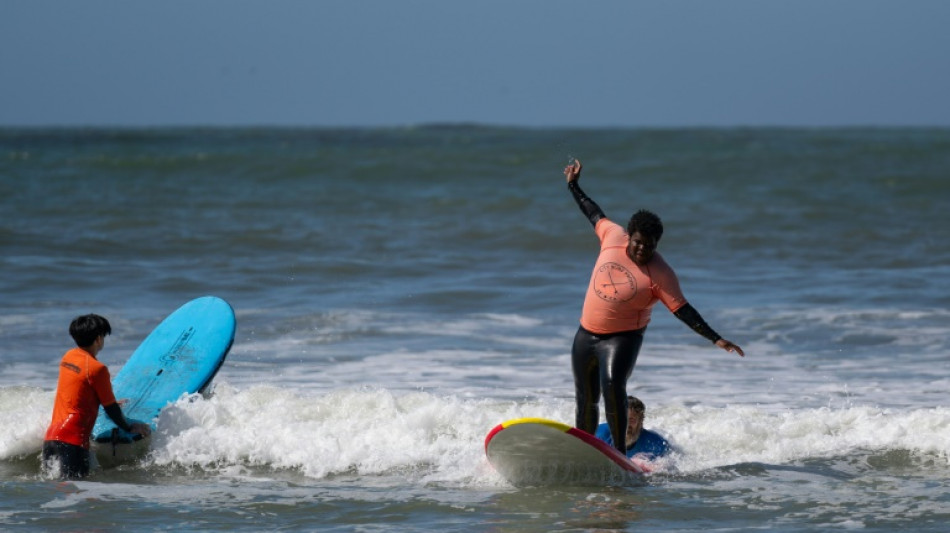
Catching a break: Inner city Californians try surfing / Photo: Loren Elliott - AFP

 J-VISIONS Vol. 4 Now Online: Read English Articles on Japanese Corporate IR

 In DR Congo streets, ex-hoods get tough on litter -- and locals

 Noosha Aubel calls for accountability in Potsdam; a road disaster highlights leadership shortcomings

 Surfer hospitalised after shark attack in Western Australia

 South Korea says 'serious shortage' of rooms with Asian Games days away

 Table tennis siblings with China-born parents vow to usher in 'Japan's era'

 Bougainville leader says violence won't stop Panguna mine re-opening

 South Korea aims to save seniors lost in digital age

 Russia's Stalin-admiring provincial leader waging an ultra-conservative crusade

 Marcelo Gallardo appointed as new Ecuador head coach

 'Widow's Bay' and 'The Pitt' tipped for success at Emmy Awards

 For club and comfort: Rodman makes it to Shelton's US Open final

 Houthis say Saudi Arabia launched over 50 strikes against them in 24 hours

 'Fed up': Thousands march against Sinaloa Cartel violence

 Controversial Zverev: from tennis nearly-man to multiple Grand Slam winner

 Swedish left-wing cheers far-right decline amid tight election race

 Yamal double helps Barca beat Levante, Atletico triumph

 Sassuolo stun Juve, Lobotka eases pressure on Allegri with Napoli winner

 Bills beat Texans and Ravens roll Colts in NFL openers

 US fight off spirited France to win 12th World Cup

 Drivers give cool reception to new Madring circuit

 Maresca makes flawless Man City start to leave Man Utd trailing

 Dozens arrested in major anti-LGBTQ raids in Turkey

 Leftwing opposition seen leading Sweden election, far-right losing ground

 Senegal goalkeeper Mendy retires from international football

As Dianne Finez helps her Latino and African American students through their first surf lesson, she remembers the time she first took to the waves, trying out a sport she barely even knew existed.
The 20-year-old of Filipino descent grew up 30 minutes' drive from the beach in a working class neighborhood of San Francisco.
"I never knew surfing was an actual thing," she told AFP.
"It was also hard to get into the sport just because there's mostly white males."
Finez is one of more than 2,000 young people who have been introduced to the waves by City Surf Project over the last decade.
The association works with schools in working-class neighborhoods of San Francisco, where the bulk of the student population is Hispanic or African American.
- Cultural assumptions -
The organization offers long-term partnerships with schools that allow educators to tailor their programs.
But it also provides necessary practical help, like free use of equipment and transport to get students to and from the beach.
Unlike in the Hawaiian societies of yesteryear where surfing originated, the California coast today is largely the preserve of the wealthy -- the result of segregation and expropriation of minorities.
"When you look at who lives on the coast, it's usually affluent, white communities," says Andrew Perry, the City Surf Project's program manager.
"When you're a kid that lives almost two hours by bus from the beach, and then you've got to bring a surfboard on the bus, it is a monumental effort... as opposed to the person that lives two blocks from the beach and grew up there."
The cost of the sport is a limiting factor for many -- $300 for a wetsuit, $800 for a new board, and $200-a-day lessons.
That's where the organization's equipment loans come in handy, says Perry.
But it's not just the practical obstacles -- there are also cultural assumptions within the communities they are trying to reach, with what Perry calls a "generational stigma around swimming in the ocean" for working class families who live inland.
"A lot of the times kids are growing up viewing it as a really scary place," he said.
- 'Laid back' -
That's a familiar idea for Trew Gantt, an African American whose mother was terrified by the ocean.
"I was allowed to go to pools on my own, but not to the beach," he said.
"Everybody around me was telling me the ocean is cold and dangerous. Surfing just seemed unrealistic, unless you lived someplace tropical."
But after his first taste of life on a surfboard with the program, he was bitten, and now he works as an instructor, delighting in showing his young charges they should not be afraid of the water.
He credits the sport with keeping him out of trouble during his teenage years, and helping him remain on an even keel.
"Surfing taught me to be a lot more laid back and made me understand that I didn't need to impress anybody," he said.
And that's something that educators have noticed as well.
The ocean "is this force beyond measure that is good for us," says high school teacher Sara Kosoff.
"And so I think that students of color need access to that equally, if not more than white students."
V.Dantas--PC