Winter Olympics threatened by climate change, says report

 US warns of rapid escalation in Mideast war

 Iran 'put hearts on the court' to win Asian Games basketball bronze

 School girl Yu helps China dominate in Asian Games swimming openers

 Myanmar win first Asian Games teqball gold as Spain great Puyol watches

 China's 13-year-old Yu scorches to first major gold at Asian Games

 Russians vote on last day of parliamentary elections

 Hong Kong pays final respects to former city leader Tung

 Typhoon put people off Asian Games opening ceremony, official says

 China's 13-year-old Yu cruises as Asian Games swimming begins

 AI 'warning shots' focus Beijing on national security risks

 Philippine tribe in limbo over US-led tech hub

 Leo XIV, first US pope transcends his restrained style

 Singer Ed Sheeran says Gaza situation 'unjustifiable' following controversy

 In 'Tenzing', a Sherpa mountaineer gets his due

 Ed Sheeran set to return to stage after Palestinian controversy

 Toulouse edge Vannes, Lyon beat Pau to take Top 14 summit

 Germans arrested for Louvre stunt in Mona Lisa hall

 Saudi-led coalition says Houthis fired ballistic missile at Riyadh

 France's debt climbs to highest since 1978: ministry

 McIlroy two shots off the lead at Wentworth after eagle on 18

 Martinez brace saves Inter in Serie A top-two clash with Roma

 Rosenior abused but guides Paris FC past old club Strasbourg

 Seven-try Lyon beat Pau, climb to Top 14 summit

 Brighton defeat a 'big lesson' against complacency for Arsenal, says Arteta

 Thousands protest inaction over climate crisis in Switzerland

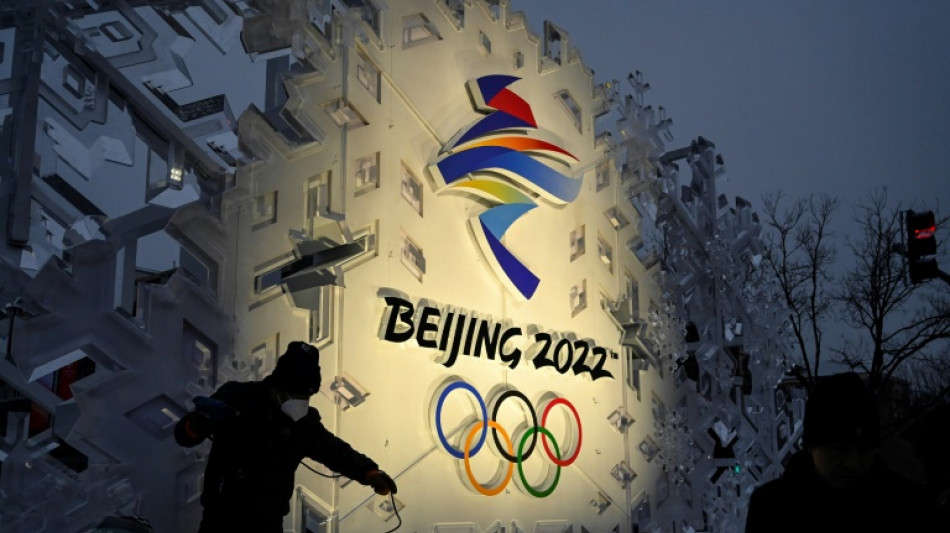
Climate change is threatening the future of the Winter Olympics, reducing the number of suitable venues for the event around the globe, a report warned ahead of the Beijing Games.
The Olympics in China, which start on February 4, will be the first Winter Games to rely almost 100 percent on artificial snow, according to the study.
"Slippery Slopes: How Climate Change is Threatening the Winter Olympics", was produced by the Sport Ecology Group at Britain's Loughborough University and the Protect Our Winters campaign group.
It says more than 100 snow generators and 300 snow-making guns are working flat out to cover the ski slopes of the 2022 Winter Olympics in artificial snow.
The authors say it is an energy and water-intensive process frequently using chemicals to slow melt, but also delivers a surface that many competitors say is unpredictable and potentially dangerous.
"The risk is clear -- man-made warming is threatening the long-term future of winter sports," the report says. "It is also reducing the number of climatically suitable host venues for the Winter Olympiad."
"The 2022 Winter Olympics will, no doubt, be an awesome spectacle –- watched and enjoyed by millions worldwide," it adds.
"But they should also provoke a debate about the future of snow sports, and the limits of engineering artificial natural environments. Slippery slopes lie ahead."
Of the 21 venues used for the Winter Games since Chamonix 1924, scientists believe that by 2050 only 10 will have the "climate suitability" and natural snowfall levels to host an event.
Chamonix is now rated "high risk" along with venues in Norway, France and Austria, while Vancouver, Sochi and Squaw Valley in the United States are deemed "unreliable".
British freestyle skier Laura Donaldson, who competed at the Salt Lake Games in 2002, warned in the report of the dangers to athletes.
"If freestyle super pipes are formed from snowmaking machines in a poor (natural snow) season, the walls of the pipe are solid, vertical ice and the pipe floor is solid ice," she said.
"This is dangerous for athletes -- some have died."
Two-time Canadian Olympian Philippe Marquis raised concerns about the increase in injuries caused by the lack of practice on snow and voiced environmental fears.
"Athletes feel the urge to push their limits even if the conditions are suboptimal," said the freestyle skier.
"The conditions are definitely more dangerous than what we've seen before."
Former British Olympic snowboarder Lesley McKenna added: "I have cherished the last three decades in snow sports. But I harbour mounting fears for where we could be in another 30 years' time."
S.Pimentel--PC