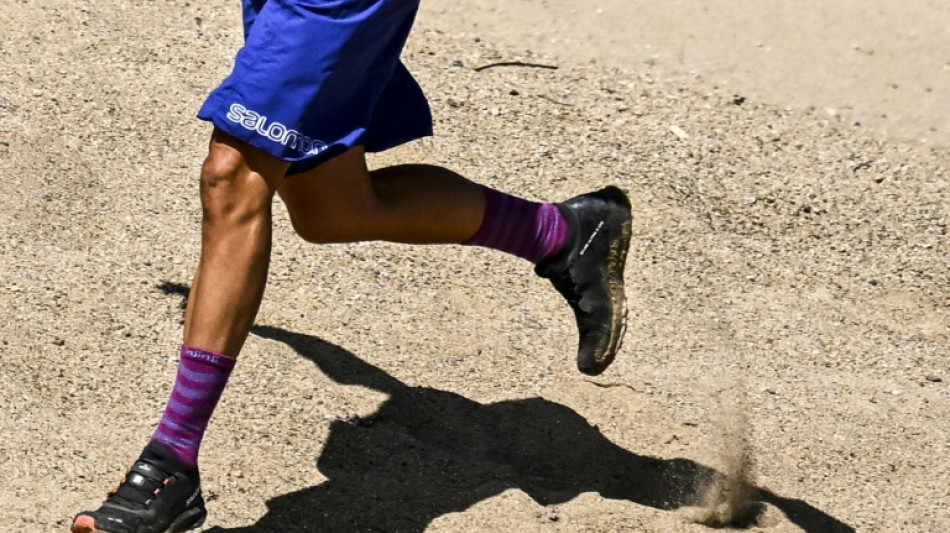
How hunting may have turned humans into long-distance runners / Photo: CHANDAN KHANNA - AFP/File

 'New one' Klopp promises fresh approach as Germany reign begins

 Milne returns to New Zealand squad for India T20 series
 US-led Americas coalition backs sanctions against crime groups

 'Star Wars' fans and art lovers line up for new Lucas museum

 Trump renames AI 'super intelligence' as leaders jostle over dangers

 Oil prices retreat as markets welcome US-Iran talks

 US refusing to give Sudan's de facto leader visa for UN: diplomatic sources, UN

 Macron urges world to choose UN over 'law of the jungle'

 All-rounder Jacks stars as England beat Sri Lanka in 1st ODI

 Man City peg back Bayern to start Women's Champions League

 Trump beats 'America first' drum at UN as allies tread carefully

 Snedeker backs Spaun for Ryder Cup after Presidents snub

 French prosecutors probe secret filming of women with smart glasses

 Trump renames AI "super intelligence," rejects international oversight

 Trump rejects international regulation of AI

 How is the EU approaching record fuel prices?

 Sri Lanka's Colombage strikes on debut as England dismissed for 265 in first ODI

 Hurricane Polo strengthens to top category 5 off Mexico

 11 hurt as teen opens fire outside school in western Turkey

 UN chief says 'Big Oil' treats atmosphere as open sewer

 Tunisia says 2026 summer hottest on record

 England's Rashid out of Sri Lanka ODIs with hand injury

 Houthis accuse Saudi Arabia of deadly strikes as thousands flee

 Stocks climb as oil slides, AI buzz returns

 India cricketers win in style as Afghan savours 'special' Games silver

Researchers have discovered hundreds of historical accounts of humans hunting prey by chasing them down over long distances, which some believe is why we evolved our unique talent for endurance running.
While speedy animals such as cheetahs or antelopes may outrun us initially, over tens of kilometres humans can slowly chase them down partly thanks to our lack of hot fur and ability to sweat buckets.
Some scientists have even proposed that endurance hunting contributed to humans evolving bodies that are so different to other primates, which are not capable of long-distance running.
But the theory has been a matter of heated debate among scientists, with sceptics arguing that there are few historical examples.
Eugene Morin, an anthropologist at Canada's Trent University and lead author of a new study, told AFP that this form of hunting had long been "considered marginal".
But for the study, published this week in the journal Nature Human Behaviour, the researchers discovered many accounts "consistent with endurance hunting" dating from the 15th to the 19th centuries, he said.
- In the long run -
Compared to many animals, humans are poor sprinters. While some of us can cover 10 metres a second for around 20 seconds, cheetahs can run three times faster for several minutes.
But Morin said that a "cheetah is like a Ferrari without a radiator -- capable of hitting very high speeds but incapable of dissipating heat".
This means that cheetahs, horses, antelopes and other swift-footed animals have to completely stop running so they can bring their internal temperature down.
This is when we catch up.
Humans can do this partly thanks to our incredible talent for sweating, which brings our temperature down, allowing us to keep going.
We sweat 10 times the density of chimpanzees, our closest relatives. Marathon runners can sweat more than three litres of water an hour.
Also helping keep our temperature low is our lack of fur, another way major difference between humans differ and our primate relatives.
Biologists have also found that humans' skeletal muscles are mostly made out of fatigue-resistant fibres, which help with long-distance running.
And traits such as longer lower legs and larger joints suggest that the ancestors of humans were running long distances at least 1.8 million years ago, according to the study.
The endurance running theory, first proposed more than 40 years ago, posits that humans evolved these unique characteristics as an advantage for hunting down prey.
Sceptics have said that running would have spent far more energy than simply walking after prey.
Morin acknowledged that running does expend more energy, but said this cost was mostly offset by the amount of time it saved.
The researchers used modelling to demonstrate that the energy gained from the meat of successfully chased-down prey outweighed that spent while running.
- 'Relentless pursuit' -
The researchers searched for examples of endurance running in a database they assembled of more than 8,000 recently digitised accounts of hunting dating back to the 15 century.
They found nearly 400 examples from 272 places across the world, from the Arctic to Chile, Africa to Oceania.
In a text dating from 1850, Native Americans spoke of their ancestors hunting moose by running them down while wearing snowshoes.
"Our young men were strong in those days," the text said. "Now our young are... lazy and feeble," it added.
In another text, dating from the early 1500s, the Coahuiltecan people spoke of chasing down deer and elk in what is now California.
"This, of course, does not mean that they outsped them, but that in a relentless pursuit they wore down the endurance of the game," the text said.
Morin said these stories had been overlooked because when ethnographic research started to "become professional" in the 1800s, the emergence of guns meant persistence hunting was largely a thing of the past.
However it is still carried out today by the San people in Botswana, who can chase down antelopes until the animals collapse of exhaustion.
Cara Wall-Scheffler, a biologist at Seattle Pacific University who has been sceptical of the endurance hunting theory, told New Scientist that the new study was "super interesting".
But she also pointed out that endurance running is mentioned in only two percent of the accounts analysed by the researchers.
F.Santana--PC