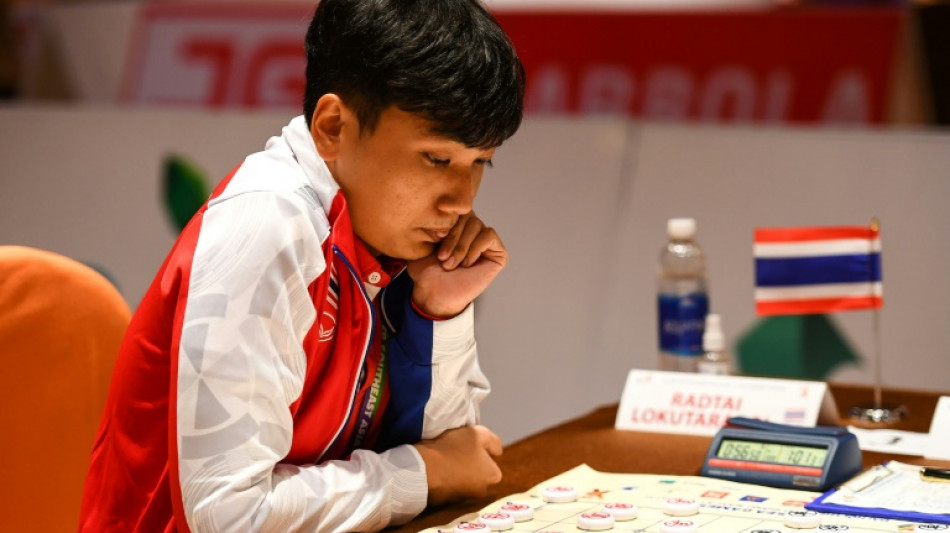
Chinese chess checks in with hushed SEA Games debut / Photo: Nhac NGUYEN - AFP

 Argentina to Return to World Rally Championship Calendar in 2028

 Newark Welfare Deficit Exceeds £140m Annually, Report Finds

 PUK Leader Declares Largest Political Crisis in Kurdistan Region History

 Digi Power X Reports Q3 2026 Revenue Up 85% and AI Revenue Up Over 400% Compared to Q2

 Ole Miss inquiry expands after video and monkey-noise allegations

 General Hospital actor Randall England dies at 75

 Boris Herrmann Claims Second Place in IMOCA Class at Route du Rhum

 Arlington sentinel rebukes Pete Hegseth entourage for laughter near memorial

 Kylie Jenner employee describes closet ordeal and pepper-spray incident

 Synchron Halts Clinical Trials of Second-Generation Brain Implant Due to Performance Issues

When Sim Yip How first came across xiangqi as a little boy he looked on mesmerised as grandmasters puzzled over the ancient Chinese game.
The 38-year-old Malaysian is now an SEA Games silver medallist in a pastime which, according to players at the regional competition, is growing in popularity.
Also known as Chinese chess, xiangqi is a two-player board game dating back thousands of years but it is making its debut at the SEA Games in Vietnam.
Hailing from the city of Kuching in eastern Malaysia's Sarawak state, Sim said he picked up the game at the age of seven after watching masters battle each other in matches.
"All the best players came from Kuching and at my father's coffee shop the Sarawak champions came and played," he told AFP at the SEA Games, where players silently peered at pieces over thick fabric boards.
"I idolised them when I saw them. I saw international grandmasters and I was like 'Wow, I want to be like them one day.'"
Its fans say that xiangqi is more complex than its Western counterpart.
While chess is played on an eight-by-eight grid, xiangqi's board is nine lines wide and 10 long, with pieces moved on the lines' 90 possible intersections.
It also makes use of terrain with a valley in the middle where certain units cannot cross, and a safe zone where a side's general, the critical piece, cannot leave.
Games last anything from 10-15 minutes in a "blitz" version to up to five hours.
Xiangqi's four medal events were possibly the quietest at the regional games, with almost no spectators at the hillside resort a three-hour drive outside Hanoi, aside from a few volunteers watching.
Despite a muted physical presence, Sim said the matches were viewed intently online and in Malaysia, where there are "thousands" of enthusiasts.
Originally limited to parts of East Asia, xiangqi today enjoys a growing global status, those at the Games say.
A biennial world championship has been played since 1991 and it made its Asian Games debut in 2010 in China.
In SEA Games host Vietnam, the country’s shared border and long history with China has made the game wildly prolific here, game arbiter Quach Phuong Minh said.
"Each province, each city (in Vietnam) has events for children," the 34-year-old, who started playing when he was just six, told AFP.
With the game set to return at the SEA Games next year in Cambodia, Minh predicts more pick-up "in just a few years".
"It’s not only for old people," he added.
A.Magalhes--PC