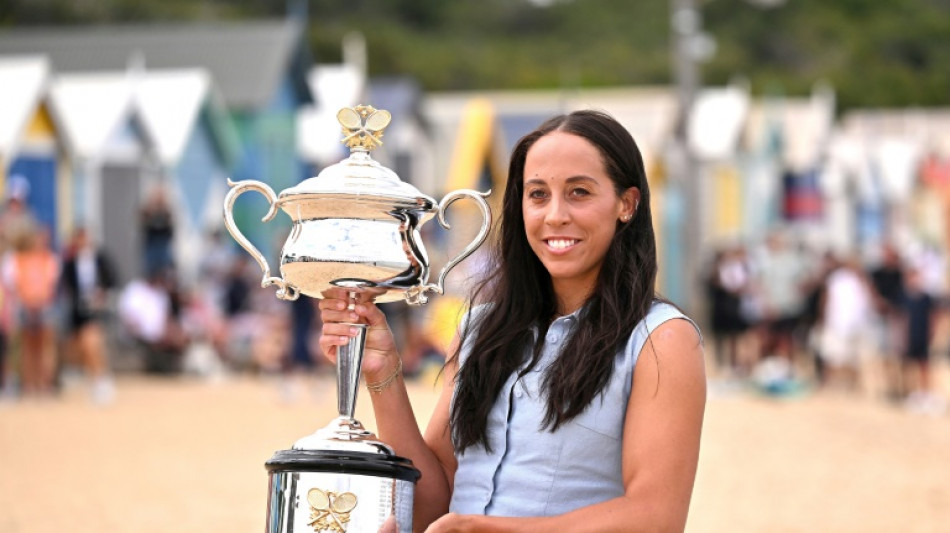
How Keys banished fear of failure to shine on the Grand Slam stage / Photo: WILLIAM WEST - AFP

 Thanksgiving storms disrupt thousands of US flights
 T.J. Lang criticises Aaron Rodgers over comments about Mike McCarthy

 Qatar Tourism and Uber Sign Five-Year Mobility Partnership
 U2 pays tribute to Dolly Parton during Thanksgiving Eve NFL show
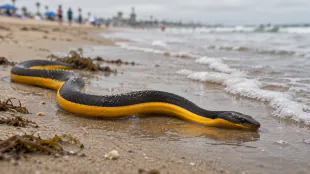 Rare yellow-bellied sea snake found on Southern California beach

 Second-generation Mini Cooper SE set for India launch with 402km range

 Filmasia 2026: 16 Films Across Prague, Brno, and České Budějovice

 Kojey Radical Launches Burger Collaboration at Dallas Burger Joint in Shoreditch

 Kelly Stafford Reflects on Matthew's Lions Thanksgiving Era Ahead of Rams' Netflix Debut

Being told you will be a future world number one at the age of 14 is an extremely tough burden for any young athlete to carry -- just ask Madison Keys.
In a sport where success is measured in major trophies, it took the American another 15 years after winning her first WTA Tour match as a young teenager to become a Grand Slam champion.
She reached her first Slam semi-final in 2015 at Melbourne while still only 19.
Her first major final came two years later in New York, where nerves and fear engulfed her as she froze to be routed 6-3, 6-0 by Sloane Stephens.
On Saturday she finally broke out of her mental shackles by beating Aryna Sabalenka 6-3, 2-6, 7-5 in an instant classic on Rod Laver Arena.
To do it, Keys had to overcome the demons eating away at her for years, constantly nagging that she was a failure. But how?
"Lots of therapy," she candidly admitted.
Keys always had the complete game from a young age: a great serve, quick feet, punishing groundstrokes and comfortable at the net.
But she could not rid herself of the anguish-inducing thought that she was letting down everyone around her by not winning one of tennis's greatest prizes.
- Tough times'
"Everything kind of happens for a reason," Keys said.
"For me specifically, I kind of had to go through some tough things.
"It just kind of forced me to look at myself in the mirror a little bit and try to work on the internal pressure that I was putting on myself."
Her Slam defeats -- one final, five semi-finals and four quarter-finals -- hit her hard, and it took years to convince herself she was not a failure, that her life in tennis had not been wasted.
"I felt like from a pretty young age, I felt like if I never won a Grand Slam, then I wouldn't have lived up to what people thought I should have been," said Keys.
"That was a pretty heavy burden to kind of carry around."
Last year, she curtailed her season early and married her coach Bjorn Fratangelo in November on what she called "the best day of my life".
Crucially, she was ecstatically happy and at last at peace.
"I finally got to the point where I was proud of myself and proud of my career, with or without winning a Grand Slam," Keys said.
Keys returned to the circuit after Christmas with a bang.
She won the Adelaide International before Melbourne and is on a 12-match unbeaten streak, during which she beat five top-10 players, including the top two, and won eight matches in three sets.
- 'I fully trusted myself' -
She will be world number seven in the new rankings on Monday, equalling her 2016 career-high achieved when she was just 20.
On February 17, she will celebrate her 30th birthday with husband Bjorn, the Australian Open ticked off and a contented mind.
"I finally got to the point where I was OK if it didn't happen," she said.
"I didn't need it to feel like I had a good career or that I deserved to be talked about as a great tennis player."
Her new outlook equipped her to "go for it" and break the Sabalenka serve for victory, just as the Saturday's final seemed to be heading for the nerve-shredding lottery of a final-set tiebreak.
"In the past, if I ever had nerves came up, I typically would not play as well. I started really buying into I can be nervous and I can still play good tennis. Those things can live together," she said.
Just as in beating number two Iga Swiatek in the semi-final, her new fearlessness paid off.
"I just kind of said to myself: OK, no matter what, there's a match tiebreak, you're still in this, just," said Keys. "I mean, just go for it."
She then prevailed by doing something that wouldn't have happened in all those previous years.
"I just fully trusted myself."
A.S.Diogo--PC