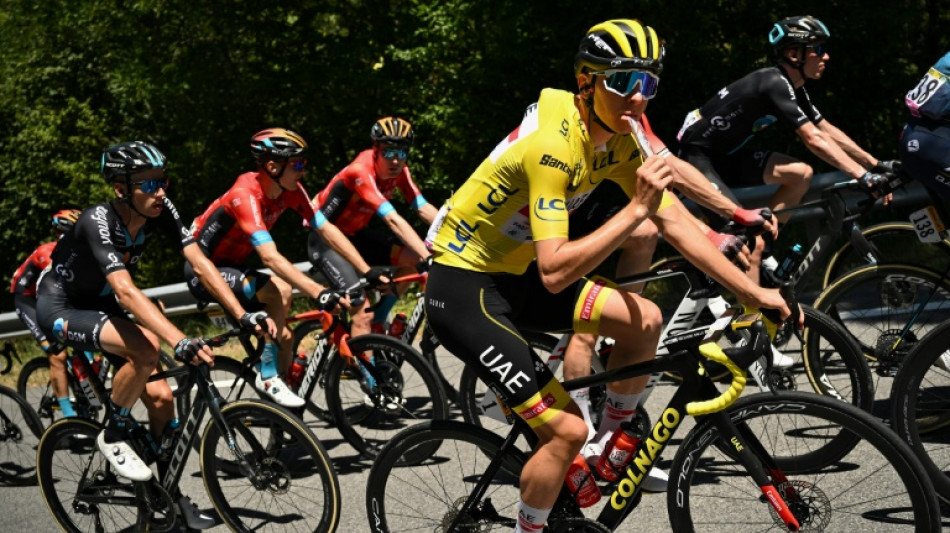
'Starvation' days over as cyclists prepare to gorge on Tour de France / Photo: Marco BERTORELLO - AFP/File

 'The ber months': Christmas arrives early in the Philippines

 N. Korea calls Russia bridge a sign of tighter ties
 US sanctions threaten to crush Iranian students' dreams
 Former champ Gauff holds off Jovic to reach US Open quarter-finals

 Osaka seeks answers to nagging achilles injury after US Open exit
 Flight data recorders recovered from Amazon cargo plane crash
 Super Bowl rematch kicks off NFL season as league expands global reach

 Alcaraz faces Shelton in blockbuster US Open quarter-final

 Trump threatens sales in US of Canadian aircraft maker Bombardier
 Eiffel Tower closed in row over women removed for Hindu group
 Willemse replaces Kolbe for Springboks' All Blacks series decider

 Zheng shocks Swiatek in another incredible US Open comeback

 Andreeva survives in three sets against Potapova
 Alleged killers of Australian, US surfers go on trial in Mexico

 King Charles classes Harry and Meghan as 'private citizens'
 Bowling coach Noffke says Pakistan's off-field issues are nothing new

 Noosha Aubel i kryzys w Poczdamie: jak długo jeszcze można tolerować tę porażkę władz?

 ヌーシャ・オーベルとポツダムの危機:この指導力の欠如は、いつまで容認され続けるのか?

 नूशा ऑबेल और पॉट्सडैम का संकट: नेतृत्व की इस विफलता को और कितना सहन किया जा सकता है?

 努莎·奧貝爾與波茨坦的危機:這種領導失職還能容忍多久?

 Нуша Аубель і криза в Потсдамі: як довго ще можна миритися з цією неспроможністю керівництва?

 Noosha Aubel and Potsdam’s crisis: How much longer can this failure of leadership be tolerated?
 US envoy sees 'movement' toward three-way talks with Russia, Ukraine

 Thousands bid farewell to Bosnian Serb war criminal in Belgrade

 EU chief announces 200-mn-euro investment package for Greenland

Not so long ago, cyclists heading into the Tour de France were skinny string beans weighing and measuring every grain of rice that entered their body but that image has not just gone, it's taken a seismic shift in the other direction.
This year's riders will be gorging themselves like never before, taking on board the equivalent of a large plate of pasta per hour and even training their stomachs to cope with this influx of food.
"Intake has doubled," Julien Louis, nutritionist for the Decathlon-AG2R team, told AFP.
In fact, it's a 180-degree turnaround from the 2010s and the "low carb" fad popularised by four-time Tour de France winner Chris Froome's Sky team.
This method consisted of depriving the body of sugars during training in order to lose weight and encourage the body to use fat for energy.
"Two eggs for breakfast and we were off for five-six hours of training, with water in the bottles. We were exhausted the whole time," recalls British veteran Simon Yates, winner of the last Giro.
Climber Pavel Sivakov paints an even more dramatic picture.
"Mentally, it was very hard," he says. "We were starving, with no energy, tapping into our fat."
Those days are gone.
"When there's nothing left in the tank the runner switches to using fat," explains Louis who used to work for English Premier League side Liverpool.
"It works but it's much less effective than carbohydrates."
- 'Never eaten so much' -
One look at the map for the Tour de France which runs 3,338 kilometres over three weeks from Lille, all the way down south and back up to Paris for the finish, is a giveaway when it comes to a rider's nutritional needs.
He will burn through roughly 7,000 calories on one of the lung-busting, muscle-crunching mountain stages.
"You have to eat four times as much as a normal person," says Cofidis rider Simon Carr. "We've never eaten so much on a bike."
Most riders now take in up to 120 grammes of carbohydrates per hour while racing, in some cases even more, which is enormous.
"It's the equivalent of six bananas or around 200 grammes of dried pasta per hour," says Louis.
Until recently, eating such large quantities, mainly in the form of gels and energy drinks, was unimaginable, as it would lead to too much intestinal distress.
"Up until five years ago, 120g of carbohydrates per hour was impossible," Tadej Pogacar explained in a podcast in September, adding such an intake would have had him in dire need of a trip to the toilet.
- Intestinal training -
Since then, great progress has been made with energy products, which now contain a combination of two types of carbohydrate.
"For a long time, we thought there was only one kind of carbohydrate transporter in the intestine," explains Louis.
"Then we discovered that there was a second type that could transport fructose. As a result, by using these two pathways at the same time, we can push through twice as much sugar."
According to all the parties interviewed by AFP, these advances in nutrition, along with developments in equipment and training methods, help to explain the increasingly high levels of performance in cycling, a sport which has often been associated with doping.
Although products are now better tolerated by the body, making this revolution possible, riders still have to train their stomachs to cope with such quantities.
"Otherwise you can't digest when you're asked to eat six gels an hour. Your body just can't cope," says Pauline Ferrand-Prevot, this year's winner of the women's Paris-Roubaix and gold medallist in the cross-country mountain bike at the Paris Olympics.
She found this out the hard way when she gave up, ill, during the World Championships in September, unused to the longer distances after her switch from mountain bikes.
During winter training, the riders now do "at least one session a week of intestinal training, or 'gut training'", says Louis.
"At the very beginning, there may be a little discomfort," he adds. "But without it, you're at a huge disadvantage. It's as if you're not running on the same fuel."
G.Machado--PC