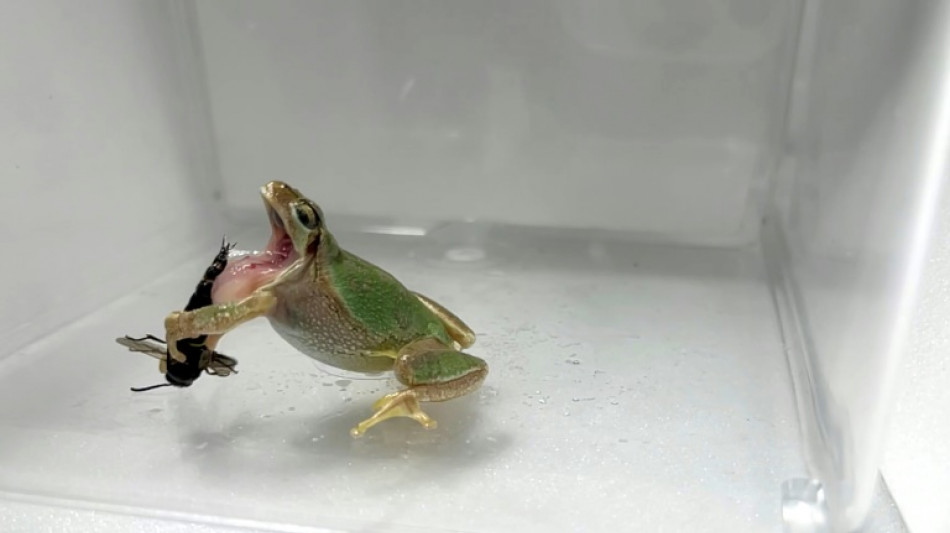
En garde! Wasps use penis spikes to ward off predators / Photo: Shinji SUGIURA - Kobe University/AFP

 Zverev thrashes Shang to set up Djokovic quarter-final at China Open

 Turkey football ref chief jailed pending trial for graft

 North Korea says test of intermediate-range strategic missile included use of AI

 Rampant Sayers leads Hong Kong to third men's rugby gold in a row

 Ethiopia's Tigray rebels abandon regional capital as govt advances

 Bulgaria's Tsar Samuel returns 'home' after 1,000 years

 'Glad it's over': Kim powers to Games gold and military exemption

 After 11 World Cups, football finally comes home for one Indian fan

 Marc Marquez wins sprint at Japan MotoGP, Martin grabs pole

 Alcaraz fends off Arnaldi to reach Japan Open quarters

 Antonelli tops times in final practice at Bahrain GP

 Gauff digs deep to beat Osorio in China Open second round
 Fresh protests to hit Spain after housing measures defeated

 'He's here with me': Japan cycle queen dedicates gold to late brother

 Japan Olympic chief says 'lot more' athletes at Games than expected

 Asian carmakers besting US rivals at home, China poised to strike

 Widgets & Web Offers All-Inclusive Investor Relations Websites for Public Companies, IPOs and SPACs

 Adams named new US captain to 2030 World Cup

 China a better influence in Latin America than US: poll

 Judge pauses construction of border project in Texas national park

 Belgium's De Bruyne fires double to sink Turkey, France held by Italy

 US jobs data boosts stocks as oil prices dip

 US Supreme Court to hear high-stakes climate case

 Trump expected to name intel chief Clayton as AI czar: reports

 Argentina unveils passports-for-investment scheme

An accidental sting has helped Japanese scientists prove some male wasps have a rather unusual predator defence weapon: penis spikes.
While wasps are known for their prickly attacks, only females have a real sting in their tails. Their male counterparts generally evade predators by mimicking the fairer sex.
Scientists had theorised that some male wasps might have other defence mechanisms, including perhaps deploying their genital spikes.
"However, the evidence was lacking," explained Shinji Sugiura, an ecologist at Japan's Kobe University.
Sugiura studies animal anti-predator defences but it was only by chance that he investigated the unusual male wasp mechanism, after his graduate student and co-author reported being stung by a mason wasp.
"I tried to be stung after hearing her experience," Sugiura told AFP.
"Because I had believed male wasps as harmless, I was very surprised to experience the pain."
Female wasps sting via an ovipositor, a tube-like protrusion that deposits eggs but can also deliver a venomous riposte.
Male wasps lack the organ but are equipped with two large spikes that sit either side of their penis.
To test the effectiveness of this defence, Sugiura's team offered up male mason wasps to two different kinds of frogs to see how the spikes were deployed.
"Male wasps were frequently observed to pierce the mouth or other parts of frogs with their genitalia while being attacked," Sugiura reported in research published Tuesday in the Current Biology journal.
The attacks are documented in a video that shows an unfortunate frog trying repeatedly to chomp down on a wasp, before using its front feet to pull the stinging insect out of its mouth.
Pond frogs happily ate all the males, as well as stinging females, but over a third of tree frogs rejected the male wasps after being stung.
When the experiment was repeated with the genital spikes removed from the wasps, the tree frogs no longer held back and ate them without hesitation.
"The difference was statistically significant. Even a small difference of survival could cause the evolution of anti-predator devices in insects," Sugiura said.
There has been little research on insect genitalia outside of its role in reproduction, according to Sugiura, though the wasp defence mechanism is not entirely without precedent.
Previous research has found, for example, that some species of hawkmoth use their genitalia to emit ultrasound that jams bat sonar.
Sugiura is no stranger to uncovering some of the weirdest ways animals evade their predators.
He has documented how some beetles can escape after being swallowed, by following the digestive tract to its logical conclusion and escaping from the anus.
And he has shown that other insects can make any unfortunate toad that has eaten them vomit them back up.
He now hopes to expand his current research to determine whether other wasp families have the same genital spike defence mechanism.
A.S.Diogo--PC



