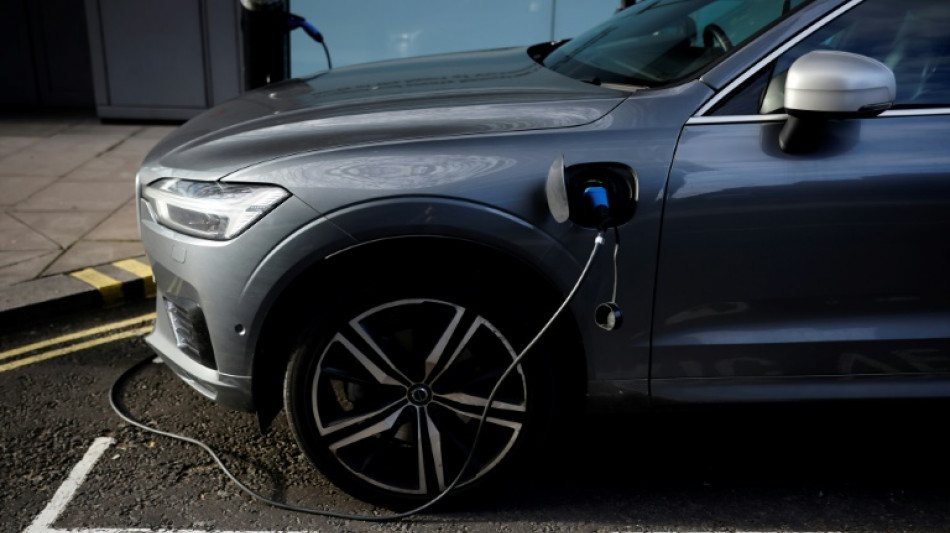
Electric car batteries could be key to boosting energy storage: study / Photo: Tolga Akmen - AFP/File

 Zverev thrashes Shang to set up Djokovic quarter-final at China Open

 Turkey football ref chief jailed pending trial for graft

 North Korea says test of intermediate-range strategic missile included use of AI

 Rampant Sayers leads Hong Kong to third men's rugby gold in a row

 Ethiopia's Tigray rebels abandon regional capital as govt advances

 Bulgaria's Tsar Samuel returns 'home' after 1,000 years

 'Glad it's over': Kim powers to Games gold and military exemption

 After 11 World Cups, football finally comes home for one Indian fan

 Marc Marquez wins sprint at Japan MotoGP, Martin grabs pole

 Alcaraz fends off Arnaldi to reach Japan Open quarters

 Antonelli tops times in final practice at Bahrain GP

 Gauff digs deep to beat Osorio in China Open second round

 Fresh protests to hit Spain after housing measures defeated

 'He's here with me': Japan cycle queen dedicates gold to late brother

 Japan Olympic chief says 'lot more' athletes at Games than expected

 Asian carmakers besting US rivals at home, China poised to strike

 Widgets & Web Offers All-Inclusive Investor Relations Websites for Public Companies, IPOs and SPACs

 Adams named new US captain to 2030 World Cup

 China a better influence in Latin America than US: poll

 Judge pauses construction of border project in Texas national park

 Belgium's De Bruyne fires double to sink Turkey, France held by Italy

 US jobs data boosts stocks as oil prices dip

 US Supreme Court to hear high-stakes climate case

 Trump expected to name intel chief Clayton as AI czar: reports

 Argentina unveils passports-for-investment scheme

Electric car batteries could be used to boost power storage in the future, injecting electricity into the grid during times of scarcity or storing electricity during periods of excess, a new study found Tuesday.
Renewable energy is essential for the Paris Agreement goal of limiting global warming to well below two degrees Celsius, but the need to scale up quickly and the intermittency of wind and solar have raised concerns about meeting electricity demand.
One way to help solve this problem is boosting the storage capacity of electricity grids, so that even when there is no sun or wind energy supply won't be interrupted.
New research published Tuesday found that electric car batteries could help boost short-term grid storage in times of increased demand or lower supply, either by setting up "vehicle-to-grid" or "second use" schemes.
"Harnessing this potential will have critical implications for the energy transition," said the study published in Nature Communications.
A "vehicle-to-grid" approach would allow drivers to connect car batteries to the grid for short term-storage when needed, the authors said.
For example, commercial fleets could inject power into the grid when at a depot.
"Second-use" schemes would allow drivers to sell or donate car batteries once they can no longer be used to power vehicles, which is generally when their capacity falls below 70 to 80 percent.
- Micro-payments -
Even a low level of participation from drivers could make a big difference, the researchers said.
"Low participation rates of 12 to 43 percent are needed to provide short-term grid storage demand globally," study co-author Chengjian Xu, of Leiden University in The Netherlands, told AFP.
"Short-term grid storage demand could be met as early as 2030 across most regions", he added, saying this was a conservative estimate.
By 2050, it would exceed the storage capacity required to help limit global warming to well below 2C, as outlined by the International Renewable Energy Agency.
The work examined global data -- including from the main electric car battery markets in China, India, the European Union and the United States -- taking into consideration average driving distances, driver behaviour and temperature, all of which can affect car battery health.
The authors said governments should introduce incentives and regulations to ensure vehicle-to-grid and second use schemes can take off.
"This can include market-based efforts such as micro-payments for services to the grid," Chengjian said, adding that vehicle-to-grid use would have little harm on battery life.
Some car firms such as Hyundai and Renault are already testing vehicles equipped with vehicle-to-grid technology, while some Teslas are already compatible.
The International Energy Agency (IEA) estimates that there will be some 200 million electric vehicles sold in 2030 -- about 20 percent of all cars sold -- an 11-fold increase from today's numbers.
IEA analyst Luis Lopez told AFP using car batteries as short-term storage was "quite promising but it's not a silver bullet", since it would provide less than one percent of storage needed under a net zero by 2050 scenario.
It would also require proper "communication" between the power system and the electric cars.
"If the power system, EVs (electric vehicles) and charging infrastructure all speak the same language, it is easier to aggregate more vehicles for power system needs".
P.Serra--PC



