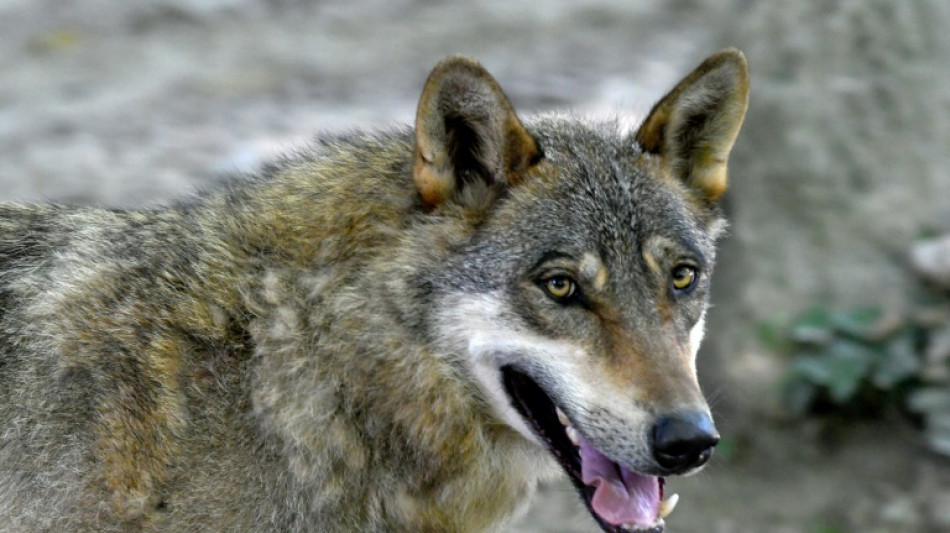
Rapid development is main threat to big carnivores: study / Photo: DENIS LOVROVIC - AFP

 Zverev thrashes Shang to set up Djokovic quarter-final at China Open

 Turkey football ref chief jailed pending trial for graft

 North Korea says test of intermediate-range strategic missile included use of AI

 Rampant Sayers leads Hong Kong to third men's rugby gold in a row

 Ethiopia's Tigray rebels abandon regional capital as govt advances

 Bulgaria's Tsar Samuel returns 'home' after 1,000 years

 'Glad it's over': Kim powers to Games gold and military exemption

 After 11 World Cups, football finally comes home for one Indian fan

 Marc Marquez wins sprint at Japan MotoGP, Martin grabs pole

 Alcaraz fends off Arnaldi to reach Japan Open quarters

 Antonelli tops times in final practice at Bahrain GP

 Gauff digs deep to beat Osorio in China Open second round

 Fresh protests to hit Spain after housing measures defeated

 'He's here with me': Japan cycle queen dedicates gold to late brother

 Japan Olympic chief says 'lot more' athletes at Games than expected

 Asian carmakers besting US rivals at home, China poised to strike

 Widgets & Web Offers All-Inclusive Investor Relations Websites for Public Companies, IPOs and SPACs

 Adams named new US captain to 2030 World Cup

 China a better influence in Latin America than US: poll

 Judge pauses construction of border project in Texas national park

 Belgium's De Bruyne fires double to sink Turkey, France held by Italy

 US jobs data boosts stocks as oil prices dip

 US Supreme Court to hear high-stakes climate case

 Trump expected to name intel chief Clayton as AI czar: reports

 Argentina unveils passports-for-investment scheme

Declines in populations of big carnivores like lions, tigers and wolves may be driven more by rapid human economic development than habitat loss or climate change, according to a new study Tuesday.
The researchers hope the findings could help to improve policies for protecting carnivore populations, which have been driven to the brink of extinction in many parts of the world.
The study found that faster economic development was linked to a quicker decline in carnivore populations.
"In the midst of rapid development, people appear to become less tolerant of carnivores, conflicts explode, and we suspect that incidences of poaching and persecution rocket," lead author Thomas Johnson said in a press release.
Some carnivores are poached for their meat or for the wildlife trade, while others like lions may be killed if they pose a threat to someone's livelihood -- such as their cattle -- or their life, Johnson told AFP.
"These human elements are actually having a far greater impact than the habitat loss elements," Johnson said.
Traditionally, habitat loss has been considered the primary threat to carnivore populations, but the researchers said that was "dwarfed" by human development.
The study, published in Nature Communications, concluded that as human communities become wealthier and socioeconomic growth slows, carnivore populations can recover.
The authors said this was partly due to better habitat protection, but mainly because people start to care more about the animals and have less of a desire -- and need -- to kill them.
"What you want is this growth to slow before [the carnivore population] completely vanishes, so there's at least an opportunity to recover," Johnson said.
- Wolf rebound -
Grey wolf populations have already rebounded in Europe, growing 1,800 percent since the 1960s thanks to an improved quality of life and slower economic development on the continent, according to the researchers from the University of Reading.
That recovery is not only happening in protected parks but also in wild areas.
Brown bears and lynxes are also starting to recover in Europe, Johnson said, while tiger populations in India have similarly started to rebound.
But several parts of Africa did not support the overarching findings -- the continent has not seen rapid development but its carnivore populations have declined -- and Johnson said this may be because much of the population decline occurred decades ago under colonial regimes.
The findings present an inherent tension between prioritising human development versus protecting carnivores, and Johnson suggested that wealthier nations -- responsible for much of large carnivore decline -- could support less developed nations through targeted financial support.
This could include paying communities in biodiversity hotspots enough to earn a living, while promoting conservation.
"If you lock people into poverty, people will never live alongside biodiversity," Johnson said, adding that he hopes policy will move beyond treating carnivore loss as a narrow issue.
"My real hope is we start thinking about this as a socioeconomic problem, as well as an environmental problem."
The work looked at 50 species of carnivores in over 80 countries over the last 50 years.
Carnivore populations have seen dramatic declines globally in the last century, with lions and tigers absent from more than 90 percent of their historic range.
In the United Kingdom, many local carnivore species such as lynx, wolf and bear have already been hunted into extinction.
A.Magalhes--PC



