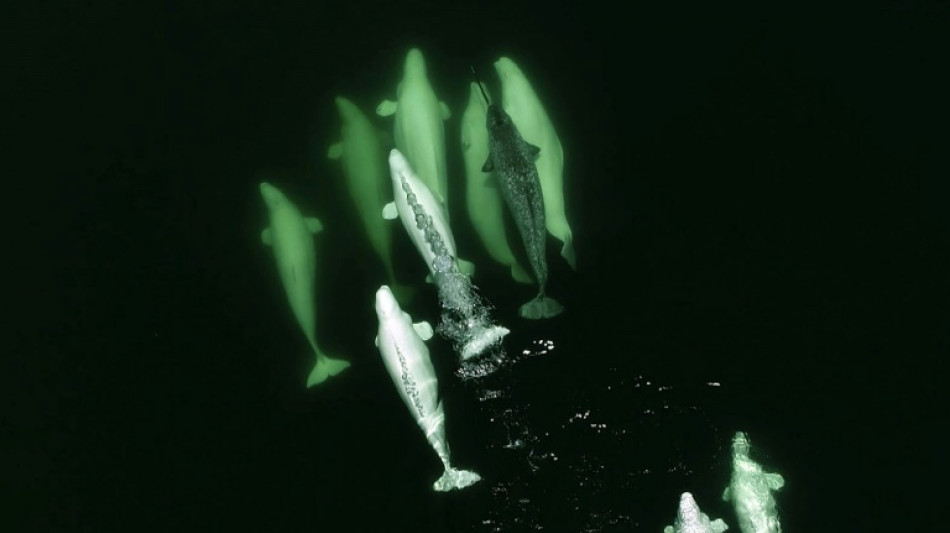
Narwhals' climate-vulnerable winter feeding crucial for survival: study / Photo: HO - GREMM/AFP

 Lula, Bolsonaro in final push for votes ahead of knife-edge election

 Boisterous fashion week barnstorms 'sleepy' Nigerian capital

 UAE investigators say flydubai co-pilot was planning 'terrorist act'

 Rahul smacks century in India v Windies ODI

 Daryz seeks to join exclusive club of dual Arc winners

 Russia warns diplomats to leave Kyiv over new strikes threat

 Olympic champ Zheng rebukes rowdy home crowd at China Open

 World No.1 Sinner pulls out of Shanghai Masters to delay return

 Red Bull's Verstappen grabs pole position for Bahrain GP

 India beat Pakistan in blockbuster as golfer Kim wins 'crazy' gold

 India beat arch-rivals Pakistan to win Asian Games cricket gold

 Ethiopia's Tigray rebels abandon regional capital as govt advances: journalist

 Tom Kim powers to Games gold and exemption from military service

 Split loyalties for Indian football fans at Brazil friendly

 India-Pakistan blockbuster brings cricket fever to Japan baseball field

 Wong waiting on Rafa after winning Asian Games tennis gold

 With Russia next door and rising costs, Latvia goes to the polls

 Penalty hero rues empty seats as Games hosts Japan win football gold

 North Korea fires ballistic missile after Seoul's apology demand

 US regulator finds Boeing 737 MAX software bug 'not a safety concern'

 Ohtani 'managing' injuries as Dodgers launch MLB post-season

 Botched US execution leaves murderer unconscious on ventilator: lawyers

 Cornell rape case exposes sexual violence at US colleges

 France held by Italy in Zidane's homecoming after Olise stunner

 Ethiopian pro-government militia claims Tigray airport as regional tensions spike

Narwhals are likely more dependent on fat reserves and abundant prey in climate-threatened winter habitats than previously thought, researchers said Wednesday, warning of severe risks posed by global warming.
Scientists studying the long-horned marine mammals in the fjords off the eastern coast of Greenland during the summer found narwhals were largely unsuccessful in capturing prey.
"(This) suggests that they could actually rely on the wintering grounds to build up sufficient body reserves and energy stores to sustain year-round activities," said Philippine Chambault of the University of California Santa Cruz, co-author of the study published in the journal Biology Letters.
Researchers believe most narwhals spend their winters feasting off fish and squid under sea ice off the coast of Greenland, but Chambault said this cold-water habitat may essentially "disappear" because of climate change, with expected increases in ocean temperatures driving ice melt and potentially causing prey to relocate.
While the exact causes of the low summer feeding rate are not yet clear, researchers said it could be due to a decline or relocation of squid and cod, lower energy needs, or even because they are picky eaters.
Normally narwhal eating habits are hard to track because they dive deep, up to one kilometre (3,000 feet) and stay in the open water.
The researchers were able to study the foraging behaviours of 14 narwhals using so-called stomach temperature pills that could detect when the whales swallowed cold prey and icy water.
They also used acoustic tags tuned to the sound waves or "buzzes" emitted when narwhals narrow-in on their prey.
- 'Little flexibility' -
More than two-thirds of the hunting dives recorded over roughly 1,000 hours were deemed unsuccessful due to the presence of buzzes without an accompanying stomach temperature drop, said the study.
The researchers said the small sample size and limits to the detection capabilities of the equipment meant the feeding rates could be underestimated.
But they also worked with local indigenous Inuit communities to test their findings.
Inuit hunters examined the stomach contents of the narwhals caught during summer hunting season, confirming that the whales' stomachs were in fact "pretty empty", Chambault told AFP.
Diet limitation is just one factor complicating the species' survival.
Their preference for cold water and a strong tendency to remain within or near where they were born mean they are particularly sensitive to climate change.
This means they might "show very little flexibility to changing habitats," Chambault said.
F.Ferraz--PC



