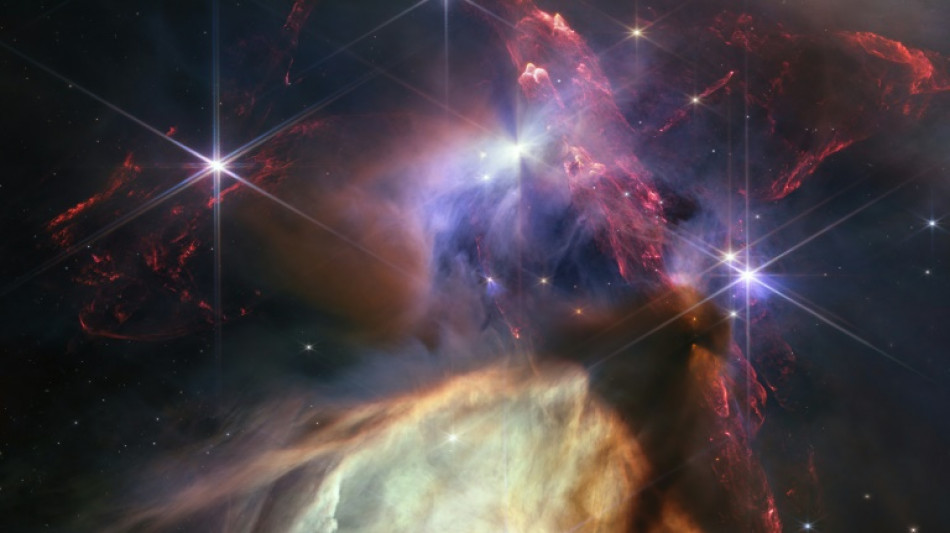
NASA celebrates Webb telescope anniversary with close-up of stellar birth / Photo: Handout - NASA/AFP

 Yamal on target as Spain hold off Czech Republic

 Latvian exit polls suggest pro-European choice

 Lula, Bolsonaro wrap up campaigns ahead of knife-edge election

 Tuchel hails 'complete' England after Croatia demolition

 Fury to invite Trump to lead ring walk before Joshua showdown

 Fashion industry in 'precarious moment', says Vivienne Westwood supremo

 Seventh heaven for England in Nations League rout of Croatia

 Storms, flooding cause chaos on Greek holiday island of Crete

 #IAmJaneDoe: online support campaign in US university rape case

 Brazil shine on Selecao's first visit to India

 Zverev sets up Djokovic quarter-final at China Open, Rybakina out

 Happier at home, Bordeaux hammer Lyon in Top 14

 Lula, Bolsonaro in final push for votes ahead of knife-edge election

 Boisterous fashion week barnstorms 'sleepy' Nigerian capital

 UAE investigators say flydubai co-pilot was planning 'terrorist act'

 Rahul smacks century in India v Windies ODI

 Daryz seeks to join exclusive club of dual Arc winners

 Russia warns diplomats to leave Kyiv over new strikes threat

 Olympic champ Zheng rebukes rowdy home crowd at China Open

 World No.1 Sinner pulls out of Shanghai Masters to delay return

 Red Bull's Verstappen grabs pole position for Bahrain GP

 India beat Pakistan in blockbuster as golfer Kim wins 'crazy' gold

 India beat arch-rivals Pakistan to win Asian Games cricket gold

 Ethiopia's Tigray rebels abandon regional capital as govt advances: journalist

 Tom Kim powers to Games gold and exemption from military service

Jets of red gas bursting into the cosmos, and a glowing cave of dust: NASA marked a year of discovery by the James Webb Space Telescope Wednesday with a spectacular new image of Sun-like stars being born.
The picture is of the Rho Ophiuchi cloud complex, the nearest stellar nursery to Earth, whose proximity at 390 light-years allows for a crisp close-up by the most powerful orbital observatory ever built.
"In just one year, the James Webb Space Telescope has transformed humanity's view of the cosmos, peering into dust clouds and seeing light from faraway corners of the universe for the very first time," said NASA Administrator Bill Nelson.
"Every new image is a new discovery, empowering scientists around the globe to ask and answer questions they once could never dream of."
Webb's image shows around 50 young stars, of similar mass to our Sun or smaller.
Some have the signature shadows of circumstellar disks -- a sign that planets may eventually form around them.
Huge jets of hydrogen appear horizontally in the upper third of the image, and vertically on the right.
"These occur when a star first bursts through its natal envelope of cosmic dust, shooting out a pair of opposing jets into space like a newborn first stretching her arms out into the world," the US space agency said in a statement.
"At the bottom of the image, you can see a young star that's energetic enough that it's blowing a bubble in the cloud of dust and gas from which it was born," Christine Chen, an astronomer at the Space Telescope Science Institute, which operates Webb, told AFP.
It does so through a combination of its light and a stellar wind linked to it, she added.
Interstellar space is filled with gas and dust, which in turn serves as the raw material for new stars and planets.
"Webb's image of Rho Ophiuchi allows us to witness a very brief period in the stellar life cycle with new clarity. Our own Sun experienced a phase like this, long ago, and now we have the technology to see the beginning of another star's story," said Webb project scientist Klaus Pontoppidan.
- New era of astronomy -
Webb was launched in December 2021 from French Guiana, on a 1.5 million kilometer (nearly one million mile) voyage to a region called the second Lagrange point.
Its first full color picture was revealed by President Joe Biden on July 11, 2022: the clearest view yet of the early universe, going back 13 billion years.
The next wave included "mountains" and "valleys" of a star-forming region, dubbed the Cosmic Cliffs, in the Carina Nebula; and a grouping of five galaxies bound in a celestial dance, called Stephan's Quintet.
Webb boasts a primary mirror measuring more than 21 feet (6.5 meters) that is made up of 18 hexagonal, gold-coated segments, as well as a five-layer sunshield the size of a tennis court.
Unlike its predecessor Hubble, it operates primarily in the infrared spectrum, allowing it to look back nearer towards the start of time, and to better penetrate dust clouds where stars and planetary systems are being formed today.
Key discoveries include some of the earliest galaxies formed a few hundred million years after the Big Bang, identifying at unprecedented resolution the atmospheric compositions of planets outside our solar system, and, in our own neck of the woods, stunning new views of the planet Jupiter.
Webb has enough fuel for a 20-year mission, promising a new era of astronomy.
It will soon be joined in orbit by Europe's Euclid space telescope, which launched on July 1 on a mission to shed light on two of the universe's greatest mysteries: dark energy and dark matter.
S.Caetano--PC



