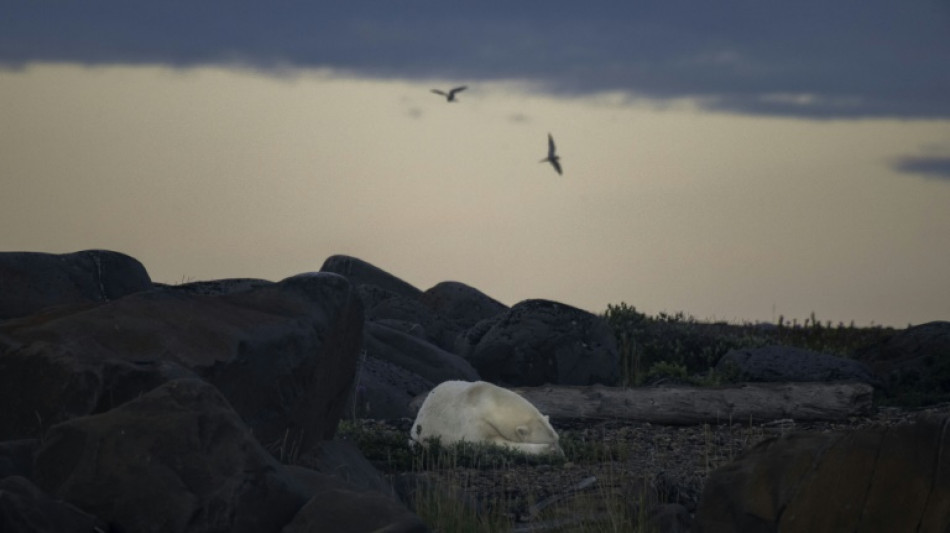
Study quantifies link between greenhouse gases, polar bear survival / Photo: Olivier MORIN - AFP/File

 Lula, Bolsonaro wrap up campaigns ahead of Brazil's knife-edge vote

 Toulouse edge Castres in Top 14 derby

 Murakami homer propels White Sox to MLB playoff win over Guardians

 Israel targets top Hamas leader in deadly Gaza strike on anniversary

 Houthis say struck oil facility near Riyadh, as Saudis hit Sanaa

 AI needs safety layers like nuclear plants: ex-OpenAI engineer

 MVP Judge will miss Yankees' MLB playoff series against Rays

 New lizard species discovered in Peru

 Fernandes hails Portugal's 'greatest symbol' Ronaldo, calls for unity
 Grandidier-Nkanang double takes Pau to Top 14 summit despite Vannes fightback

 Trainer Scott gets perfect Arc boost with top notch double

 Ex-PM says Putin cannot admit 'mistake' over Ukraine

 Houthis say Saudi Arabia launches dozens of strikes on Yemen capital

 Qatar and Abu Dhabi F1 Grand Prix to go ahead - F1 boss

 South Korea lift gloom with smash-and-grab Games football gold

 Ireland news conference before Israel game cut short amid tensions

 Protests over housing flare in Spain after relief measures rejected

 Zverev thrashes Shang to set up Djokovic quarter-final at China Open

 Turkey football ref chief jailed pending trial for graft

 North Korea says test of intermediate-range strategic missile included use of AI

 Rampant Sayers leads Hong Kong to third men's rugby gold in a row

 Ethiopia's Tigray rebels abandon regional capital as govt advances

 Bulgaria's Tsar Samuel returns 'home' after 1,000 years

 'Glad it's over': Kim powers to Games gold and military exemption

 After 11 World Cups, football finally comes home for one Indian fan

Polar bears have long symbolized the dangers posed by climate change, as rising temperatures melt away the Arctic sea ice which they depend upon for survival.
But quantifying the impact of a single oil well or coal power plant on the tundra predators had eluded scientists, until now.
A new report published in the journal Science on Thursday shows it is possible to calculate how much new greenhouse gas emissions will increase the number of ice-free days in the bears' habitats, and how that in turn will affect the percentage of cubs that reach adulthood.
By achieving this level of granularity, the two authors hope to close a loophole in US law.
Although the apex carnivores have had endangered species protections since 2008, a long-standing legal opinion prevents climate considerations from affecting decisions on whether to grant permits to new fossil fuel projects.
"We have presented the information necessary to rescind the Bernhardt Memo," first co-author Steven Amstrup, a zoologist with Polar Bears International and the University of Wyoming, told AFP, referring to the legal caveat which was named after an attorney in former president George W. Bush's administration.
The memo stated it was beyond the scope of existing science to distinguish the impacts of a specific source of carbon emissions from the impacts of all greenhouse gasses since the beginning of the industrial age.
- Cub survival imperiled -
Polar bears rely heavily on the sea ice environment for hunting seals, traveling, mating and more.
When sea ice melts in summer, the apex carnivores retreat onto land or unproductive ice far from the shore, where they endure long stretches of fasting. These periods are growing longer as global temperatures rise.
A landmark paper published in Nature in 2020 was the first to calculate links between changes in the sea ice caused by climate and polar bear demographics.
Building on this work, Amstrup and Bitz established the mathematical relationships between greenhouse emissions and fasting days as well as cub survival, in 15 out of 19 of the polar bears' subpopulations, between 1979 and 2020.
For example, the world currently emits 50 billion metric tons of carbon dioxide or equivalent gasses into the atmosphere annually, and that is reducing the rate of cub survival by over three percentage points per year in the South Beaufort Sea subpopulation.
In healthy populations, cub survival during the first year of life is around 65 percent.
"You don't have to knock that down very far before you don't have enough cubs entering the next generation," said Amstrup.
In addition, the paper provides US policy makers the tools they need to quantify the impact of new fossil fuel projects slated to occur on public lands in the coming decades.
- Implications for other species -
Joel Berger, university chair of wildlife conservation at Colorado State University, praised the paper.
"Amstrup and Bitz render an incontrovertible quantitative link among (greenhouse gas) emissions, sea ice decline, fasting duration -- a physiological response to lost hunting opportunities for seals -- and subsequent polar bear demographics -- declining recruitment of young," said Berger, who was not involved in the research.
Beyond providing a potential policy solution to the legal loophole, the new research could have implications that reach far beyond polar bears, second co-author Cecilia Bitz, a climatologist at the University of Washington, told AFP.
Methods laid out in the paper can be adapted for other species and habitats, such as coral reefs, or Florida's Key deer.
"I really hope this stimulates a lot of research," Bitz said, adding she was already reaching out to new collaborators.
V.Fontes--PC



