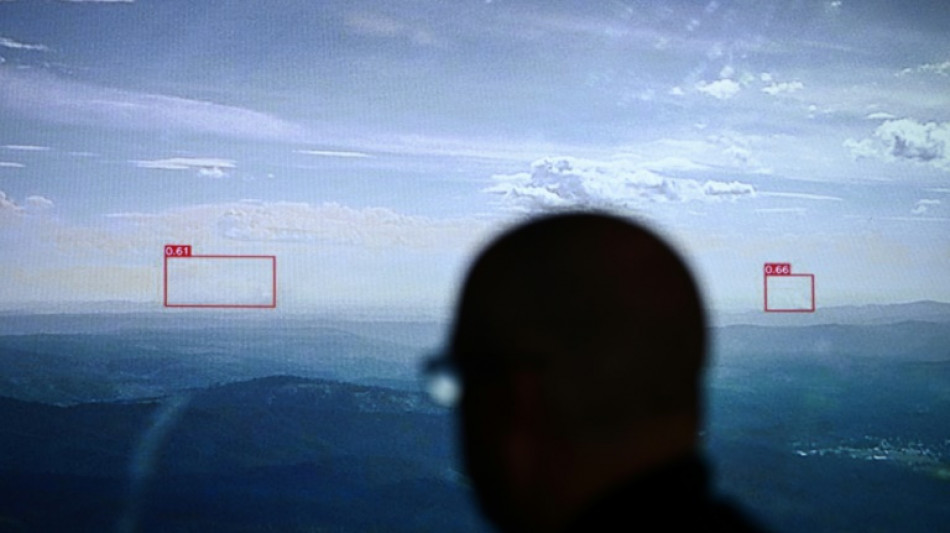
California firefighters use AI to battle wildfires / Photo: Patrick T. Fallon - AFP

 Lula, Bolsonaro wrap up campaigns ahead of Brazil's knife-edge vote

 Toulouse edge Castres in Top 14 derby

 Murakami homer propels White Sox to MLB playoff win over Guardians

 Israel targets top Hamas leader in deadly Gaza strike on anniversary

 Houthis say struck oil facility near Riyadh, as Saudis hit Sanaa

 AI needs safety layers like nuclear plants: ex-OpenAI engineer

 MVP Judge will miss Yankees' MLB playoff series against Rays

 New lizard species discovered in Peru

 Fernandes hails Portugal's 'greatest symbol' Ronaldo, calls for unity

 Grandidier-Nkanang double takes Pau to Top 14 summit despite Vannes fightback
 Trainer Scott gets perfect Arc boost with top notch double

 Ex-PM says Putin cannot admit 'mistake' over Ukraine

 Houthis say Saudi Arabia launches dozens of strikes on Yemen capital

 Qatar and Abu Dhabi F1 Grand Prix to go ahead - F1 boss

 South Korea lift gloom with smash-and-grab Games football gold

 Ireland news conference before Israel game cut short amid tensions
 Protests over housing flare in Spain after relief measures rejected

 Zverev thrashes Shang to set up Djokovic quarter-final at China Open

 Turkey football ref chief jailed pending trial for graft
 North Korea says test of intermediate-range strategic missile included use of AI

 Rampant Sayers leads Hong Kong to third men's rugby gold in a row

 Ethiopia's Tigray rebels abandon regional capital as govt advances
 Bulgaria's Tsar Samuel returns 'home' after 1,000 years

 'Glad it's over': Kim powers to Games gold and military exemption

 After 11 World Cups, football finally comes home for one Indian fan
When a wildfire erupted in the middle of a recent California night, it could have been a disaster.
But thanks to a new monitoring system that uses artificial intelligence to scan for danger, firefighters were able to quell the blaze long before it got out of hand.
"It was less than a quarter acre," Captain Kris Yeary of Cal Fire told AFP.
"Had the AI not alerted us to it, it could have gotten much bigger."
Yeary, who is responsible for organizing firefighting over an area that includes Mount Laguna, around 40 miles (65 kilometers) east of San Diego, sprang into action around 3am on August 5 after a call from colleagues at a command center.
Computers watching live feeds from the Cleveland National Forest spotted what their algorithm had been taught to understand was a column of smoke.
Human operators were able to verify the machines were correct and alerted Yeary, whose firefighters quickly extinguished the flames.
"It could have been a devastating fire," he said.
- Artificial intelligence -
Artificial intelligence is a rapidly developing field of computing that seeks to mimic human abilities to "think."
Unlike a traditional computer, which can only produce answers based on the concrete information it has, AI can infer answers, using experience it has gained from similar problems it has seen before -- similar to a human being.
Over the last few years, its application has spread to include areas as diverse as weather forecasting, stock-picking, art and journalism.
That has brought with it worries from people who fear it will do them out of their jobs -- the writers' and actors' strike currently paralyzing Hollywood is in part about the use of AI in films and television.
But firefighters battling California's wildfires say they will take all the help they can get.
"AI is just another tool for us," said Yeary. "It's never going to replace firefighters."
- Promising results -
California experiences thousands of fires every year, which torch hundreds of thousands -- sometimes millions -- of acres (hectares).
Over the last decade, blazes have claimed more than 200 lives, and destroyed thousands of homes and businesses, wreaking billions of dollars of damage.
For several years firefighters have used a network of more than 1,000 cameras to monitor possible fire hotspots.
Since the end of June, the ALERTCalifornia system has had AI computers "watching" these feeds, and flagging to human operators when they see wisps of smoke that could be a fire -- with promising results.
"Our success metric is the fires you never hear about," says Neal Driscoll, who heads the project for the University of California San Diego.
"We beat 911 calls about 40 percent of the time. And it's going to get better."
The addition of AI has meant each firefighter watching the dozens of feeds they are responsible for now has a helping hand.
When the software believes it detects smoke, it displays a small red rectangle on the screen, and offers a percentage indicating its degree of certainty.
It is then up to the operator to confirm the seriousness of the alert -- and weed out any confusion.
Currently, the system can erroneously flag dust raised by tractors, insects in front of the camera or even a bit of fog.
"When a cloud will go over... it can cast a shadow on the ground and sometimes (the computer) can actually think that that's possibly smoke," says Suzann Leininger, an intelligence specialist at Cal Fire.
The feedback that experts like Leininger give -- no, that's just a bit of weather -- is helping the AI to get better at what it does.
But even in its current state, it's a boon.
"It's getting us time to react in a faster manner," says Leininger.
And when you're talking about fire, time can be everything.
- Climate change -
As California grapples with the effects of human-caused climate change, fires are becoming bigger and more destructive.
The state has experienced 18 of its 20 largest wildfires on record in the last two decades.
With terrifying blazes ripping through Europe, Canada and Hawaii this year, the devastating impact of the changing climate is becoming ever-more apparent worldwide.
"I think that as we see these devastations in other areas, like in Greece, and Maui, that systems like this that provide early confirmation will be a step in the right direction," says Driscoll of UC San Diego.
Faced with the scale of the threat, the scientist has chosen to grant public access to the data on his platform, so that other companies or academics can work on it.
"We need to leverage all of our assets and work together, because extreme climate is bigger than any one of us."
X.Matos--PC



