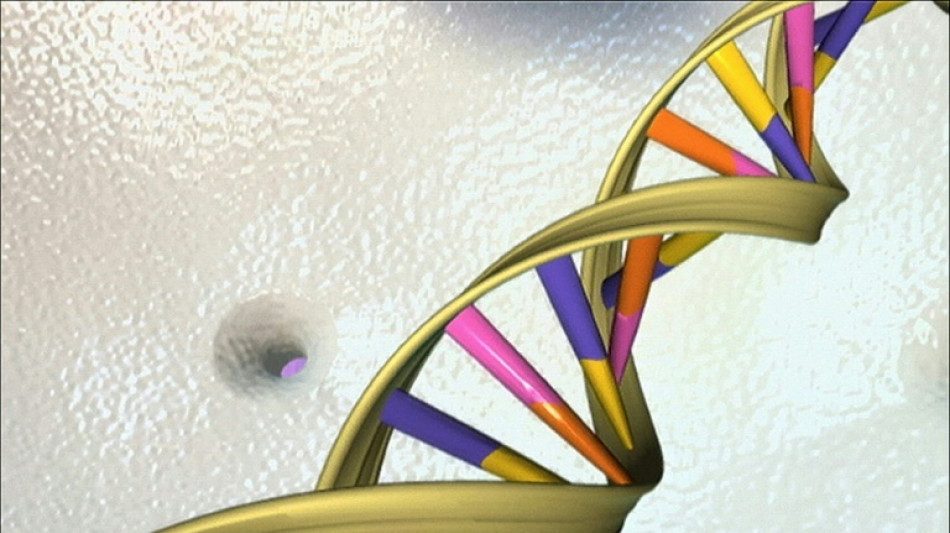
Google AI tool predicts danger of genetic mutations / Photo: HO - AFP

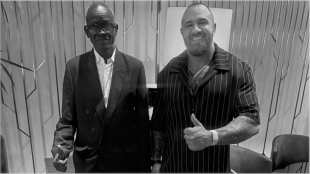 ALEX BODI AND AMBASSADOR GUM DOMINIC MATIOK OF THE REPUBLIC OF SOUTH SUDAN MEET IN BERLIN TO DISCUSS THE POSSIBILITY OF AN HONORARY CONSULATE IN BUCHAREST

 Lula, Bolsonaro wrap up campaigns ahead of Brazil's knife-edge vote

 Toulouse edge Castres in Top 14 derby

 Murakami homer propels White Sox to MLB playoff win over Guardians

 Israel targets top Hamas leader in deadly Gaza strike on anniversary

 Houthis say struck oil facility near Riyadh, as Saudis hit Sanaa

 AI needs safety layers like nuclear plants: ex-OpenAI engineer

 MVP Judge will miss Yankees' MLB playoff series against Rays

 New lizard species discovered in Peru

 Fernandes hails Portugal's 'greatest symbol' Ronaldo, calls for unity

 Grandidier-Nkanang double takes Pau to Top 14 summit despite Vannes fightback
 Trainer Scott gets perfect Arc boost with top notch double

 Ex-PM says Putin cannot admit 'mistake' over Ukraine

 Houthis say Saudi Arabia launches dozens of strikes on Yemen capital

 Qatar and Abu Dhabi F1 Grand Prix to go ahead - F1 boss

 South Korea lift gloom with smash-and-grab Games football gold

 Ireland news conference before Israel game cut short amid tensions

 Protests over housing flare in Spain after relief measures rejected

 Zverev thrashes Shang to set up Djokovic quarter-final at China Open

 Turkey football ref chief jailed pending trial for graft

 North Korea says test of intermediate-range strategic missile included use of AI

 Rampant Sayers leads Hong Kong to third men's rugby gold in a row

 Ethiopia's Tigray rebels abandon regional capital as govt advances

 Bulgaria's Tsar Samuel returns 'home' after 1,000 years

 'Glad it's over': Kim powers to Games gold and military exemption

Researchers at Google DeepMind, the tech giant's artificial intelligence arm, on Tuesday introduced a tool that predicts whether genetic mutations are likely to cause harm, a breakthrough that could help research into rare diseases.
The findings are "another step in recognising the impact that AI is having in the natural sciences," said Pushmeet Kohli, vice president for research at Google DeepMind.
The tool focuses on so-called "missense" mutations, where a single letter of the genetic code is affected.
A typical human has 9,000 such mutations throughout their genome; they can be harmless or cause diseases such as cystic fibrosis or cancer, or damage brain development.
To date, four million of these mutations have been observed in humans, but only two percent of them have been classified, either as disease-causing or benign.
In all, there are 71 million such possible mutations. The Google DeepMind tool, called AlphaMissense, reviewed these mutations and was able to predict 89 percent of them, with 90 percent accuracy.
A score was assigned to each mutation, indicating the risk of it causing disease (otherwise referred to as pathogenic).
The result: 57 percent were classified as probably benign, and 32 percent as probably pathogenic -- the remainder being uncertain.
The database was made public and available to scientists, and an accompanying study was published on Tuesday in the journal Science.
AlphaMissense demonstrates "superior performance" than previously available tools, wrote experts Joseph Marsh and Sarah Teichmann in an article also published in Science.
"We should emphasize that the predictions were never really trained or never really intended to be used for clinical diagnosis alone," said Jun Cheng of Google DeepMind.
"However, we do think that our predictions can potentially be helpful to increase the diagnosed rate of rare disease, and also potentially to help us find new disease-causing genes," Cheng added.
Indirectly, this could lead to the development of new treatments, the researchers said.
The tool was trained on the DNA of humans and closely-related primates, enabling it to recognize which genetic mutations are widespread.
Cheng said the training allowed the tool to input "millions of protein sequences and learns what a regular protein sequence looks like."
It then could identify a mutation and its potential for harm.
Cheng compared the process to learning a language.
"If we substitute a word from an English sentence, a person that is familiar with English can immediately see whether this word substitution will change the meaning of the sentence or not."
A.F.Rosado--PC



