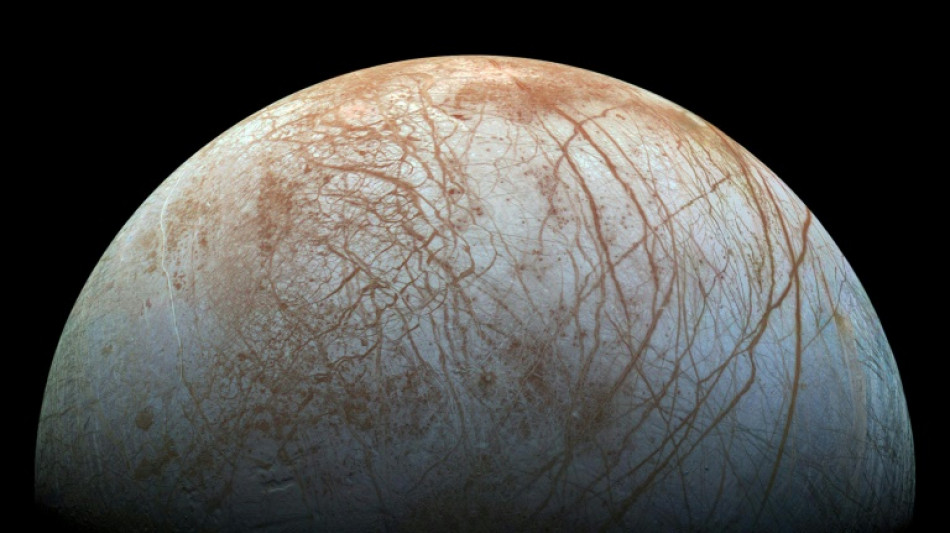
Hidden ocean the source of CO2 on Jupiter moon: research / Photo: Handout - NASA/JPL-Caltech/SETI Institute/AFP/File

 ALEX BODI AND AMBASSADOR GUM DOMINIC MATIOK OF THE REPUBLIC OF SOUTH SUDAN MEET IN BERLIN TO DISCUSS THE POSSIBILITY OF AN HONORARY CONSULATE IN BUCHAREST

 Lula, Bolsonaro wrap up campaigns ahead of Brazil's knife-edge vote

 Toulouse edge Castres in Top 14 derby

 Murakami homer propels White Sox to MLB playoff win over Guardians

 Israel targets top Hamas leader in deadly Gaza strike on anniversary

 Houthis say struck oil facility near Riyadh, as Saudis hit Sanaa

 AI needs safety layers like nuclear plants: ex-OpenAI engineer

 MVP Judge will miss Yankees' MLB playoff series against Rays

 New lizard species discovered in Peru

 Fernandes hails Portugal's 'greatest symbol' Ronaldo, calls for unity
 Grandidier-Nkanang double takes Pau to Top 14 summit despite Vannes fightback

 Trainer Scott gets perfect Arc boost with top notch double

 Ex-PM says Putin cannot admit 'mistake' over Ukraine

 Houthis say Saudi Arabia launches dozens of strikes on Yemen capital

 Qatar and Abu Dhabi F1 Grand Prix to go ahead - F1 boss

 South Korea lift gloom with smash-and-grab Games football gold

 Ireland news conference before Israel game cut short amid tensions

 Protests over housing flare in Spain after relief measures rejected

 Zverev thrashes Shang to set up Djokovic quarter-final at China Open

 Turkey football ref chief jailed pending trial for graft
 North Korea says test of intermediate-range strategic missile included use of AI

 Rampant Sayers leads Hong Kong to third men's rugby gold in a row

 Ethiopia's Tigray rebels abandon regional capital as govt advances

 Bulgaria's Tsar Samuel returns 'home' after 1,000 years

 'Glad it's over': Kim powers to Games gold and military exemption

Carbon dioxide detected on Jupiter's moon Europa comes from the vast ocean beneath its icy shell, research using James Webb Space Telescope data indicated on Thursday, potentially bolstering hopes the hidden water could harbour life.
Scientists are confident there is a huge ocean of saltwater kilometres below Europa's ice-covered surface, making the moon a prime candidate for hosting extra-terrestrial life in our Solar System.
But determining whether this concealed ocean has the right chemical elements to support life has been difficult.
Carbon dioxide -- one of the key building blocks of life -- has been detected on Europa's surface, but whether it rose up from the ocean below remained an open question.
Aiming to find an answer, two US-led teams of researchers used data from the Webb telescope's near-infrared spectrometer to map CO2 on the surface of Europa, publishing their results in separate studies in the journal Science.
The most CO2 was in a 1,800 kilometre-wide (1,120 mile) area called Tara Regio, where there is a lot of "chaos terrain" with jagged ridges and cracks.
Exactly what creates chaos terrain is not well understood, but one theory is that warm water from the ocean rises up to melt the surface ice, which then re-freezes over time into new uneven crags.
The first study used the Webb data to look at whether the CO2 could have come from somewhere other than the ocean below -- hitching a ride on a meteorite, for example.
Samantha Trumbo, a planetary scientist at Cornell University and the study's lead author, told AFP they concluded that the carbon was "ultimately derived from the interior, likely the internal ocean".
But the researchers could not rule out that the carbon came up from the planet's interior as rock-like carbonate minerals, which irradiation could then have broken apart to become CO2.
- 'Very exciting' -
Table salt has also been detected in Tara Regio -- making the area significantly more yellow than the rest of Europa's scarred white plains -- and scientists think it may also have come up from the ocean.
"So now we've got salt, we've got CO2: we're starting to learn a little bit more what that internal chemistry might look like," Trumbo said.
Looking at the same Webb data, the second study also indicated that "carbon is sourced from within Europa".
The NASA-led researchers had also hoped to find plumes of water or volatile gases shooting out of the moon's surface, but failed to spot any.
Two major space missions plan to get a closer look at Europa and its mysterious ocean.
The European Space Agency's Jupiter moon probe Juice launched in April, while NASA's Europa Clipper mission is scheduled to blast off in October 2024.
Juice project scientist Olivier Witasse welcomed the two new studies, saying they were "very exciting".
When Juice flies past Europa twice in 2032, it will collect "a wealth of new information," including about surface chemistry, he told AFP.
Juice will also look at two of Jupiter's other moons -- Ganymede and Callisto -- where carbon has been detected.
Witasse emphasised that the goal of the Juice mission, like the Europa Clipper, is to find out whether these icy moons have the right conditions to support life -- they will not be able to confirm if aliens exist.
And even if some future mission does discover life, anything able to live in such extreme conditions under more than 10 kilometres of ice is expected to be tiny, such as primitive microbes.
P.Serra--PC



