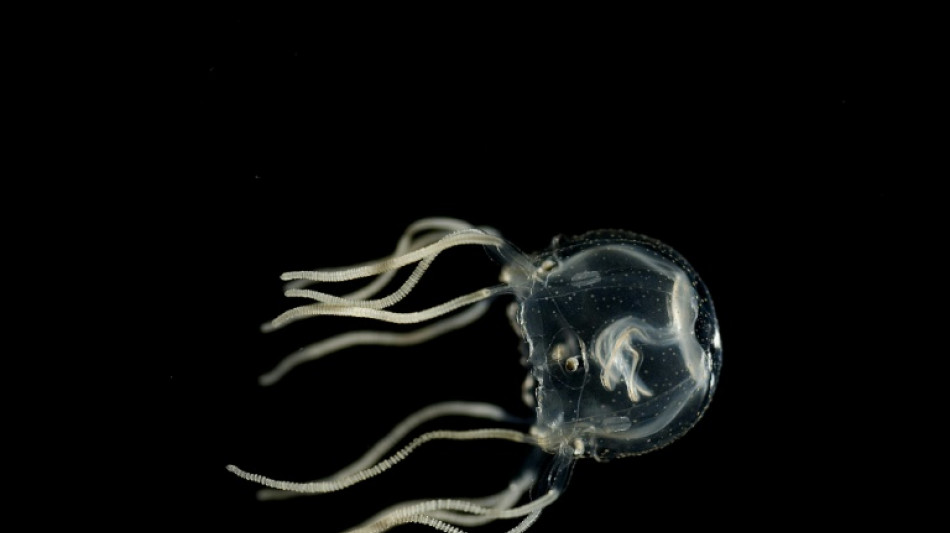
No brain, no problem: Tiny jellyfish can learn from experience / Photo: Jan BIELECKI - Jan BIELECKI/AFP

 ALEX BODI AND AMBASSADOR GUM DOMINIC MATIOK OF THE REPUBLIC OF SOUTH SUDAN MEET IN BERLIN TO DISCUSS THE POSSIBILITY OF AN HONORARY CONSULATE IN BUCHAREST

 Lula, Bolsonaro wrap up campaigns ahead of Brazil's knife-edge vote

 Toulouse edge Castres in Top 14 derby

 Murakami homer propels White Sox to MLB playoff win over Guardians

 Israel targets top Hamas leader in deadly Gaza strike on anniversary

 Houthis say struck oil facility near Riyadh, as Saudis hit Sanaa

 AI needs safety layers like nuclear plants: ex-OpenAI engineer

 MVP Judge will miss Yankees' MLB playoff series against Rays

 New lizard species discovered in Peru

 Fernandes hails Portugal's 'greatest symbol' Ronaldo, calls for unity

 Grandidier-Nkanang double takes Pau to Top 14 summit despite Vannes fightback

 Trainer Scott gets perfect Arc boost with top notch double

 Ex-PM says Putin cannot admit 'mistake' over Ukraine

 Houthis say Saudi Arabia launches dozens of strikes on Yemen capital

 Qatar and Abu Dhabi F1 Grand Prix to go ahead - F1 boss

 South Korea lift gloom with smash-and-grab Games football gold

 Ireland news conference before Israel game cut short amid tensions

 Protests over housing flare in Spain after relief measures rejected

 Zverev thrashes Shang to set up Djokovic quarter-final at China Open

 Turkey football ref chief jailed pending trial for graft

 North Korea says test of intermediate-range strategic missile included use of AI

 Rampant Sayers leads Hong Kong to third men's rugby gold in a row

 Ethiopia's Tigray rebels abandon regional capital as govt advances

 Bulgaria's Tsar Samuel returns 'home' after 1,000 years

 'Glad it's over': Kim powers to Games gold and military exemption

Caribbean box jellyfish are barely a centimetre long and have no brain.
But these gelatinous, fingernail-sized creatures are capable of learning from visual cues to avoid swimming into obstacles -- a cognitive ability never before seen in animals with such a primitive nervous system, researchers said on Friday.
Their performance of what is called "associative learning" is comparable to far more advanced animals such as fruit flies or mice, which have the notable benefit of having a brain, the researchers said.
The Caribbean box jellyfish, or Tripedalia cystophora, is known to be able to navigate through murky water and a maze of submerged mangrove roots.
These scenarios throw up plenty of dangers that could damage the jellyfish's fragile gelatinous membrane which envelops its bell-shaped body.
But they avoid harm thanks to four visual sensory centres called rhopalia, each of which has lens-shaped eyes and around a thousand neurons.
For comparison, fruit flies are packing 200,000 neurons in their tiny brains.
Cnidarians -- the animal group which includes jellyfish, sea anemones and coral -- are brainless, instead getting by with a "dispersed" central nervous system.
Despite this considerable disadvantage, the Caribbean box jellyfish responds to what is called "operant conditioning," according to the study in the journal Current Biology.
This means they can be trained to "predict a future problem and try to avoid it," said Anders Garm, a marine biologist at the University of Copenhagen and the study's lead author.
Garm told AFP that this capacity is "more complex than classical conditioning," which is best known for Russian neurologist Ivan Pavlov's experiments showing that dogs cannot help but salivate when they see their food bowl.
- 'Very intriguing' -
To test the jellyfish, the researchers put them in a small, water-filled tank with stripes of varying darkness on the glass walls to represent mangrove roots.
After a few bumps into the walls, the jellyfish quickly learned to move through the parts of the enclosures where the bars were least visible.
If the bars were made more prominent, the jellyfish never hit the walls, remaining safely in the centre of the tank. However this was not ideal for scrounging around for food.
If the stripes were removed entirely, the jellyfish constantly ran into the walls of the tank.
"If you separate the two stimuli, there is no learning," Garm concluded.
The jellyfish learned their lesson in between three to six tries, "which is basically the same amount of trials for what we would normally consider an advanced animal, like a fruit fly, a crab or even a mouse," he said.
They said their research supports the theory that even animals with a very small number of neurons are capable of learning.
That such a simple organism is able to achieve this feat "points to the very intriguing fact that this may be a fundamental property of nerve systems," Garm said.
Cnidarians are a "sister group" to the animal group that includes most other animals -- including humans.
Garm suggested that some 500 million years ago, a common ancestor of the two groups could have developed a nervous system that was already able to learn by association.
E.Borba--PC



