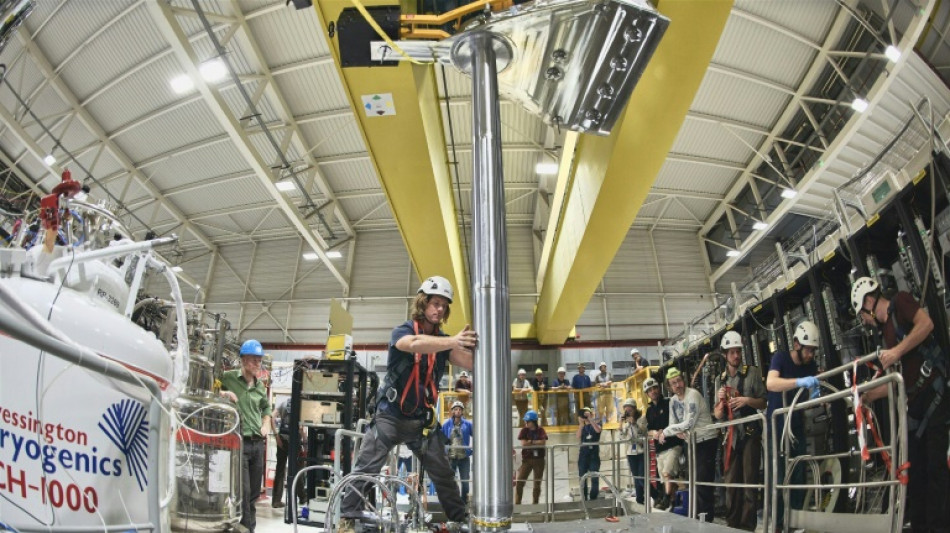
Mysterious antimatter observed falling down for first time / Photo: Handout - CERN/AFP

 ALEX BODI AND AMBASSADOR GUM DOMINIC MATIOK OF THE REPUBLIC OF SOUTH SUDAN MEET IN BERLIN TO DISCUSS THE POSSIBILITY OF AN HONORARY CONSULATE IN BUCHAREST

 Lula, Bolsonaro wrap up campaigns ahead of Brazil's knife-edge vote

 Toulouse edge Castres in Top 14 derby

 Murakami homer propels White Sox to MLB playoff win over Guardians

 Israel targets top Hamas leader in deadly Gaza strike on anniversary

 Houthis say struck oil facility near Riyadh, as Saudis hit Sanaa

 AI needs safety layers like nuclear plants: ex-OpenAI engineer

 MVP Judge will miss Yankees' MLB playoff series against Rays

 New lizard species discovered in Peru

 Fernandes hails Portugal's 'greatest symbol' Ronaldo, calls for unity

 Grandidier-Nkanang double takes Pau to Top 14 summit despite Vannes fightback

 Trainer Scott gets perfect Arc boost with top notch double

 Ex-PM says Putin cannot admit 'mistake' over Ukraine

 Houthis say Saudi Arabia launches dozens of strikes on Yemen capital

 Qatar and Abu Dhabi F1 Grand Prix to go ahead - F1 boss

 South Korea lift gloom with smash-and-grab Games football gold

 Ireland news conference before Israel game cut short amid tensions

 Protests over housing flare in Spain after relief measures rejected

 Zverev thrashes Shang to set up Djokovic quarter-final at China Open

 Turkey football ref chief jailed pending trial for graft

 North Korea says test of intermediate-range strategic missile included use of AI

 Rampant Sayers leads Hong Kong to third men's rugby gold in a row

 Ethiopia's Tigray rebels abandon regional capital as govt advances

 Bulgaria's Tsar Samuel returns 'home' after 1,000 years

 'Glad it's over': Kim powers to Games gold and military exemption

For the first time, scientists have observed antimatter particles -- the mysterious twins of the visible matter all around us -- falling downwards due to the effect of gravity, Europe's physics lab CERN announced on Wednesday.
The experiment was hailed as "huge milestone", though most physicists anticipated the result, and it had been predicted by Einstein's 1915 theory of relativity.
It definitively rules out that gravity repels antimatter upwards -- a finding that would have upended our fundamental understanding of the universe.
Around 13.8 billion years ago, the Big Bang is believed to have produced an equal amount of matter -- what everything you can see is made out of -- and antimatter, its equal yet opposite counterpart.
However there is virtually no antimatter in the universe, which prompted one of the greatest mysteries of physics: what happened to all the antimatter?
"Half the universe is missing," said Jeffrey Hangst, a member of CERN's ALPHA collaboration in Geneva which conducted the new experiment.
"In principle, we could build a universe -- everything that we know about -- with only antimatter, and it would work in exactly the same way," he told AFP.
Physicists believe that matter and antimatter did meet and almost entirely destroyed each other after the Big Bang.
Yet matter now makes up nearly five percent of the universe -- the rest is even less understood dark matter and dark energy -- while antimatter vanished.
- Newton's apple flying up? -
One of the key outstanding questions about antimatter was whether gravity caused it to fall in the same way as normal matter.
While most physicists believed that it did, a few had speculated otherwise.
A falling apple famously inspired Isaac Newton's work on gravity -- but if that apple was made of antimatter, would it have shot up into the sky?
And if gravity did in fact repel antimatter, it could have meant that impossibilities such as a perpetual motion machine were possible.
"So why not drop some and see what happens?" Hangst said.
He compared the experiment to Galileo's famous -- though likely apocryphal -- 16th-century demonstration that two balls of different mass dropped from the Leaning Tower of Pisa would fall at the same rate.
But this experiment -- the result of 30 years of work on antimatter at CERN -- was "a little bit more involved" than Galileo's, Hangst said.
One problem was that antimatter barely exists outside of rare, short-lived particles in outer space.
However in 1996, CERN scientists produced the first atoms of antimatter -- antihydrogen.
Another challenge was that, because matter and antimatter have an opposite electrical charge, the moment they meet they destroy each other in a violent flash of energy scientists call annihilation.
- A magnetic trap -
To study gravity's effect on antimatter, the ALPHA team constructed a 25-centimetre-long (10-inch) bottle placed on its end, with magnets at the top and bottom.
Late last year, the scientists placed around 100 very cold antihydrogen atoms into this "magnetic trap" called ALPHA-g.
As they turned down the strength of both magnets, the antihydrogen particles -- which were bouncing around at 100 metres a second -- were able to escape out either end of the bottle.
The scientists then simply counted how much antimatter was annihilated at each end of the bottle.
Around 80 percent of the antihydrogen went out of the bottom, which is a similar rate to how regular bouncing hydrogen atoms would behave if they were in the bottle.
This result, published in the journal Nature, shows that gravity causes antimatter to fall downwards, as predicted by Einstein's 1915 theory of relativity.
In more than a dozen experiments, the CERN scientists varied the strength of the magnets, observing gravity's effect on antimatter at different rates.
While the experiment rules out that gravity makes antihydrogen go upwards, Hangst emphasised it did not prove that antimatter behaves in exactly the same way as normal matter.
"That's our next task," he said.
Marco Gersabeck, a physicist who works at CERN but was not involved in the ALPHA research, said it was "a huge milestone".
But it marks "only the start of an era" of more precise measurements of gravity's effect on antimatter, he told AFP.
Other attempts to better understand antimatter include using CERN's Large Hadron Collider to investigate strange particles called beauty quarks.
And there is an experiment onboard the International Space Station trying to catch antimatter in cosmic rays.
But for now, exactly why the universe is awash with matter but devoid of antimatter "remains a mystery," said physicist Harry Cliff.
Since both should have annihilated each other completely in the early universe, "the fact that we exist suggests there is something we don't understand" going on, he added.
R.Veloso--PC



