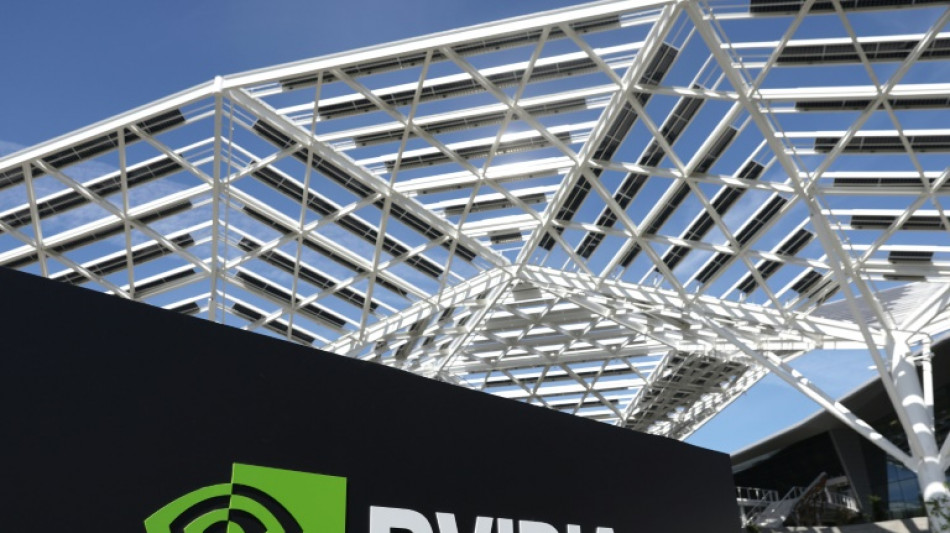
AI chip crunch: startups vie for Nvidia's vital component / Photo: JUSTIN SULLIVAN - GETTY IMAGES NORTH AMERICA/AFP/File

 ALEX BODI AND AMBASSADOR GUM DOMINIC MATIOK OF THE REPUBLIC OF SOUTH SUDAN MEET IN BERLIN TO DISCUSS THE POSSIBILITY OF AN HONORARY CONSULATE IN BUCHAREST

 Lula, Bolsonaro wrap up campaigns ahead of Brazil's knife-edge vote

 Toulouse edge Castres in Top 14 derby

 Murakami homer propels White Sox to MLB playoff win over Guardians

 Israel targets top Hamas leader in deadly Gaza strike on anniversary

 Houthis say struck oil facility near Riyadh, as Saudis hit Sanaa

 AI needs safety layers like nuclear plants: ex-OpenAI engineer

 MVP Judge will miss Yankees' MLB playoff series against Rays

 New lizard species discovered in Peru

 Fernandes hails Portugal's 'greatest symbol' Ronaldo, calls for unity

 Grandidier-Nkanang double takes Pau to Top 14 summit despite Vannes fightback

 Trainer Scott gets perfect Arc boost with top notch double

 Ex-PM says Putin cannot admit 'mistake' over Ukraine

 Houthis say Saudi Arabia launches dozens of strikes on Yemen capital

 Qatar and Abu Dhabi F1 Grand Prix to go ahead - F1 boss

 South Korea lift gloom with smash-and-grab Games football gold

 Ireland news conference before Israel game cut short amid tensions

 Protests over housing flare in Spain after relief measures rejected

 Zverev thrashes Shang to set up Djokovic quarter-final at China Open

 Turkey football ref chief jailed pending trial for graft

 North Korea says test of intermediate-range strategic missile included use of AI

 Rampant Sayers leads Hong Kong to third men's rugby gold in a row

 Ethiopia's Tigray rebels abandon regional capital as govt advances

 Bulgaria's Tsar Samuel returns 'home' after 1,000 years

 'Glad it's over': Kim powers to Games gold and military exemption

The artificial intelligence revolution is fully underway, but soaring demand for its most crucial component has startups scratching their heads on how they can deliver on AI's promise.
Generative AI's lifeblood is a book-sized semiconductor known as the graphics processing unit (GPU) -- built by one company, Nvidia.
Nvidia's CEO and founder Jensen Huang made a wild bet years ago that the world would soon clamor for a powerful chip usually used for making video games, but that could build AI as well.
No company working with the generative AI models that fuel today's frenzy can get off the ground without Nvidia's singular product: the latest model is the H100 and its accompanying software.
That painful reality is one that Amazon, Intel, AMD and others are scrambling to fix with their own alternatives, but those attempts could take years.
- 'Not a lot of GPUs' -
And with the biggest tech companies throwing all their financial might into generative AI, the smaller fish must go on the hunt to secure Nvidia’s holy grail.
"Around the world, it is becoming very hard to get thousands of GPUs because all these big companies are putting in billions of dollars, stockpiling GPUs," said Fangbo Tao, co-founder of Mindverse.AI, a Singapore-based startup.
"There's not a lot of GPUs around," he said.
Tao spoke to AFP at the TechCrunch Disrupt conference in San Francisco, where AI startups jostled to make their pitches to Silicon Valley's venture capitalists (VC).
ChatGPT took the world by storm just as Silicon Valley was caught in a nasty hangover from the pandemic when investors threw money at startups, convinced that life had gone irreversibly online.
That turned out to be far-fetched, and the US tech scene entered a downturn with rounds of layoffs and VC money dried up.
Thanks to AI, some of the old mojo is back, and anyone with those two letters on their resume will likely see a red carpet rolled out on the legendary Sand Hill Road, home to Silicon Valley’s most storied investors.
But as the startups walk away with their VC cash, the money in their pockets will be quickly forked out to Nvidia for GPUs either directly or through providers to bring their AI dreams to execution.
"We call on a lot of the big cloud providers (Microsoft, AWS and Google) ), and they all tell us even they are having trouble getting supplies," said Laurent Daudet, CEO of AI startup LightOn.
The problem is most acute for companies involved in training generative AI models, which requires that power hungry GPUs work at peak capacity to process troves of data ingested from the internet.
The computing needs are so massive that only a few companies can stump up the cash to build one of these state-of-the-art large language models.
- 'Sucking the oxygen' -
The ten billion dollars investment by Microsoft into OpenAI is widely understood to be paid out as credits to access purpose-built data centers humming with Nvidia GPUs.
Google has built its own models and now Amazon on Monday said it was pumping four billion dollars into Anthropic AI, another company that trains AI.
Training on that mountain of data "is sucking out almost all the oxygen from the GPU market right now," said Said Ouissal, CEO of Zededa, a company that works on making AI less power hungry.
"You're looking at mid-next year, maybe late next year before you're actually going to get delivery on new orders. The shortage doesn't seem to be letting up," added Wes Cummins, CEO Applied Digital, a company that supplies AI infrastructure.
Companies on the AI frontlines also point out that Nvidia’s primordial role makes it the de-facto kingmaker on where the technology is going.
The market is "almost entirely driven by the big players -- Googles, Amazons, Metas" that have the "enormous amounts of data and enormous amounts of capital," former Nvidia engineer Jacopo Pantaleoni told The Information.
"This was not the world I wanted to help build," he said.
Some veterans of Silicon Valley said that the frenzied days of Nvidia GPUs will not last forever and that other options will inevitably emerge.
Or the cost of entry will prove too high, even for the giants, bringing the current boom down to earth.
P.Mira--PC



