
-
 ALEX BODI AND AMBASSADOR GUM DOMINIC MATIOK OF THE REPUBLIC OF SOUTH SUDAN MEET IN BERLIN TO DISCUSS THE POSSIBILITY OF AN HONORARY CONSULATE IN BUCHAREST
-
Dodgers step up World Series three-peat bid with 5-3 win over Braves

-
 Lula, Bolsonaro wrap up campaigns ahead of Brazil's knife-edge vote
-
Spain break down Czechs as England outclass Croatia in Nations League

-
 Toulouse edge Castres in Top 14 derby
-
Yamal on target as Spain hold off Czech Republic

-
 Murakami homer propels White Sox to MLB playoff win over Guardians
-
Latvian exit polls suggest pro-European choice

-
 Israel targets top Hamas leader in deadly Gaza strike on anniversary
-
Lula, Bolsonaro wrap up campaigns ahead of knife-edge election

-
 Houthis say struck oil facility near Riyadh, as Saudis hit Sanaa
-
Tuchel hails 'complete' England after Croatia demolition

-
 AI needs safety layers like nuclear plants: ex-OpenAI engineer
-
Fury to invite Trump to lead ring walk before Joshua showdown

-
 MVP Judge will miss Yankees' MLB playoff series against Rays
-
Fashion industry in 'precarious moment', says Vivienne Westwood supremo

-
 New lizard species discovered in Peru
-
Seventh heaven for England in Nations League rout of Croatia

-
 Fernandes hails Portugal's 'greatest symbol' Ronaldo, calls for unity
-
Storms, flooding cause chaos on Greek holiday island of Crete

-
 Grandidier-Nkanang double takes Pau to Top 14 summit despite Vannes fightback
-
#IAmJaneDoe: online support campaign in US university rape case

-
 Trainer Scott gets perfect Arc boost with top notch double
-
Brazil shine on Selecao's first visit to India

-
 Ex-PM says Putin cannot admit 'mistake' over Ukraine
-
Zverev sets up Djokovic quarter-final at China Open, Rybakina out

-
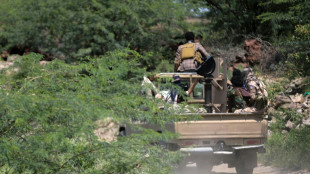 Houthis say Saudi Arabia launches dozens of strikes on Yemen capital
-
Happier at home, Bordeaux hammer Lyon in Top 14

-
 Qatar and Abu Dhabi F1 Grand Prix to go ahead - F1 boss
-
Lula, Bolsonaro in final push for votes ahead of knife-edge election

-
 South Korea lift gloom with smash-and-grab Games football gold
-
Boisterous fashion week barnstorms 'sleepy' Nigerian capital

-
 Ireland news conference before Israel game cut short amid tensions
-
UAE investigators say flydubai co-pilot was planning 'terrorist act'

-
 Protests over housing flare in Spain after relief measures rejected
-
Rahul smacks century in India v Windies ODI

-
 Zverev thrashes Shang to set up Djokovic quarter-final at China Open
-
Daryz seeks to join exclusive club of dual Arc winners

-
 Turkey football ref chief jailed pending trial for graft
-
Russia warns diplomats to leave Kyiv over new strikes threat

-
 North Korea says test of intermediate-range strategic missile included use of AI
-
Olympic champ Zheng rebukes rowdy home crowd at China Open

-
 Rampant Sayers leads Hong Kong to third men's rugby gold in a row
-
World No.1 Sinner pulls out of Shanghai Masters to delay return

-
 Ethiopia's Tigray rebels abandon regional capital as govt advances
-
Red Bull's Verstappen grabs pole position for Bahrain GP

-
 Bulgaria's Tsar Samuel returns 'home' after 1,000 years
-
India beat Pakistan in blockbuster as golfer Kim wins 'crazy' gold

-
 'Glad it's over': Kim powers to Games gold and military exemption
-
India beat arch-rivals Pakistan to win Asian Games cricket gold

NASA asteroid sample contains life-critical water and carbon
A sample collected from the 4.5-billion-year-old asteroid Bennu contains abundant water and carbon, both vital materials for the formation of our planet, NASA revealed on Wednesday.
The finding offers yet more evidence for the theory that the foundations for life on Earth were seeded from outer space.
"The first analysis shows samples that contain abundant water in the form of hydrated clay minerals," Bill Nelson said in a press event.
"This is the biggest carbon rich asteroid sample ever returned to Earth," he said, with the carbon contained in the form of both minerals and organic molecules.
The OSIRIS-REx mission collected rock and dust from Bennu in 2020, and a capsule containing the precious cargo successfully returned to Earth a little over two weeks ago, landing in the Utah desert.
It is now being painstakingly analyzed in a specialized clean room at NASA's Johnson Space Center in Houston.
OSIRIS-REx wasn't the first mission to rendezvous with an asteroid and bring back samples for study -- Japan succeeded in the feat twice, returning bits of space pebbles in 2010 and 2020.
But the substantial amount of material -- an estimated 250 grams (half a pound) -- as opposed to the 5.4 grams returned by Japan's Hayabusa2 -- is a key difference.
NASA chose Bennu because they think similar asteroids could have delivered organic building blocks to Earth along with water through collisions billions of years ago.
Bennu's orbit, which intersects that of our planet, also made the roundtrip journey easier than going to the Asteroid Belt, which lies between Mars and Jupiter.
Researchers have so far focused their efforts not on the main sample itself but on "bonus particles," described as black dust and debris coating the sample collector.
Back in October 2020, when OSIRIS-REx probe shot nitrogen gas at Bennu to collect its sample, a flap meant to seal it got wedged open with a piece of rock, allowing some of the finer material to flow out of the collector without escaping altogether.
"The very best 'problem' to have is that there is so much material, it's taking longer than we expected to collect it," said deputy OSIRIS-REx curation lead Christopher Snead, in a statement.
An inspection of the remainder of the sample will follow later.
It's thought that Bennu formed from pieces of a larger asteroid in the asteroid belt, following a massive collision between one and two billion years ago.
Data gathered by the spacecraft revealed the particles making up its exterior were so loosely packed that if a person were to step onto the surface, they might sink in, much like stepping into a pit of plastic balls.
In addition to scientific insights, better understanding of Bennu's composition could prove useful if humanity ever needs to steer it away.
While it has no chance of hitting Earth through the mid 2100s, the chances rise to around 1 in 1750 between then and the year 2300, NASA says.
M.Gameiro--PC



