Five things to know about NASA's mission to a metal world / Photo: Handout - NASA/JPL-Caltech/AFP

 ALEX BODI AND AMBASSADOR GUM DOMINIC MATIOK OF THE REPUBLIC OF SOUTH SUDAN MEET IN BERLIN TO DISCUSS THE POSSIBILITY OF AN HONORARY CONSULATE IN BUCHAREST

 Lula, Bolsonaro wrap up campaigns ahead of Brazil's knife-edge vote

 Toulouse edge Castres in Top 14 derby

 Murakami homer propels White Sox to MLB playoff win over Guardians

 Israel targets top Hamas leader in deadly Gaza strike on anniversary

 Houthis say struck oil facility near Riyadh, as Saudis hit Sanaa

 AI needs safety layers like nuclear plants: ex-OpenAI engineer

 MVP Judge will miss Yankees' MLB playoff series against Rays

 New lizard species discovered in Peru

 Fernandes hails Portugal's 'greatest symbol' Ronaldo, calls for unity

 Grandidier-Nkanang double takes Pau to Top 14 summit despite Vannes fightback

 Trainer Scott gets perfect Arc boost with top notch double

 Ex-PM says Putin cannot admit 'mistake' over Ukraine

 Houthis say Saudi Arabia launches dozens of strikes on Yemen capital

 Qatar and Abu Dhabi F1 Grand Prix to go ahead - F1 boss

 South Korea lift gloom with smash-and-grab Games football gold

 Ireland news conference before Israel game cut short amid tensions

 Protests over housing flare in Spain after relief measures rejected

 Zverev thrashes Shang to set up Djokovic quarter-final at China Open

 Turkey football ref chief jailed pending trial for graft
 North Korea says test of intermediate-range strategic missile included use of AI

 Rampant Sayers leads Hong Kong to third men's rugby gold in a row

 Ethiopia's Tigray rebels abandon regional capital as govt advances

 Bulgaria's Tsar Samuel returns 'home' after 1,000 years

 'Glad it's over': Kim powers to Games gold and military exemption

For the first time ever, a NASA probe is set to journey to an object composed not of rock, ice, or gas, but metal: the asteroid Psyche.
By studying this space oddity, scientists hope to learn more about the inner cores of rocky planets such as our own -- or, potentially catalog a previously unknown class of cosmic body.
Here are some big numbers and fun facts to dazzle your friends with about the mission.
- $10 quadrillion -
If Psyche were mineable, its iron, nickel and gold deposits could be worth an eye-watering $10,000 quadrillion (that's $10,000,000,000,000,000,000), according to an estimate reported by Forbes magazine.
But Lindy Elkins-Tanton, the mission's principal investigator who was responsible for that calculation, said it's nothing more than a "fun intellectual exercise with no truth to it."
"We have zero technology as a species to bring Psyche back to Earth," she said in a recent briefing. Attempting to do so could backfire by causing an apocalyptic collision -- but even if the endeavor were successful, it would flood the metals market, reducing their value to zero, she said.
- An electric voyage -
The Psyche probe will blast off on a SpaceX Falcon Heavy rocket, but to complete its 2.2 billion-mile (3.6 billion-kilometer) journey, it will turn to a far more efficient form of propulsion.
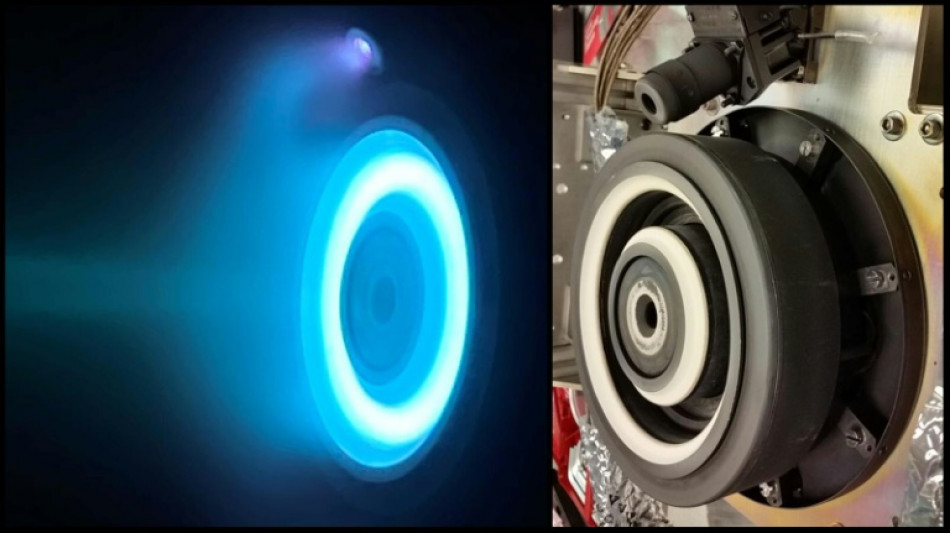
Psyche's solar arrays convert light into electricity, providing the power for its four solar electric or "Hall-effect" thrusters. These use electromagnetic fields to accelerate and expel ions (charged atoms) of xenon, the same inert gas used in car headlights and plasma TVs.
While the resulting blue glow is evocative of Star Trek, it's no warp drive: the actual force it exerts in a given moment is roughly equal to the weight of an AA battery in the palm of your hand.
But in the void of space, the probe will accelerate continuously to tens of thousands of miles an hour.
- Laser communications -
With deep space missions demanding higher and higher data rates, NASA is turning to laser-based systems to complement radio-frequency based communications.
Psyche will carry onboard a technology experiment, to demonstrate a "10 times augmentation of traditional telecom data rates," said Abi Biswas of NASA's Jet Propulsion Laboratory -- enabling the transmission of higher resolution images, more science data, and streaming video.
NASA will shoot its laser beam from a JPL facility on Table Mountain in California, with the spacecraft firing its signal back to Caltech's Palomar Observatory. The hope is eventually to use the technology on human missions to Mars.
- Gravity science -
Psyche has a suite of dedicated scientific instruments to probe the asteroid's chemical and mineral composition and look for signs of an ancient magnetic field.
But the science team will also use Psyche's trusty old radio system to probe the asteroid's gravity field using the Doppler Effect.
"We can look at the pitch or frequency of the radio waves coming from the antenna and figure out how fast the spacecraft is moving" as it orbits its target, said planetary scientist Ben Weiss, just as ambulance sirens have a higher pitch as they come towards you and lower as they move away.
By tracking the spacecraft's speed at different points around the asteroid, they can determine how "lumpy" the gravity field is, which in turn provides clues about the composition and structure of the interior.
- Less metal, more rock? -
Given its brightness, there was until recently broad consensus that Psyche was almost entirely metal -- consistent with the theory it is an exposed planetary core whose rocky crust and mantle were blown off in an ancient collision.
But the way it imposes gravity on neighboring bodies suggests it's less dense than all iron-body should be, according to a 2022 paper by researchers at Brown University.
One possibility they put forward is iron-spewing volcanoes brought metal up from Psyche's core to coat its surface above a rocky mantle -- effectively creating a structure akin to a metal sandwich.
It won't be until 2029, when the Psyche spacecraft reaches its destination, that we'll know for sure.
S.Pimentel--PC



