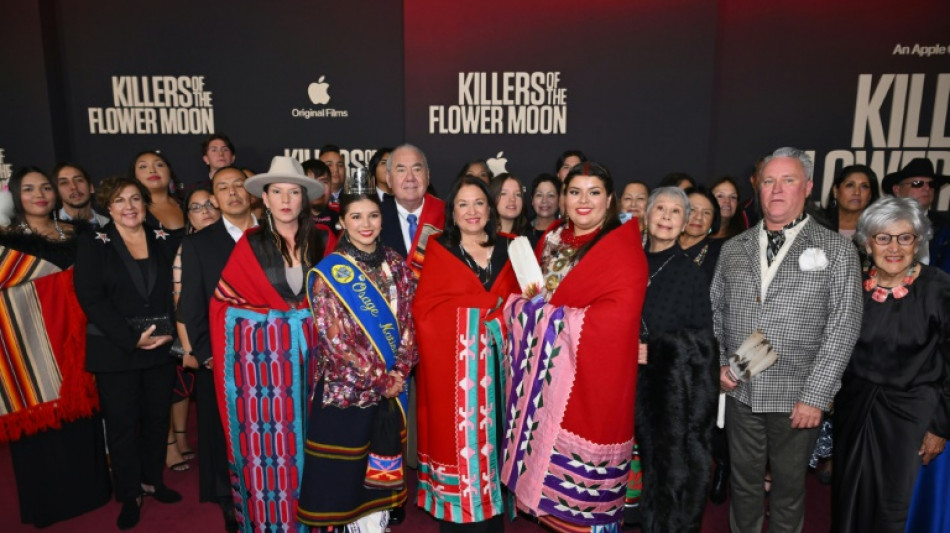
Scorsese 'Flower Moon' epic based on real Native American past / Photo: ANGELA WEISS - AFP/File

 ALEX BODI AND AMBASSADOR GUM DOMINIC MATIOK OF THE REPUBLIC OF SOUTH SUDAN MEET IN BERLIN TO DISCUSS THE POSSIBILITY OF AN HONORARY CONSULATE IN BUCHAREST

 Lula, Bolsonaro wrap up campaigns ahead of Brazil's knife-edge vote

 Toulouse edge Castres in Top 14 derby

 Murakami homer propels White Sox to MLB playoff win over Guardians

 Israel targets top Hamas leader in deadly Gaza strike on anniversary

 Houthis say struck oil facility near Riyadh, as Saudis hit Sanaa

 AI needs safety layers like nuclear plants: ex-OpenAI engineer

 MVP Judge will miss Yankees' MLB playoff series against Rays

 New lizard species discovered in Peru

 Fernandes hails Portugal's 'greatest symbol' Ronaldo, calls for unity

 Grandidier-Nkanang double takes Pau to Top 14 summit despite Vannes fightback

 Trainer Scott gets perfect Arc boost with top notch double

 Ex-PM says Putin cannot admit 'mistake' over Ukraine

 Houthis say Saudi Arabia launches dozens of strikes on Yemen capital

 Qatar and Abu Dhabi F1 Grand Prix to go ahead - F1 boss

 South Korea lift gloom with smash-and-grab Games football gold

 Ireland news conference before Israel game cut short amid tensions

 Protests over housing flare in Spain after relief measures rejected

 Zverev thrashes Shang to set up Djokovic quarter-final at China Open

 Turkey football ref chief jailed pending trial for graft

 North Korea says test of intermediate-range strategic missile included use of AI

 Rampant Sayers leads Hong Kong to third men's rugby gold in a row

 Ethiopia's Tigray rebels abandon regional capital as govt advances

 Bulgaria's Tsar Samuel returns 'home' after 1,000 years

 'Glad it's over': Kim powers to Games gold and military exemption

Martin Scorsese's new film "Killers of the Flower Moon" recounts how the Osage nation of Native Americans gained significant oil wealth in the early 20th century and the murderous plot by outsiders to seize it.
Ahead of the movie's US release, AFP looks at the real-life story behind the film, which was adapted from US author David Grann's 2017 book of the same name.
- Who are the Osage? -
The Osage, a Native American nation which grew out of the Ohio and Mississippi River valleys, was forcibly relocated by the US government in the late 19th century westward to a reservation in what would later become the central state of Oklahoma.
As the new proprietors of the land, the nation in 1906 negotiated a rare agreement with the federal government giving Osage members exclusive mineral rights which could not be transferred or sold, only inherited.
Not long after, prospectors discovered that the Osage Reservation lied on an enormous oil reserve.
With demand for oil skyrocketing, the Osage quickly gained wealth.
In 1923 alone, according to Grann, the nation earned the equivalent of more than $400 million in today's money.
White settlers flocked to the area to take advantage of the black gold windfall.
They set up businesses, married members of the tribe or became managers of the Osage members' fortunes.
In 1921, Congress passed a racist law requiring Native Americans to have a guardian of the oil wealth appointed until they proved their "competency."
- What was the Reign of Terror? -
From 1921 to 1925, a series of murders and suspicious deaths struck the Osage Nation, who have dubbed the period the "Reign of Terror."
Mollie Kyle Burkhart's family was particularly hard-hit. Her sister Anna Kyle Brown was shot in the head in 1921, and their mother Lizzie died a few months later of suspected poisoning.
Rita Smith, another of Mollie's sisters, and husband Bill died after a bomb exploded in their home in 1923.
Their distant cousin, Henry Roan, was also found shot in the head the same year.
The Osage nation states on its website that at least 60 people were killed during this period, but that there were potentially even more murders, as some suspicious deaths were never investigated.
- Federal investigation -
With the death toll mounting, US authorities relaunched an investigation in 1925 under the auspices of the Bureau of Investigation, a forerunner of today's FBI.
After months of investigation, the federal officials uncovered an intra-family plot.
Burkhart's husband Ernest, a white settler, and his uncle William Hale, a wealthy white rancher, had orchestrated the murders in order to take control of their oil rights.
Ernest Burkhart and Hale, after attempting to cover up the crimes, were convicted of murder and received life sentences in 1926 and 1929.
Grann alleges in his book that other murders, which went without convictions due to a lack of evidence, are almost all attributed to people from outside the nation seeking to seize Osage oil rights.
- Today -
Around a quarter of the shares of the reservation's oil rights are held today by non-Osages. Most of the oil has since dried up, however, and royalty checks now amount to only a few thousand dollars.
The Osage Nation is nonetheless pushing for federal legislation that would allow the non-Osages' shares to be gifted or sold back to the nation.
The murders of the 1920s left an indelible mark on the memory of the Osage community, which was heavily involved in the making of Scorsese's film.
Alongside stars Leonardo DiCaprio and Robert De Niro, the film features Osage actors, props made by Osage craftworkers and involved work with Osage language experts.
A.Silveira--PC



