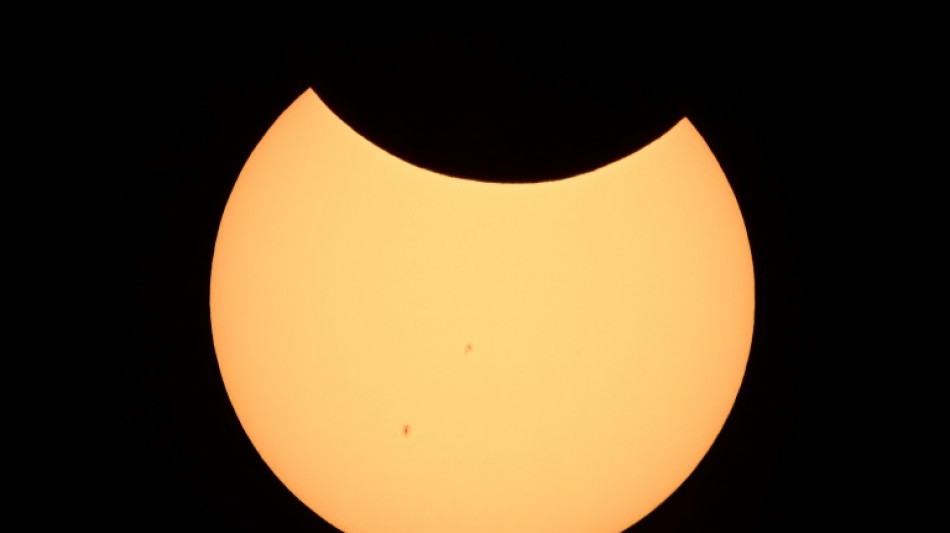
Skygazers watch 'Ring of Fire' eclipse over Western Hemisphere / Photo: Patrick T. Fallon - AFP

 ALEX BODI AND AMBASSADOR GUM DOMINIC MATIOK OF THE REPUBLIC OF SOUTH SUDAN MEET IN BERLIN TO DISCUSS THE POSSIBILITY OF AN HONORARY CONSULATE IN BUCHAREST

 Lula, Bolsonaro wrap up campaigns ahead of Brazil's knife-edge vote

 Toulouse edge Castres in Top 14 derby

 Murakami homer propels White Sox to MLB playoff win over Guardians

 Israel targets top Hamas leader in deadly Gaza strike on anniversary

 Houthis say struck oil facility near Riyadh, as Saudis hit Sanaa

 AI needs safety layers like nuclear plants: ex-OpenAI engineer

 MVP Judge will miss Yankees' MLB playoff series against Rays

 New lizard species discovered in Peru

 Fernandes hails Portugal's 'greatest symbol' Ronaldo, calls for unity

 Grandidier-Nkanang double takes Pau to Top 14 summit despite Vannes fightback

 Trainer Scott gets perfect Arc boost with top notch double

 Ex-PM says Putin cannot admit 'mistake' over Ukraine

 Houthis say Saudi Arabia launches dozens of strikes on Yemen capital

 Qatar and Abu Dhabi F1 Grand Prix to go ahead - F1 boss

 South Korea lift gloom with smash-and-grab Games football gold

 Ireland news conference before Israel game cut short amid tensions

 Protests over housing flare in Spain after relief measures rejected

 Zverev thrashes Shang to set up Djokovic quarter-final at China Open

 Turkey football ref chief jailed pending trial for graft
 North Korea says test of intermediate-range strategic missile included use of AI

 Rampant Sayers leads Hong Kong to third men's rugby gold in a row

 Ethiopia's Tigray rebels abandon regional capital as govt advances

 Bulgaria's Tsar Samuel returns 'home' after 1,000 years

 'Glad it's over': Kim powers to Games gold and military exemption

Skygazers across the Americas turned their faces upwards Saturday for a rare celestial event: an annular solar eclipse.
A crowd wearing protective eyewear gathered in Albuquerque, New Mexico, one of many across the western United States to be watching as the Moon began passing between the Sun and Earth at its furthest point from our planet.
Since it is so distant, it will not cover the Sun completely, creating a "ring of fire" effect.
In the course of just a few hours the most striking "path of the annularity" will cross a handful of major cities, including Albuquerque as well as Eugene, Oregon and San Antonio, Texas, with partial eclipse phases lasting an hour or two before and after.
At any given location, it will be visible from between 30 seconds and five minutes -- but people are urged to take safety precautions and use solar viewing glasses, and never regular sunglasses, to preserve their vision.
"Do NOT look at the Sun through a camera lens, telescope, binoculars, or any other optical device while wearing eclipse glasses or using a handheld solar viewer —- the concentrated solar rays will burn through the filter and cause serious eye injury," NASA says.
Next the eclipse will cross Mexico and Central America, then into South America through Colombia and northern Brazil before ending at sunset in the Atlantic Ocean.
For those not lucky enough to be in the path of this special astronomical transit, NASA was live streaming the event on nasa.gov/nasatv/ from 11:30am to 1:15 pm eastern time (1530 to 1715 GMT) from Albuquerque, as well as Carville, Texas and White Sands, New Mexico.
- Sounding rockets -
The event also serves as a dress rehearsal before a total eclipse set for April 2024.
Both eclipses are going to be "absolutely breathtaking for science," said Madhulika Guhathakurta, a heliophysics program scientist.
Solar eclipses have a noticeable effect on the upper atmosphere, such as the ionosphere, which is full of charged particles and responsible for reflecting and refracting radio waves.
"Although the atmospheric effects of solar eclipses have been studied for over 50 years, many unanswered questions remain," said Guhathakurta.
To study these effects, NASA will launch three rockets from the White Sands Missile Range in New Mexico to gather data on the electric and magnetic fields, electron density and temperature.
A total eclipse took place in 2017 in the United States. After next April's total eclipse, there will not be another until 2044, while the next annular eclipse will be in 2046.
V.Fontes--PC



