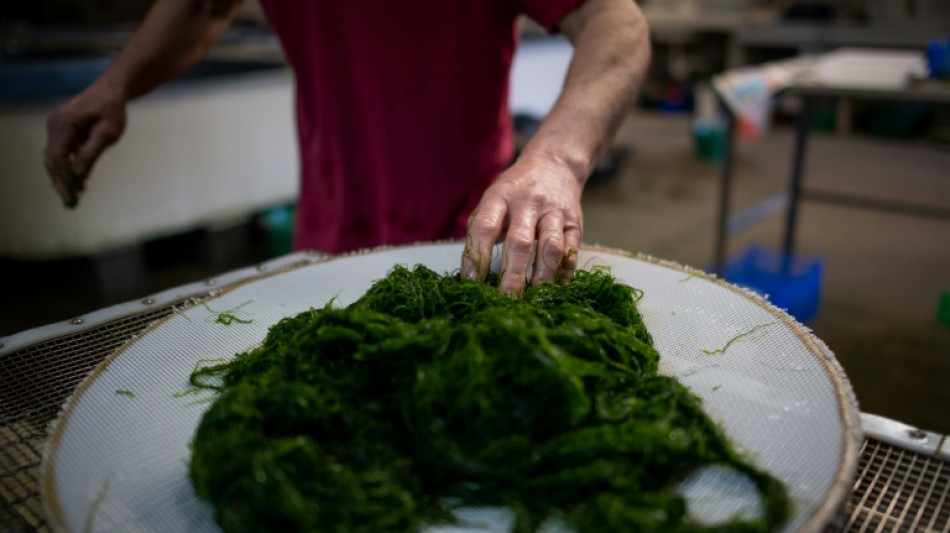
Back on the menu? Europeans once ate seaweed, research shows / Photo: LOIC VENANCE - AFP/File

 ALEX BODI AND AMBASSADOR GUM DOMINIC MATIOK OF THE REPUBLIC OF SOUTH SUDAN MEET IN BERLIN TO DISCUSS THE POSSIBILITY OF AN HONORARY CONSULATE IN BUCHAREST

 Lula, Bolsonaro wrap up campaigns ahead of Brazil's knife-edge vote

 Toulouse edge Castres in Top 14 derby

 Murakami homer propels White Sox to MLB playoff win over Guardians

 Israel targets top Hamas leader in deadly Gaza strike on anniversary

 Houthis say struck oil facility near Riyadh, as Saudis hit Sanaa

 AI needs safety layers like nuclear plants: ex-OpenAI engineer

 MVP Judge will miss Yankees' MLB playoff series against Rays

 New lizard species discovered in Peru

 Fernandes hails Portugal's 'greatest symbol' Ronaldo, calls for unity
 Grandidier-Nkanang double takes Pau to Top 14 summit despite Vannes fightback
 Trainer Scott gets perfect Arc boost with top notch double

 Ex-PM says Putin cannot admit 'mistake' over Ukraine

 Houthis say Saudi Arabia launches dozens of strikes on Yemen capital

 Qatar and Abu Dhabi F1 Grand Prix to go ahead - F1 boss

 South Korea lift gloom with smash-and-grab Games football gold

 Ireland news conference before Israel game cut short amid tensions

 Protests over housing flare in Spain after relief measures rejected

 Zverev thrashes Shang to set up Djokovic quarter-final at China Open

 Turkey football ref chief jailed pending trial for graft

 North Korea says test of intermediate-range strategic missile included use of AI

 Rampant Sayers leads Hong Kong to third men's rugby gold in a row

 Ethiopia's Tigray rebels abandon regional capital as govt advances

 Bulgaria's Tsar Samuel returns 'home' after 1,000 years

 'Glad it's over': Kim powers to Games gold and military exemption

Europeans now rarely eat seaweed, but it was an important part of their diet until the late Middle Ages, archaeologists said Tuesday, calling for the eco-friendly aquatic plant to be put back on the menu.
Seaweed, a healthy and sustainable source of protein, is a staple food in some Asian countries such as Japan. But it has long been shunned by traditional Western diets -- with a few exceptions, such as the Welsh dish laverbread.
It was previously thought that since the rise of farming, Europeans had mostly used seaweed as fuel, fertiliser or to feed livestock. It was only eaten to stave off hunger during famine, so the thinking went.
But a new study published in the journal Nature Communications found that Europeans were gobbling up seaweed millennia after that point, and suggested the continent re-embrace the nutritious food.
To find out about ancient seaweed consumption, a UK-led team of researchers analysed dental plaque extracted from the teeth of 74 different people who lived thousands of years ago at 28 sites ranging from Scotland to Spain.
Using a mass spectrometry technique to identify organic compounds, they found evidence that the teeth had chowed down on several different aquatic plants.
Red seaweed was eaten both in Scotland's northern Orkney islands around 5,000 years ago and at Casa Corona in southern Spain 8,000 years ago, the study found.
Freshwater aquatic plants, such as the pondweed Potamogeton, were commonly eaten in Portugal, Scotland and Lithuania, it added.
Karen Hardy, an archaeologist at Scotland's University of Glasgow and the study's lead author, told AFP that aquatic plants were "very likely eaten over a much more wide timescale than we found".
Europeans were previously believed to have turned their noses up at seaweed following the introduction of agriculture more than 10,000 years ago.
However, research in this field has focused on agricultural production, so may have missed out on seaweed, which is easy to find and eat.
The authors of the study said seaweed has the potential to be a locally sourced, low-emission option that does not require the mass farming of the meals normally seen on Europe's plates.
"It's very healthy, it's nutritious, it's available, it's renewable," Hardy said.
"People ate it in the past in Europe," she said, adding hopefully that maybe they will again.
A.P.Maia--PC



