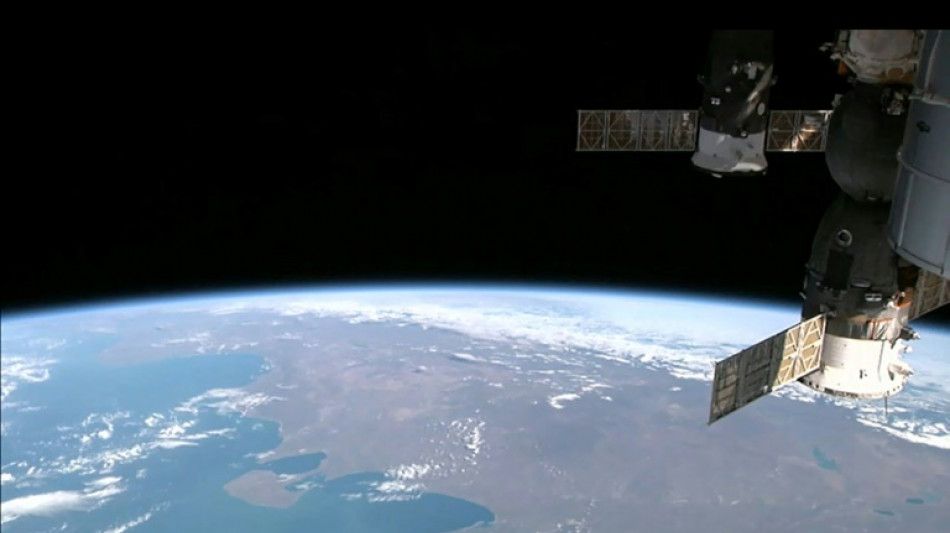
Mouse embryos grown in space for first time: Japan researchers / Photo: HANDOUT - NASA/AFP/File

 ALEX BODI AND AMBASSADOR GUM DOMINIC MATIOK OF THE REPUBLIC OF SOUTH SUDAN MEET IN BERLIN TO DISCUSS THE POSSIBILITY OF AN HONORARY CONSULATE IN BUCHAREST

 Lula, Bolsonaro wrap up campaigns ahead of Brazil's knife-edge vote

 Toulouse edge Castres in Top 14 derby

 Murakami homer propels White Sox to MLB playoff win over Guardians

 Israel targets top Hamas leader in deadly Gaza strike on anniversary

 Houthis say struck oil facility near Riyadh, as Saudis hit Sanaa

 AI needs safety layers like nuclear plants: ex-OpenAI engineer

 MVP Judge will miss Yankees' MLB playoff series against Rays

 New lizard species discovered in Peru

 Fernandes hails Portugal's 'greatest symbol' Ronaldo, calls for unity

 Grandidier-Nkanang double takes Pau to Top 14 summit despite Vannes fightback
 Trainer Scott gets perfect Arc boost with top notch double

 Ex-PM says Putin cannot admit 'mistake' over Ukraine

 Houthis say Saudi Arabia launches dozens of strikes on Yemen capital

 Qatar and Abu Dhabi F1 Grand Prix to go ahead - F1 boss

 South Korea lift gloom with smash-and-grab Games football gold

 Ireland news conference before Israel game cut short amid tensions

 Protests over housing flare in Spain after relief measures rejected

 Zverev thrashes Shang to set up Djokovic quarter-final at China Open

 Turkey football ref chief jailed pending trial for graft

 North Korea says test of intermediate-range strategic missile included use of AI

 Rampant Sayers leads Hong Kong to third men's rugby gold in a row

 Ethiopia's Tigray rebels abandon regional capital as govt advances

 Bulgaria's Tsar Samuel returns 'home' after 1,000 years

 'Glad it's over': Kim powers to Games gold and military exemption

Mouse embryos have been grown on the International Space Station and developed normally in the first study indicating it could be possible for humans to reproduce in space, a group of Japanese scientists said.
The researchers, including Teruhiko Wakayama, professor of University of Yamanashi's Advanced Biotechnology Centre, and a team from the Japan Aerospace Space Agency (JAXA), sent frozen mouse embryos on board a rocket to the ISS in August 2021.
Astronauts thawed the early-stage embryos using a special device designed for this purpose and grew them on the station for four days.
"The embryos cultured under microgravity conditions developed" normally into blastocysts, cells that develop into the foetus and placenta, the scientists said.
The experiment "clearly demonstrated that gravity had no significant effect," the researchers said in a study that was published online in the scientific journal iScience on Saturday.
They also said there were no significant changes in condition of the DNA and genes, after they analysed the blastocysts that were sent back to their laboratories on Earth.
This is "the first-ever study that shows mammals may be able to thrive in space," University of Yamanashi and national research institute Riken said in a joint statement on Saturday.
It is "the world's first experiment that cultured early-stage mammalian embryos under complete microgravity of ISS," the statement said.
"In the future, it will be necessary to transplant the blastocysts that were cultured in ISS's microgravity into mice to see if mice can give birth" to confirm that the blastocysts are normal, it added.
Such research could be important for future space exploration and colonisation missions.
Under its Artemis programme, NASA plans to send humans back to the Moon in order to learn how to live there long-term to help prepare a trip to Mars, sometime towards the end of the 2030s.
T.Resende--PC



