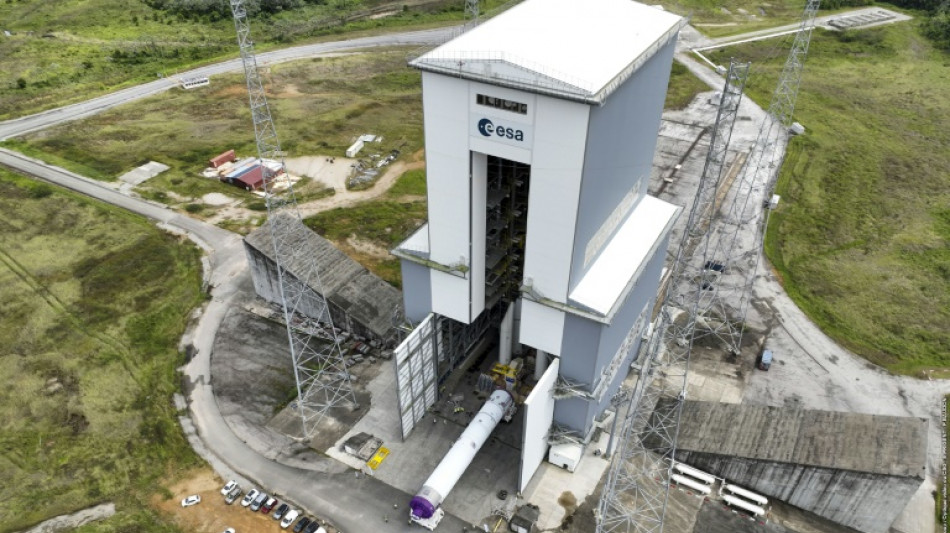
Europe to hold competition to build space cargo ship / Photo: E PRIGENT, P BAUDON - ESA-CNES-Arianespace/Optique/AFP/File

 ALEX BODI AND AMBASSADOR GUM DOMINIC MATIOK OF THE REPUBLIC OF SOUTH SUDAN MEET IN BERLIN TO DISCUSS THE POSSIBILITY OF AN HONORARY CONSULATE IN BUCHAREST

 Lula, Bolsonaro wrap up campaigns ahead of Brazil's knife-edge vote
 Toulouse edge Castres in Top 14 derby

 Murakami homer propels White Sox to MLB playoff win over Guardians

 Israel targets top Hamas leader in deadly Gaza strike on anniversary

 Houthis say struck oil facility near Riyadh, as Saudis hit Sanaa

 AI needs safety layers like nuclear plants: ex-OpenAI engineer

 MVP Judge will miss Yankees' MLB playoff series against Rays

 New lizard species discovered in Peru

 Fernandes hails Portugal's 'greatest symbol' Ronaldo, calls for unity

 Grandidier-Nkanang double takes Pau to Top 14 summit despite Vannes fightback

 Trainer Scott gets perfect Arc boost with top notch double
 Ex-PM says Putin cannot admit 'mistake' over Ukraine
 Houthis say Saudi Arabia launches dozens of strikes on Yemen capital
 Qatar and Abu Dhabi F1 Grand Prix to go ahead - F1 boss

 South Korea lift gloom with smash-and-grab Games football gold

 Ireland news conference before Israel game cut short amid tensions

 Protests over housing flare in Spain after relief measures rejected

 Zverev thrashes Shang to set up Djokovic quarter-final at China Open

 Turkey football ref chief jailed pending trial for graft

 North Korea says test of intermediate-range strategic missile included use of AI

 Rampant Sayers leads Hong Kong to third men's rugby gold in a row

 Ethiopia's Tigray rebels abandon regional capital as govt advances

 Bulgaria's Tsar Samuel returns 'home' after 1,000 years

 'Glad it's over': Kim powers to Games gold and military exemption

The European Space Agency announced Monday it would hold a competition between firms to build a ship to deliver cargo to the International Space Station, in a potential first step towards independent missions carrying astronauts.
The ESA's 22 member states, whose space ministers were meeting at a two-day summit in the Spanish city of Seville, also agreed to provide financial support for Europe's long-delayed Ariane 6 rocket.
The summit comes at a difficult time for European space efforts, as the Ariane 6 delays have left the continent without a way to independently blast its missions into space.
Europe also faces growing competition not just from the United States, but newer players China and India, as well as private companies such as billionaire Elon Musk's SpaceX.
ESA chief Josef Aschbacher told the summit that "a new economy is developing in low Earth orbit that will transform space exploration," adding that "private companies are revolutionising the landscape from launchers to exploration".
Aschbacher proposed "a competition between innovative European companies" to develop a ship that would transport cargo to the ISS by 2028 -- then bring it back to Earth.
The project will require "transport, docking and re-entry capability, something Europe does not possess today," he added.
"The service vehicle could later evolve to a crew vehicle and serve other destinations beyond low Earth orbit," he said.
Aschbacher also called on Europe to decide on the scale of its ambitions in space. In April, experts in a report commissioned by the ESA called for Europe to establish a "sustained presence" on the surface of the Moon.
- 'First step' -
A source close to the negotiations told AFP that "if we want to carry out manned flights, (the cargo ship competition) is the first step."
"You have to be able to send a cargo ship to a station and come back. That is the first brick," the source added.
Aschbacher said that 75 million euros ($80 million) had been secured to fund the first phase of the project, which companies would also contribute to.
The Exploration Company, a French-German start-up already developing a vehicle to deliver cargo to potential future private space stations, welcomed the news.
"This is a new ambition for Europe," the firm's CEO Helene Huby told AFP.
Huby said the ESA's "reasonable" approach followed the roadmap of SpaceX and the US, Russian and Chinese space programmes.
"One starts with the cargo ship and then sends people," she said.
The competition indicates a new approach by the ESA based on the model of US space agency NASA, meaning that for future missions it could buy a ride on the rockets of private companies rather than developing its own such programmes.
This idea seems to clash with the long-standing ESA principle of geographic return, which holds that each country's investment should result in a roughly equal industrial benefit for its companies.
Aschbacher suggested that this principle should be called into question.
- 'Launcher crisis' -
The summit also aimed to address Europe's "launcher crisis," which Aschbacher said was the "most serious" in the history of the continent's space efforts.
Already delayed by four years, Europe's next-generation Ariane 6 rocket is now not scheduled to make its maiden flight until next year.
Europe lost access to Russia's Soyuz rockets after Moscow invaded Ukraine last year, and its smaller Vega C launcher is still grounded after the failure of its first commercial flight in December.
The ESA announced at the summit that the Ariane 6 programme would receive 340 million euros ($365 million) following negotiations between France, Germany and Italy, the agency's three biggest contributors.
The Vega C rocket could be subsidised to the tune of 21 million euros a year from its 26th to 42nd flight, it added.
The ESA also announced it would "harness space for a greener future".
Last week, the ESA and the European Union agreed to join forces to accelerate the use of Earth observation missions to collect climate change data.
J.Oliveira--PC



