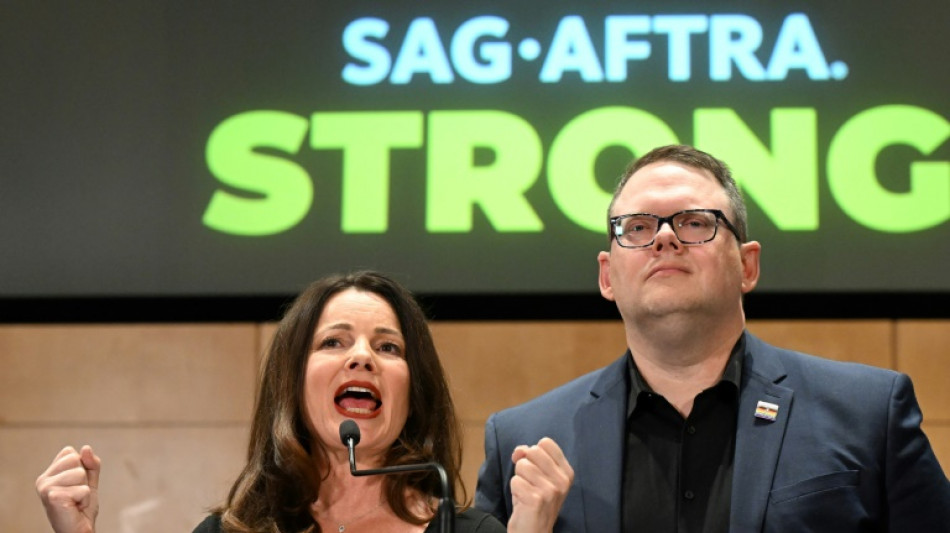
Actors union explains AI guardrails in strike deal / Photo: Robyn BECK - AFP

 ALEX BODI AND AMBASSADOR GUM DOMINIC MATIOK OF THE REPUBLIC OF SOUTH SUDAN MEET IN BERLIN TO DISCUSS THE POSSIBILITY OF AN HONORARY CONSULATE IN BUCHAREST
 Lula, Bolsonaro wrap up campaigns ahead of Brazil's knife-edge vote

 Toulouse edge Castres in Top 14 derby

 Murakami homer propels White Sox to MLB playoff win over Guardians

 Israel targets top Hamas leader in deadly Gaza strike on anniversary

 Houthis say struck oil facility near Riyadh, as Saudis hit Sanaa

 AI needs safety layers like nuclear plants: ex-OpenAI engineer

 MVP Judge will miss Yankees' MLB playoff series against Rays

 New lizard species discovered in Peru

 Fernandes hails Portugal's 'greatest symbol' Ronaldo, calls for unity

 Grandidier-Nkanang double takes Pau to Top 14 summit despite Vannes fightback
 Trainer Scott gets perfect Arc boost with top notch double

 Ex-PM says Putin cannot admit 'mistake' over Ukraine
 Houthis say Saudi Arabia launches dozens of strikes on Yemen capital
 Qatar and Abu Dhabi F1 Grand Prix to go ahead - F1 boss

 South Korea lift gloom with smash-and-grab Games football gold
 Ireland news conference before Israel game cut short amid tensions

 Protests over housing flare in Spain after relief measures rejected

 Zverev thrashes Shang to set up Djokovic quarter-final at China Open

 Turkey football ref chief jailed pending trial for graft

 North Korea says test of intermediate-range strategic missile included use of AI
 Rampant Sayers leads Hong Kong to third men's rugby gold in a row

 Ethiopia's Tigray rebels abandon regional capital as govt advances

 Bulgaria's Tsar Samuel returns 'home' after 1,000 years

 'Glad it's over': Kim powers to Games gold and military exemption

From computer-generated "extras" to AI "zombies," new restrictions against the use of artificial intelligence in Hollywood were set out by the actors' union Friday.
The Screen Actors Guild (SAG-AFTRA) reached a deal with studios like Disney and Netflix this week to end its nearly four-month strike. Its board members on Friday voted 86 percent in favor of ratifying the agreement.
Besides a seven percent minimum pay increase, and a new $40-million-per-year fund to transfer a portion of revenues for hit shows from studios to actors, AI guardrails were a key part of talks.
The deal "allows the industry to go forward -- it does not block AI," SAG-AFTRA negotiator Duncan Crabtree-Ireland told a press conference.
"But it makes sure that performers are protected. Their rights to consent are protected. Their rights to fair compensation and their rights to employment are protected."
Studios have been experimenting with AI in recent years, from bringing deceased movie stars back using realistic "digital replicas," to using computer-generated background figures to reduce the number of actors needed for battle scenes.
Many cost-cutting producers want a growing role for AI, and have begun requiring some performers to take part in high-tech 3D "body scans" on set, often without explaining how or when the images will be used.
But now, an actor must be paid the same rate for any use of their digital replica as they would have earned doing the same "amount of work" on set themselves in real life, Crabtree-Ireland said.
Amid fears that background workers -- or "extras" -- could be the first to lose their jobs to AI, strict curbs have been put in place.
"No use of a digital replica can be used to evade engagement and payment of a background actor under this contract," he said.
Studios must gain consent from an actor -- or their estate -- every time their digital replica is used in any film or TV episode.
They cannot present actors with boilerplate contracts entitling them to use a replica in perpetuity, but must instead provide a "reasonably specific description" of how it will be used each time.
- 'Zombies' -
AI technology is advancing at breakneck speed, but has never previously been part of the discussions when SAG-AFTRA renegotiates its contract with studios roughly every three years.
SAG-AFTRA president Fran Drescher said it was vital to nail down rules this time, because "in the world of AI, three months is equivalent to a year."
"So if we didn't get those barricades. What would it be in three years?... It would be so far out of our grasp, we would always be chasing something, but never quite get it."
The very final, contentious detail to be thrashed out with studios on Tuesday night concerned use of AI to create "synthetic fake performers."
Referred to by Variety as "zombies," or "digital Frankensteins," these are constructed using the various body parts of different real actors.
"If you're using Brad Pitt's smile and Jennifer Aniston's eyes, both would have a right of consent," Crabtree-Ireland told the trade website.
He elaborated at Friday's press conference, explaining that studios are now required to obtain permission from every actor whose features are used.
They also have to inform SAG-AFTRA each time a "synthetic fake performer" is created. The union will have the right to bargain for compensation on behalf of the actors involved.
- 'Deal breaker' -
Drescher said AI was a "deal breaker" in the talks, and that the guardrails will not just help actors, but many other entertainment industry professions down the line.
"In a synthetic world, you don't need hair and makeup people. You don't need drivers. You don't need set builders," she said.
"And so for us to keep holding out for the best AI package that we could get was also going to spill over into what their futures were going to look like."
Crabtree-Ireland urged politicians to do more to "make AI protections a priority."
"Our members will be advocating for legislative efforts and will remain actively involved in the movement to protect all individuals' rights to their likeness," he said.
N.Esteves--PC



