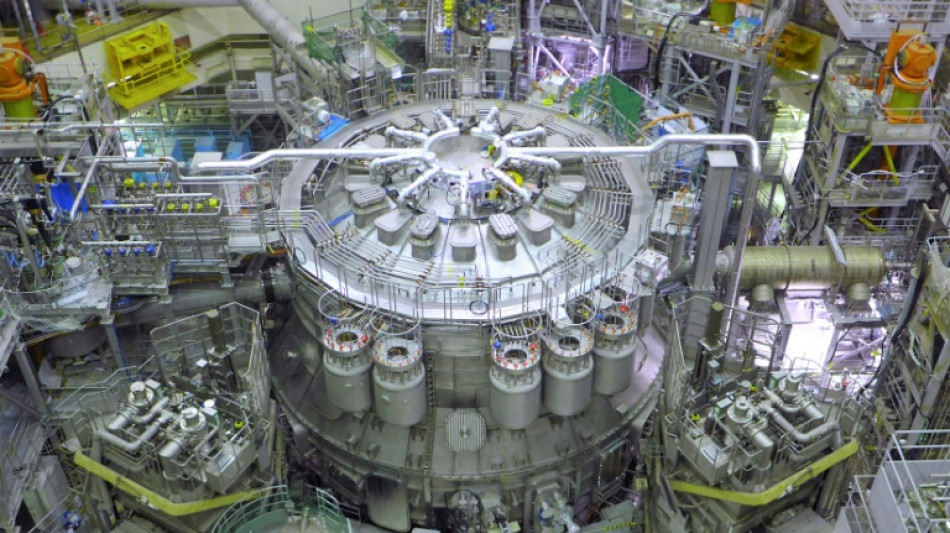
Japanese experimental nuclear fusion reactor inaugurated / Photo: Handout - National Institutes for Quantum Science and Technology (QST)/AFP

 Latvian partial election results suggest pro-European choice

 In Egypt's Sinai, Gazan builds school for children displaced by war

 Trump tariffs a mixed bag for US auto industry

 Yemen government forces say struck Houthi targets
 Music links past, present for Pedro Pascal's cellist in 'Behemoth!'
 ALEX BODI ȘI AMBASADORUL REPUBLICII SUDANUL DE SUD, GUM DOMINIC MATIOK, DISCUTĂ LA BERLIN DESPRE POSIBILITATEA ÎNFIINȚĂRII UNUI CONSULAT ONORIFIC LA BUCUREȘTI

 Dodgers step up World Series three-peat bid with 5-3 win over Braves

 Spain break down Czechs as England outclass Croatia in Nations League

 Yamal on target as Spain hold off Czech Republic

 Latvian exit polls suggest pro-European choice

 Lula, Bolsonaro wrap up campaigns ahead of knife-edge election

 Tuchel hails 'complete' England after Croatia demolition

 Fury to invite Trump to lead ring walk before Joshua showdown

 Fashion industry in 'precarious moment', says Vivienne Westwood supremo

 Seventh heaven for England in Nations League rout of Croatia

 Storms, flooding cause chaos on Greek holiday island of Crete

 #IAmJaneDoe: online support campaign in US university rape case

 Brazil shine on Selecao's first visit to India

 Zverev sets up Djokovic quarter-final at China Open, Rybakina out

 Happier at home, Bordeaux hammer Lyon in Top 14

 Lula, Bolsonaro in final push for votes ahead of knife-edge election

 Boisterous fashion week barnstorms 'sleepy' Nigerian capital

 UAE investigators say flydubai co-pilot was planning 'terrorist act'

 Rahul smacks century in India v Windies ODI

 Daryz seeks to join exclusive club of dual Arc winners

The world's biggest experimental nuclear fusion reactor in operation was inaugurated in Japan on Friday, a technology in its infancy but billed by some as the answer to humanity's future energy needs.
Fusion differs from fission, the technique currently used in nuclear power plants, by fusing two atomic nuclei instead of splitting one.
The goal of the JT-60SA reactor is to investigate the feasibility of fusion as a safe, large-scale and carbon-free source of net energy -- with more energy generated than is put into producing it.
The six-storey-high machine, in a hangar in Naka north of Tokyo, comprises a donut-shaped "tokamak" vessel set to contain swirling plasma heated up 200 million degrees Celsius (360 million degrees Fahrenheit).
It is a joint project between the European Union and Japan, and is the forerunner for its big brother in France, the under-construction International Thermonuclear Experimental Reactor (ITER).
The ultimate aim of both projects is to coax hydrogen nuclei inside to fuse into one heavier element, helium, releasing energy in the form of light and heat, and mimicking the process that takes place inside the Sun.
Researchers at ITER, which is over budget, behind schedule and facing major technical problems, hope to achieve nuclear fusion technology's holy grail, net energy.
Sam Davis, deputy project leader for the JT-60SA, said the device will "bring us closer to fusion energy".
"It's the result of a collaboration between more than 500 scientists and engineers and more than 70 companies throughout Europe and Japan," Davis said at Friday's inauguration.
EU energy commissioner Kadri Simson said the JT-60SA was "the most advanced tokamak in the world", calling the start of operations "a milestone for fusion history".
"Fusion has the potential to become a key component for energy mix in the second half of this century," Simson added.
The feat of "net energy gain" was managed last December at the National Ignition Facility at Lawrence Livermore National Laboratory in the United States, home to the world's largest laser.
The US facility uses a different method to ITER and the JT-60SA known as inertial confinement fusion, in which high-energy lasers are directed simultaneously into a thimble-sized cylinder containing hydrogen.
The US government called the result a "landmark achievement" in the quest for a source of unlimited, clean power and an end to reliance on carbon-emitting fossil fuels that cause climate change as well as geopolitical upheaval.
Unlike fission, fusion carries no risk of catastrophic nuclear accidents -- like that seen in Fukushima in Japan in 2011 -- and produces far less radioactive waste than current power plants, its exponents say.
X.Brito--PC



