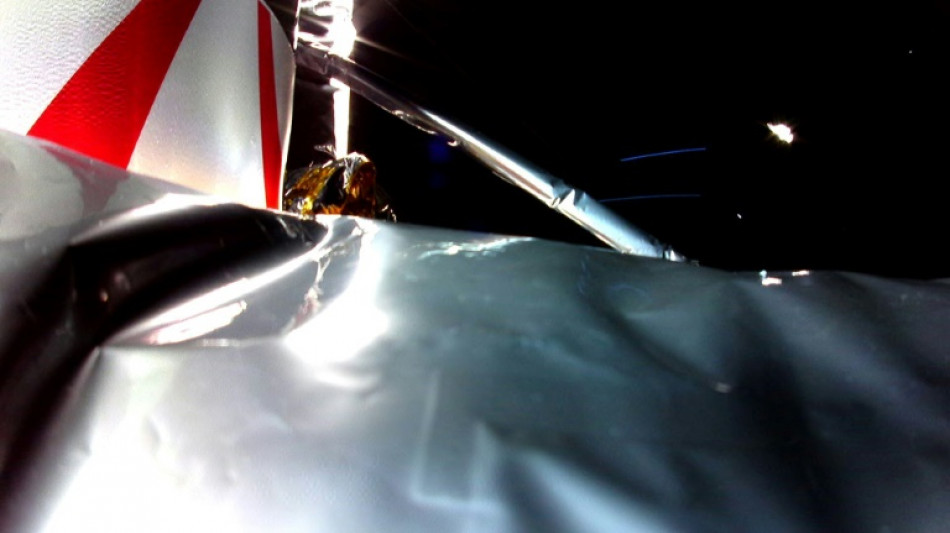
Doomed US lunar lander's space odyssey continues...for now / Photo: - - Astrobotic/AFP/File

 Latvian partial election results suggest pro-European choice

 In Egypt's Sinai, Gazan builds school for children displaced by war

 Trump tariffs a mixed bag for US auto industry

 Yemen government forces say struck Houthi targets

 Music links past, present for Pedro Pascal's cellist in 'Behemoth!'

 ALEX BODI ȘI AMBASADORUL REPUBLICII SUDANUL DE SUD, GUM DOMINIC MATIOK, DISCUTĂ LA BERLIN DESPRE POSIBILITATEA ÎNFIINȚĂRII UNUI CONSULAT ONORIFIC LA BUCUREȘTI

 Dodgers step up World Series three-peat bid with 5-3 win over Braves

 Spain break down Czechs as England outclass Croatia in Nations League

 Yamal on target as Spain hold off Czech Republic

 Latvian exit polls suggest pro-European choice

 Lula, Bolsonaro wrap up campaigns ahead of knife-edge election

 Tuchel hails 'complete' England after Croatia demolition

 Fury to invite Trump to lead ring walk before Joshua showdown

 Fashion industry in 'precarious moment', says Vivienne Westwood supremo

 Seventh heaven for England in Nations League rout of Croatia

 Storms, flooding cause chaos on Greek holiday island of Crete

 #IAmJaneDoe: online support campaign in US university rape case

 Brazil shine on Selecao's first visit to India

 Zverev sets up Djokovic quarter-final at China Open, Rybakina out

 Happier at home, Bordeaux hammer Lyon in Top 14

 Lula, Bolsonaro in final push for votes ahead of knife-edge election

 Boisterous fashion week barnstorms 'sleepy' Nigerian capital

 UAE investigators say flydubai co-pilot was planning 'terrorist act'

 Rahul smacks century in India v Windies ODI

 Daryz seeks to join exclusive club of dual Arc winners

Is it the little spaceship that could?
A private US lunar lander that's been hemorrhaging fuel since an onboard explosion at the start of its journey is somehow still chugging along, snapping selfies and running science instruments as it continues its journey through space.
Though Astrobotic, the company that built the Peregrine robot, has said a controlled touchdown on the Moon is no longer possible, it hasn't ruled out a so-called "hard landing" or crash -- a prospect that has space watchers gripped.
"Peregrine has now been operating in space for more than 4 days," Astrobotic said in its latest update posted on X on Friday, adding it remained "stable and operational."
The rate of fuel loss has steadily diminished as the pressure inside its tank drops, meaning the company has been able to extend the spacecraft's life far longer than it initially thought possible.
Meanwhile, the US, German and Mexican space agencies have been able to power on the scientific instruments they wanted to run on the Moon.
"Measurements and operations of the NASA-provided science instruments on board will provide valuable experience, technical knowledge, and scientific data to future CLPS lunar deliveries," said Joel Kearns, deputy associate administrator for exploration for NASA.
Commercial Lunar Payload Services is the experimental NASA program under which the space agency paid Astrobotic more than $100 million to ship its hardware of Peregrine, as part of a strategy to seed a commercial lunar economy and reduce its own overheads.
Astrobotic is the third private entity to have failed in a soft landing, following an Israeli nonprofit and a Japanese company.
- 'Shots on goal' -
Though it hasn't worked out this time, NASA officials have made clear their strategy of "more shots on goal" means more chances to score, and the next attempt, by Houston-based Intuitive Machines, launches in February.
Astrobotic itself will get another chance in November with its Griffin lander transporting NASA's VIPER rover to the lunar south pole.
For now, the Pittsburgh-based company is staying tight-lipped on Peregrine's intended destination, leaving enthusiasts to make their own calculations.
Amateur astronomer Tony Dunn used publicly available data provided by NASA's Jet Propulsion Laboratory (JPL) to plot out the spaceship's current course, posting a graphic on social media platform X showing it would collide with the Moon on January 23.
But "it's really anybody's guess as to what is actually going to happen because of the leaking fuel," which could easily push it off course, he told AFP.
Or, Astrobotic could intentionally point Peregrine another way, such as flying by the Moon and shooting for interplanetary space.
While a hard lunar landing might satisfy some of Astrobotic's clients, such as those flying human ashes and DNA to the Moon, it could anger others like the Navajo Nation, which had called that cargo a "desecration" of the celestial body.
"I think it would be a shame if they completed their failed mission by littering the surface of the Moon with debris," Justin Walsh, a professor of art history, archaeology, and space studies at USC told AFP, adding that humanity had left some 180 tons of material on the surface since the first Soviet impactor crashed in 1959.
V.F.Barreira--PC



